


Views: 0 Author: Site Editor Publish Time: 2026-09-09 Origin: Site


Cryogenic storage operates in a high-stakes environment where a temperature deviation of just a few degrees can compromise years of biological research or halt industrial manufacturing processes. Facility managers and lab directors face significant operational risks when selecting mismatched cryogenic equipment. Choosing a vessel with inadequate holding times, improper dispensing mechanisms, or insufficient capacity directly leads to excessive boil-off rates, rapid sample degradation, and severe safety hazards.
To mitigate these risks, you must align your specific application requirements with the correct vessel architecture. Whether you manage a high-throughput fertility clinic or a large-scale industrial facility, understanding the exact capabilities of a liquid nitrogen tank is mandatory. This technical evaluation framework helps you navigate the complexities of cryogenic storage, ensuring you select equipment that guarantees thermal stability, operational efficiency, and strict safety compliance.
Application Dictates Architecture: The primary use case—whether static biological storage, active clinical dispensing, or industrial cooling—determines the necessary tank design, from standard Dewars to self-pressurizing systems.
Thermal Efficiency is Paramount: Static Holding Time (SHT) and baseline boil-off rates are the most critical metrics for evaluating long-term operational costs and sample security.
Scalability Requires Specialized Equipment: High-volume operations require transitioning from manual-pour vessels to an ultra-large self-pressurized liquid nitrogen tank to maintain supply chain continuity.
Compliance and Safety are Non-Negotiable: Proper implementation requires mandatory facility upgrades, including oxygen depletion monitors, specialized ventilation, and strict PPE protocols.
Defining your primary use case establishes the baseline success criteria for cryogenic equipment. Different industries demand entirely different thermal profiles, access frequencies, and dispensing methods. You cannot force a static storage unit to perform high-volume industrial dispensing without risking catastrophic failure or severe injury.
Laboratories rely on cryogenic vessels to maintain internal temperatures between -150°C and -196°C. This extreme cold ensures the long-term viability of DNA, blood, tissues, and sensitive cell cultures by completely suspending cellular metabolism. Facility managers must choose between liquid-phase storage and vapor-phase storage based on sample vulnerability and operational workflow.
Liquid-phase storage submerges samples directly into the liquid nitrogen pool. This method provides maximum thermal stability and the longest holding times. However, it introduces a known risk of cross-contamination between biological samples if vials leak or rupture during freezing. Vapor-phase storage suspends samples above the liquid pool. It prevents cross-contamination while maintaining temperatures below the critical -135°C glass transition threshold. To maximize internal storage density and facilitate rapid inventory tracking, laboratories utilize specialized racking systems, color-coded canisters, and standardized cryoboxes.
Implementing a strict inventory management protocol minimizes the time the tank remains open during sample retrieval. Consider these standard practices for biological storage:
Map all sample locations in a digital database before opening the lid.
Use color-coded aluminum canes to identify specific cell lines instantly.
Limit lid-open time to less than 30 seconds per retrieval to prevent ambient heat ingress.
Store highly sensitive primary cells in the lower racks closest to the liquid phase.
Medical and veterinary fields utilize cryogenic storage for highly sensitive, low-volume access. IVF clinics depend on these vessels for the secure, decades-long storage of embryos and sperm. Dermatology clinics use liquid nitrogen for cryotherapy procedures, applying controlled freezing to remove malignant or benign tissue. Veterinary genetics facilities store valuable breeding stock genetic material to preserve specific bloodlines.
In these clinical settings, tanks frequently supply computerized Controlled-Rate Freezers (CRFs). CRFs require a steady, precise flow of liquid nitrogen to achieve gradual, programmed temperature drops before samples transfer to final long-term storage. If the temperature drops too quickly, intracellular ice crystals form and destroy the cell wall. If it drops too slowly, the cells dehydrate. Clinical applications demand equipment that supports frequent, low-volume access while ensuring minimal temperature fluctuation during retrieval.
Industrial environments utilize liquid nitrogen primarily for open-cycle refrigeration. Manufacturing facilities use extreme cold for shrink-fitting metal components. By chilling a machined inner part in a liquid nitrogen bath, the metal contracts. Operators then insert the contracted part into a housing. As the part warms to room temperature, it expands to create an incredibly tight interference fit that requires no adhesives or welding.
Food production facilities use cryogenic freezing tunnels to rapidly freeze products. This rapid temperature drop prevents large ice crystal formation, preserving the cellular texture and moisture content of the food. Materials testing laboratories also subject aerospace and automotive components to cryogenic temperatures to evaluate structural integrity and material embrittlement under extreme conditions.
These industrial applications share a common requirement: high-flow dispensing and a continuous liquid nitrogen supply. Industrial tanks must integrate seamlessly with automated production lines, demanding robust valving, high-capacity pressure systems, and heavy-duty stainless steel construction.
Once you define your application, you must categorize the available solutions and map them to your operational requirements. Tank architecture directly dictates thermal efficiency, operator safety, and workflow integration.
Standard Dewars are vacuum-jacketed, non-pressurized vessels designed primarily for static, low-volume storage. They feature a double-wall aluminum or stainless steel construction. Manufacturers pull a high vacuum in the space between the inner and outer walls and fill it with multi-layer super insulation (MLSI) to minimize conductive and convective heat transfer. Users access the contents through a top neck opening sealed with a foam core plug.
While highly efficient for static storage, standard Dewars present significant limitations for active dispensing. Extracting liquid requires manual pouring or the use of manual dipping ladles. This introduces a high risk of user error, spillage, and cryogenic burns. They serve best as stationary repositories for long-term biological sample archiving where access is infrequent and liquid transfer is minimal.
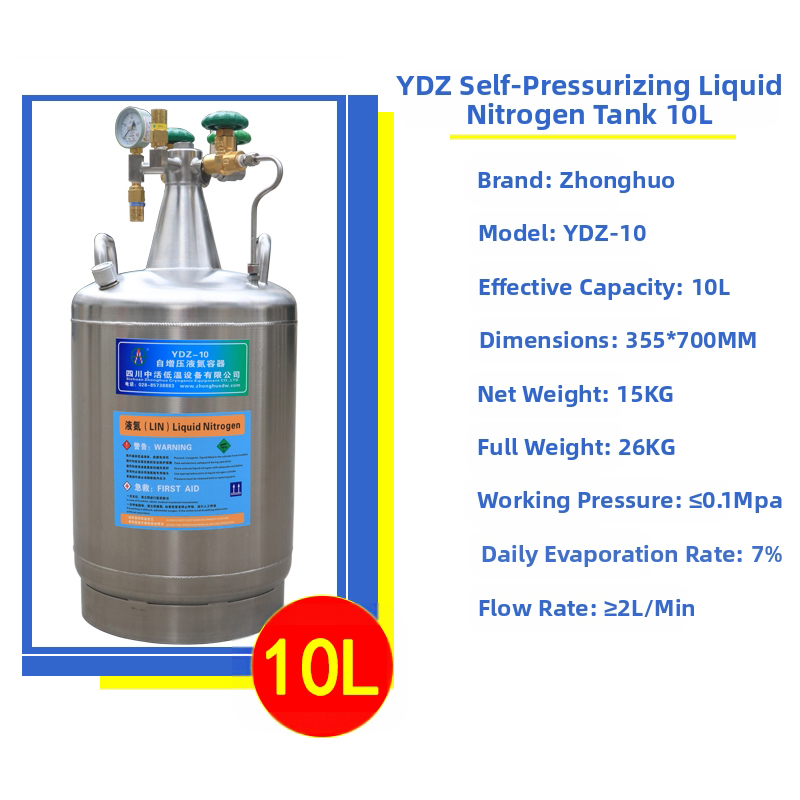
Active dispensing requires a fundamental shift in tank architecture. A self-pressurizing liquid nitrogen tank utilizes a specialized internal pressure-building circuit. A small amount of liquid nitrogen diverts into a vaporization coil located near the outer shell. As ambient heat warms this liquid, it turns to gas and expands. The system routes this expanding gas back into the top of the inner vessel.
This internal pressure build-up safely forces liquid up through a central dip tube and out of a dispensing valve. This mechanism eliminates manual pouring entirely. It stands as the standard architecture for automated supply to secondary freezers, CRFs, or continuous industrial processes. Operators can precisely control flow rates using integrated pressure regulators and liquid dispensing valves, typically operating between 0.5 bar and 1.5 bar.
Facilities often require the movement of cryogenic liquids between loading docks, central storage rooms, and individual laboratories. A mobile self-pressurized liquid nitrogen tank incorporates structural reinforcements and heavy-duty caster systems to facilitate safe transport. These units feature lower centers of gravity and internal baffling plates to minimize liquid sloshing during movement, which can destabilize the tank and increase boil-off.
Procurement teams must evaluate the trade-offs inherent in mobile designs. While they offer exceptional transportability across clinical or manufacturing floors, the structural reinforcements required for mobility can create minor thermal bridges between the inner and outer vessels. This results in slightly reduced static holding times compared to stationary units of the exact same volume. However, the operational flexibility they provide makes them indispensable for dynamic facility layouts where hard-piped liquid nitrogen is unavailable.
High-capacity biobanks and large-scale manufacturing facilities consume massive volumes of cryogenic liquid daily. Standard 50L or 100L cylinders quickly become inefficient, requiring constant vendor deliveries, frequent changeovers, and excessive handling. An ultra-large self-pressurized liquid nitrogen tank provides capacities typically ranging from 500L to 1000L or more.
These units function as centralized micro-bulk storage solutions. They connect directly to facility piping manifolds, supplying multiple endpoints simultaneously through vacuum-jacketed piping. By consolidating storage into a single ultra-large vessel, facilities drastically reduce the frequency of vendor refills and ensure uninterrupted supply chain continuity for critical processes. These tanks require dedicated concrete pads and permanent manifold connections.
Evaluating competing models requires looking past marketing specifications and focusing on technical dimensions that drive operational outcomes. You must analyze thermal performance, physical constraints, and automation capabilities to ensure the equipment matches your facility infrastructure.
Static Holding Time (SHT) represents the number of days a tank can hold liquid nitrogen before it completely evaporates under ideal, unopened conditions. Several physical factors dictate the daily boil-off rate. A narrower neck diameter reduces the surface area exposed to ambient heat, improving SHT. The integrity of the vacuum space and the quality of the insulation materials also directly impact thermal efficiency.
You must calculate true operational SHT versus manufacturer-stated maximums. Manufacturer SHT assumes the tank sits in a temperature-controlled room and remains completely sealed. In reality, frequent lid openings, sample retrieval, and higher ambient facility temperatures drastically reduce this timeframe. Always apply a safety factor of 30% to 50% when estimating operational holding times for active storage vessels.
Tank Architecture | Primary Use Case | Dispensing Method | Operational Footprint |
|---|---|---|---|
Standard Dewar | Long-term static biological archiving | Manual pour or dipping ladle | Small to Medium |
Stationary Self-Pressurizing | Automated supply to CRFs and freezers | Pressure-driven valve dispensing | Medium |
Mobile Self-Pressurizing | Transport across clinical/manufacturing floors | Pressure-driven valve dispensing | Medium (requires maneuvering space) |
Ultra-Large Micro-Bulk | Centralized facility supply, high-volume biobanks | Manifold connection, high-flow valves | Large (requires structural assessment) |
Selecting the right size requires balancing liquid capacity, sample capacity, and the physical footprint of the tank. A larger liquid volume provides longer holding times but increases the floor space required. You must measure all door widths, elevator dimensions, and hallway corners along the transport route before ordering.
Evaluate floor load-bearing limits carefully. A fully loaded 1000L tank exerts massive point-load pressure on facility floors. Structural engineering approval is mandatory before installing high-capacity units in upper-level laboratories. If the floor cannot support the weight, you must distribute the load using steel plates or select multiple smaller vessels instead.
Modern cryogenic management relies heavily on automation. Manual decanting introduces human error and thermal instability. Automated withdrawal devices and pressure-building circuits provide precise, repeatable liquid transfer without exposing operators to splash hazards.
High-stakes biological storage requires the integration of telemetry and environmental monitoring. Advanced tanks feature liquid level alarms, temperature probes, and automated refill controllers. These systems monitor internal conditions and automatically trigger a refill from a bulk supply line when levels drop below a defined threshold. Compatibility with digital inventory management systems, such as barcode scanners and smart lids, minimizes open-lid time during sample audits, further protecting sample integrity.
Procuring the equipment is only the first step. You must address the severe operational risks and facility requirements associated with cryogenic liquids. Safety compliance requires rigorous protocols, specialized personal protective equipment, and permanent infrastructure upgrades.
Liquid nitrogen boils at -196°C. Contact with skin or eyes causes severe cryogenic burns and immediate frostbite. The transfer of liquid nitrogen between vessels presents the highest risk of exposure due to splashing and rapid gas expansion. When warm piping meets cryogenic liquid, violent boiling occurs until the piping cools down.
Facilities must mandate specific Personal Protective Equipment (PPE) requirements for all operators handling cryogenic liquids:
Cryogenic Gloves: Must be loose-fitting so operators can throw them off instantly if liquid spills inside. Never use standard winter gloves or tight rubber gloves.
Face Protection: A full-face shield is mandatory to protect against liquid splashes. Safety glasses alone are insufficient.
Body Protection: Heavy-duty cryogenic aprons provide a necessary barrier against spills. Operators must wear long pants over boots to prevent liquid from pooling inside footwear.
The most severe hidden danger of cryogenic storage is asphyxiation. Liquid nitrogen has an expansion ratio of 1:694. One liter of liquid rapidly expands into nearly 700 liters of pure nitrogen gas. In a confined space, this massive volume of gas quickly displaces oxygen, creating a lethal, oxygen-deficient atmosphere without any warning signs, as nitrogen is colorless and odorless.
Mandatory facility integrations are required to mitigate this risk. Rooms housing cryogenic equipment must feature active ventilation systems with high air exchange rates. You must install calibrated oxygen depletion monitors. Because cold nitrogen gas is denser than air, mount these sensors low to the ground, typically 12 to 18 inches above the floor. Connect these monitors to visual and audible alarm systems both inside and outside the room to warn personnel before they enter a compromised environment.
Cryogenic vessels require strict lifecycle management to ensure continuous safety and thermal performance. Routine maintenance requirements include periodic vacuum testing, frost-line inspections, and the annual calibration of pressure relief valves. Burst discs must be inspected for corrosion and replaced according to the manufacturer's schedule.
The vacuum insulation space dictates the lifespan of the tank. Over many years, outgassing from internal metal surfaces can slowly degrade the vacuum, even with internal molecular sieves designed to absorb stray gas molecules. Personnel must know the signs of catastrophic vacuum failure. If a tank exhibits external sweating, rapid frost accumulation on the outer shell, or an unusually cold exterior temperature, the vacuum has failed. The tank will rapidly lose its liquid contents and must be removed from service immediately.
Conduct a comprehensive facility infrastructure audit, specifically measuring door clearances, elevator capacities, and floor load-bearing limits.
Verify the capacity and placement of your room ventilation systems and install low-mounted oxygen depletion monitors.
Calculate your true operational boil-off rates by factoring in your expected daily access frequency and ambient room temperatures.
Consult with a specialized cryogenic equipment engineer to map your required flow rates to the appropriate pressure-building tank architecture.
A: The duration depends entirely on the Static Holding Time (SHT), tank volume, neck diameter, and frequency of access. A sealed static Dewar can last several months. However, active self-pressurizing tanks accessed daily may require refilling every few weeks due to operational evaporation.
A: Dewars are unpressurized, vacuum-jacketed vessels that require manual pouring or dipping to retrieve contents. Self-pressurizing tanks utilize an internal vaporization circuit to build pressure, allowing them to dispense liquid safely through integrated valves without manual lifting.
A: Yes, but indoor storage is strictly conditional upon the room having adequate active ventilation. You must install calibrated oxygen depletion monitors with audible and visual alarms to prevent severe asphyxiation hazards caused by nitrogen gas expansion.
A: Sizing is based on the total number of vials or straws you intend to store, the required holding time, and whether the tank serves as primary storage or a backup supply. Always factor in a 20% capacity buffer for future laboratory expansion.
A: The primary indicators of vacuum failure include rapid, unexplained liquid loss, excessive frost or condensation forming on the outer shell, and an exterior surface that feels unusually cold to the touch.
A: Routine maintenance includes annual inspections of pressure relief valves, burst discs, and pressure gauges. You must also conduct routine checks of the vacuum seal integrity and inspect all dispensing hoses for signs of wear or embrittlement.

 yongy0223@gmail.com
 +86-17693104145
 Lanzhou New Area, Lanzhou City, Gansu Province, on the second floor to the east of New Harbor Road, to the east of Building Materials Road No. 2, to the west of Qilian Mountain Avenue (Jingqi Road)


