


Views: 0 Author: Site Editor Publish Time: 2026-09-28 Origin: Site


Downtime costs factories thousands of dollars every single hour. Running out of utility gases stops production lines fast. Imagine a high-speed laser cutting line processing aerospace-grade aluminum. A sudden drop in nitrogen pressure means oxidized cuts, scrapped materials, and hours of costly reset time.
A centralized bulk supply solves this bottleneck completely. You will learn exactly how these specialized vessels function under extreme conditions. We will break down the thermal engineering behind them and provide an actionable guide to selecting the right equipment for your facility.
Uninterrupted Supply: Centralized bulk storage eliminates manual cylinder swap-outs. This ensures continuous 24/7 operation for demanding manufacturing processes.
Superior Thermal Retention: Advanced vacuum technologies block external heat transfer. This minimizes daily boil-off rates and saves massive operational costs.
High-Density Storage: Keeping elemental gases in a liquid state allows plants to stockpile vast quantities in a very small physical footprint.
Smart Telemetry: Modern systems utilize digital monitoring for real-time tracking of liquid levels, preventing unexpected run-outs.
Decades of Reliability: Engineered with austenitic stainless steel, these high-quality vessels offer over 20 years of service with predictable maintenance schedules.
Before diving into the mechanical details, it helps to understand the current manufacturing landscape. Recent supply chain volatility has exposed the risks of relying on "just-in-time" cylinder deliveries. High-output facilities are actively phasing out decentralized gas storage. The global engineering trend is moving rapidly toward localized, automated bulk reserves. Plant managers now prioritize systems that insulate their production floors from regional gas shortages. By transitioning to on-site high-capacity storage, factories lock in predictable operational costs and eliminate manual handling risks.
To truly appreciate the value of bulk gas systems, you must understand their foundational mechanics. A vacuum insulated storage tank is a highly specialized, double-walled container. Engineers design these units specifically to hold liquefied gases at temperatures plummeting below -150°C. They are not standard pressurized containers. Instead, they function as sophisticated thermal management systems built to fight ambient environmental heat.
The core advantage lies in the liquid-to-gas expansion ratio. When elemental gases cool to their liquid state, they condense exponentially. A single volume of liquid nitrogen expands to roughly 694 volumes of usable gas at room temperature. This massive compression ratio makes bulk liquid storage incredibly efficient. Rather than hoarding small amounts of high-pressure gas in heavy steel tubes, a factory can store a massive, low-pressure liquid reserve in a fraction of the space.
Industrial plants rely on these units for critical operations. Common inventories include Liquid Oxygen, Liquid Nitrogen, Liquid Argon, and Liquefied Natural Gas. By rigorously maintaining freezing temperatures, the system keeps a vast, ready-to-use supply on standby.
Standard manufacturing setups often supply gases via high-pressure cylinders. The fatal flaw here is the physical bottleneck. Cylinders hold severely limited volumes. Once depleted, they require manual disconnection, physical movement, and reconnection. Each swap-out forces a temporary halt in gas flow. This creates micro-stoppages across the production line.
A centralized system eliminates these stoppages entirely. Liquid flows from the vessel through an ambient air vaporizer and directly into the facility's piping network. Automated machinery never waits for a technician to wrestle a heavy cylinder into place.
Heavy manufacturing relies on a relentless flow rate. Certain industrial sectors simply cannot function on the restricted output of standard cylinders. Picture a food processing plant utilizing liquid nitrogen for rapid freezing processes. The volume required to flash-freeze thousands of pounds of produce per hour is staggering. Semiconductor manufacturing requires ultra-pure argon for inert environments. Healthcare facilities demand massive, fail-safe volumes of oxygen. In all these scenarios, high flow rate demands make bulk storage non-negotiable.
Operationally, these systems allow for concurrent filling and dispensing. Bulk delivery tanker trucks connect to a dedicated fill line. They pump cryogenic fluid into the vessel while the facility continues to draw gas through the vaporizer circuit. The production line experiences zero pressure drops during scheduled deliveries. Integrating an IoT-monitored 7.5m³ industrial cryogenic tank takes this a step further. Digital telemetry automatically alerts gas suppliers before levels drop critically low, completely automating the procurement cycle.
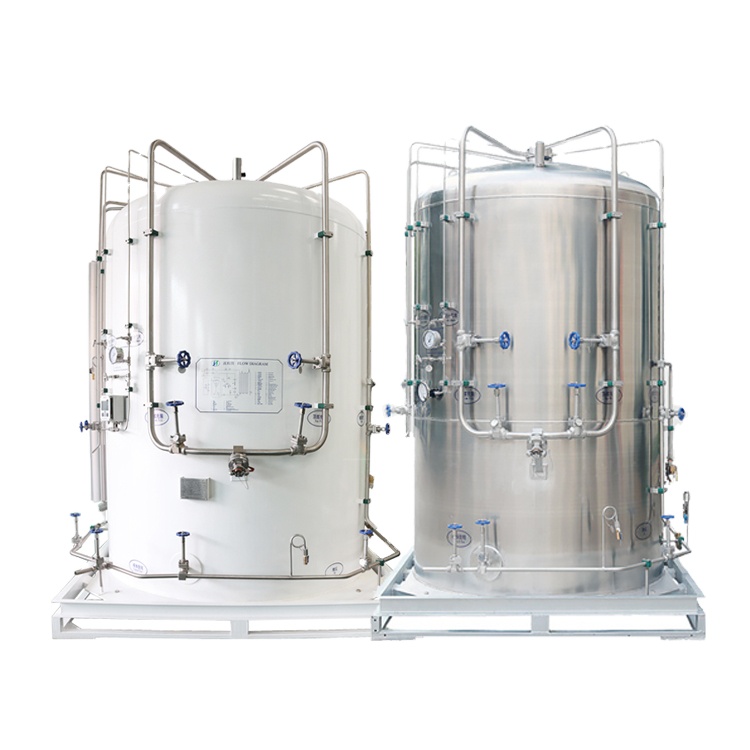
Why does insulation matter so much? The fundamental challenge of storing these liquids is heat leak. Ambient temperatures run hundreds of degrees hotter than the stored fluid. This creates a massive thermal gradient. Heat relentlessly attempts to breach the container walls. If thermal energy penetrates the inner vessel, the liquid absorbs it and vaporizes. This phase change causes internal pressure to spike rapidly. If the pressure exceeds the maximum allowable working pressure, safety relief valves trigger. Venting valuable gas into the atmosphere is a direct financial loss. Exceptional insulation is the most critical component of the entire setup.
To combat heat transfer, engineers utilize a double-walled design. The system consists of an inner vessel holding the liquid and an outer vessel serving as a protective shell. The masterstroke is the annular space between the two walls. During manufacturing, industrial pumps evacuate the air in this cavity to create a deep, stable vacuum. Because heat requires a physical medium to travel via conduction and convection, the vacuum effectively paralyzes these forms of thermal transfer.
However, a vacuum does not stop radiant heat. To block radiation, technicians densely pack the vacuum space with expanded perlite powder. Perlite is a naturally occurring siliceous volcanic rock. When heated, it expands into a highly porous, lightweight barrier. The perlite particles scatter and absorb radiant heat. This dual-action thermal barrier keeps boil-off rates to a mere fraction of a percent per day.
Extreme temperatures dictate strict material requirements. Standard carbon metals become dangerously brittle below -150°C. They are prone to shattering under stress.
The inner vessel remains in direct, punishing contact with the cryogenic fluid. Manufacturers construct it almost exclusively from austenitic stainless steel, such as grade 304 or 316L. From a metallurgical standpoint, its unique crystal structure ensures the steel retains high tensile strength and ductility at ultra-low temperatures. This completely prevents cold embrittlement.
In contrast, the outer shell never touches the freezing liquid. Its primary functions are to provide structural integrity, contain the vacuum, and withstand external environmental factors. Engineers typically specify high-quality carbon steel for this component. The exterior receives sandblasting and heavy-duty polyurethane coatings to prevent rust and reflect solar radiation.
The plumbing manifold must also survive extreme thermal stress. Piping consists of stainless steel or specialized copper alloys. Technicians install purpose-built cryogenic valves featuring extended stems. These extended stems keep the valve packing and handles far away from the freezing liquid. They do not freeze solid and remain easily operable. Dual safety relief valve systems are standard, ensuring the unit remains fully protected even during routine maintenance.
Transitioning from individual cylinders to bulk storage yields immediate cost reductions. The economies of scale are highly favorable. To illustrate the operational differences, review the technical comparison below.
Operational Metric | High-Pressure Cylinders | Bulk Cryogenic Storage |
|---|---|---|
Supply Continuity | Frequent micro-stoppages for manual swap-outs. | 100% continuous flow via external vaporizers. |
Storage Pressure | Extremely high, often exceeding 2,000 psi. | Low and stable, typically 100 to 250 psi. |
Space Efficiency | Requires massive sprawling footprint for full and empty units. | High-density vertical storage minimizes footprint. |
Labor Costs | High. Requires constant manual handling and inventory checks. | Minimal. Automated telemetry handles inventory tracking. |
Safety Risks | High kinetic hazards, crushing risks, and valve-shear dangers. | Stationary, low-pressure operation drastically reduces risks. |
Selecting the correct storage equipment is a critical procurement decision. Plant managers must evaluate daily gas consumption rates, peak flow demands, and spatial constraints. Specifying the wrong equipment leads to insufficient gas flow or unnecessary capital expenditure.
Sizing your equipment correctly is the first step. Engineers calculate required capacity by evaluating average daily consumption and peak hourly flow rates. A general industry rule is to size the vessel to hold at least one to two weeks of gas supply. This buffers against unforeseen delivery delays.
For smaller manufacturing plants, laboratories, or specialized laser cutting operations, space is often limited. A 2m³ liquid gas cryogenic mini tank provides an excellent balance of capacity and footprint. These compact units replace dozens of high-pressure cylinders while requiring minimal installation space.
Heavy industries such as primary metal fabrication or large-scale chemical blanketing require significantly larger capacities. In these demanding environments, engineers specify a 10m³ liquid gas cryogenic tank. This accommodates massive flow requirements and drastically reduces the frequency of bulk deliveries.
A common misconception is that the storage vessel alone dictates the gas flow rate. In reality, the unit works in tandem with an external vaporization system. When choosing equipment, you must specify the Maximum Allowable Working Pressure. The tank's pressure rating must align perfectly with your machinery's input requirements. Furthermore, the ambient air vaporizer must be sized correctly. If the vaporizer is too small for peak flow demand, it will freeze into a solid block of ice. This causes a severe pressure drop and potentially allows dangerous liquid to enter downstream carbon steel piping.
Capital equipment investments demand a low Total Cost of Ownership. Fortunately, bulk storage systems are renowned for exceptional durability. A properly engineered vacuum-perlite insulated vessel provides decades of reliable service. The industry standard life expectancy is 20 to 30 years. Because the inner vessel is sealed within a vacuum and holds pure non-corrosive gases, it is virtually immune to internal rust.
While highly durable, these systems require routine visual and mechanical checks. Plant personnel should conduct daily visual inspections for excessive frost on the outer carbon steel shell. Frost on the vaporizer coils is normal. Frost on the main tank body is not. Localized frost indicates a cold spot, suggesting a loss of vacuum in that specific area. Annual maintenance involves testing safety relief valves for proper calibration.
Over a decade of service, the vacuum level may degrade slightly due to outgassing. This is the microscopic release of trapped gases from metal surfaces. If the vacuum degrades, boil-off rates increase. However, the equipment does not need to be scrapped. Specialized technicians can restore the thermal efficiency through a process called re-pumping. They connect high-vacuum diffusion pumps to the evacuation valve, pulling the vacuum back to strict factory specifications. This cost-effective procedure extends operational life for another decade.
Upgrading to a centralized cryogenic storage system is a highly strategic engineering choice. It secures continuous production, significantly lowers gas procurement costs, and insulates your facility against supply chain disruptions. By moving away from decentralized cylinders, plants eliminate micro-stoppages and drastically improve workplace safety.
Zero downtime translates directly to higher profit margins. Evaluate your current industrial gas consumption rates and peak flow demands today. Visit gascryovessels.com to explore our full range of high-performance storage solutions. Contact our engineering team to find the exact equipment specifications that match your facility's unique operational needs.
The primary vessels utilized are double-walled vacuum insulated storage tanks. For small-scale mobility, liquid cylinders are common. However, for continuous high-volume industrial manufacturing, stationary vacuum-perlite insulated vessels are the industry standard. These large-capacity units offer superior thermal performance for long-term storage.
The main function is to safely receive, store, and dispense industrial gases in their liquid state at extremely low temperatures. Storing gas as a liquid allows facilities to hold up to 700 times more product in the same footprint. The equipment utilizes advanced vacuum insulation to maintain the liquid state and ensure a steady supply to the production line.
Yes, standard engineering practice dictates installing these units outdoors. The outer shell features heavy-duty carbon steel finished with weather-resistant industrial coatings. Outdoor placement ensures adequate ventilation in the rare event of pressure venting, preventing asphyxiation risks. It also provides unimpeded access for bulk delivery trucks.
IoT telemetry systems remove human error from inventory management. These smart systems utilize highly accurate differential pressure sensors to monitor liquid levels in real-time. If the volume drops below a critical set-point, the system instantly triggers automated alerts to facility management and the gas supplier. This guarantees a bulk delivery arrives long before the unit runs dry.
Due to high-efficiency vacuum perlite insulation, heat transfer is minimal. A well-maintained industrial vessel typically experiences a natural evaporation rate of just 0.5% to 1% per day. If a facility constantly draws gas for production, this boil-off is routed directly into the supply line, meaning zero product is wasted. If left completely idle, it can store liquid for several weeks before internal pressure triggers the safety relief valves.
Installation requires a reinforced concrete foundation designed to support the vessel's fully loaded weight. The site must maintain strict clearance distances from combustible materials, electrical transformers, and building air intakes. Additionally, the area requires crash protection bollards to prevent vehicle impact, along with proper safety signage and restricted access for unauthorized personnel.

 yongy0223@gmail.com
 +86-17693104145
 Lanzhou New Area, Lanzhou City, Gansu Province, on the second floor to the east of New Harbor Road, to the east of Building Materials Road No. 2, to the west of Qilian Mountain Avenue (Jingqi Road)


