


Views: 0 Author: Site Editor Publish Time: 2026-07-01 Origin: Site


A cryogenic tank holds and moves liquefied gases at very low temperatures. This equipment uses special engineering to keep gases like liquid oxygen and nitrogen cold and safe. Safety is very important, so the tanks have pressure relief valves and are built strong. Gansu Shenleng Cryogenic Equipment Co., Ltd. makes cryogenic tanks that follow strict industry rules.
Key Element
Description
Material Selection
Uses strong carbon steels and stainless steels for strength and to stop embrittlement.
Design Criteria
Follows strict rules for shell thickness and how the tank is built.
Welding and Fabrication
Needs very good welding to make sure the tank is strong and does not leak.
Inspection and Testing
Has careful testing, like ultrasonic and radiographic checks, to make sure the tank is safe.
Accessories and Safety Features
Adds pressure relief valves and manholes to help keep things safe.
Cryogenic tanks hold very cold liquid gases for many industries. They keep the gases cold and safe. These tanks have two walls with a vacuum between them. This stops heat from getting in. It helps the gases stay as liquids. Safety tools like pressure relief valves help stop leaks. Real-time monitors watch for problems. These features protect people from accidents. The tanks need regular checks and care. This helps them work well for a long time. It also finds problems early. Picking a good company, like Gansu Shenleng, is important. They make strong tanks that follow safety rules.

A cryogenic tank is a container for very cold liquefied gases. It keeps things like liquid oxygen and nitrogen cold. This stops them from turning into gas. The tank uses special engineering to keep heat out. This helps the gas stay cold.
The table below shows how cryogenic tanks are different from other tanks:
Feature | Cryogenic Tank | Other Storage Tanks |
|---|---|---|
Operating Temperature | Below -150°C | Above -150°C |
Heat Transfer Reduction | Specialized design with double-walled vacuum insulation | Standard insulation methods |
Construction Material | High-grade stainless steel and carbon steel | Varies, often less specialized |
Insulation | Perlite filling to stop heat conduction | Common insulation materials |
Compliance | Follows ISO standards | Varies by type |
Cryogenic tanks have two walls and vacuum insulation. This keeps the inside cold and stops gas from escaping. These tanks are important for industries that need safe storage for liquefied gases.
There are different types of cryogenic tanks. Each type has its own job and size. The main types are horizontal cryogenic storage tanks, microbulk cryogenic tanks, LNG storage tanks, cryogenic ISO tank containers, and cryogenic semi-trailers.
The table below shows the main types, their sizes, and their benefits:
Type of Cryogenic Tank | Typical Capacity (liters) | Common Gases | Main Advantage |
|---|---|---|---|
Horizontal Cryogenic Storage Tanks | 1,000–80,000 | LNG, nitrogen, oxygen, hydrogen | Easier transportation and flexible site integration |
Microbulk Cryogenic Tanks | 500–7,500 | Nitrogen, oxygen, argon, CO₂ | Lower operating cost compared with gas cylinders |
LNG Storage Tanks | 10,000–1,000,000+ | LNG | Ultra-low boil-off and long-term LNG storage |
Cryogenic ISO Tank Containers | 10,000–26,000 | LNG, LIN, LOX, LAR, CO₂ | International transport compatibility |
Cryogenic Semi-Trailers | 20,000–60,000 | LNG, oxygen, nitrogen, argon | Efficient long-distance cryogenic transportation |
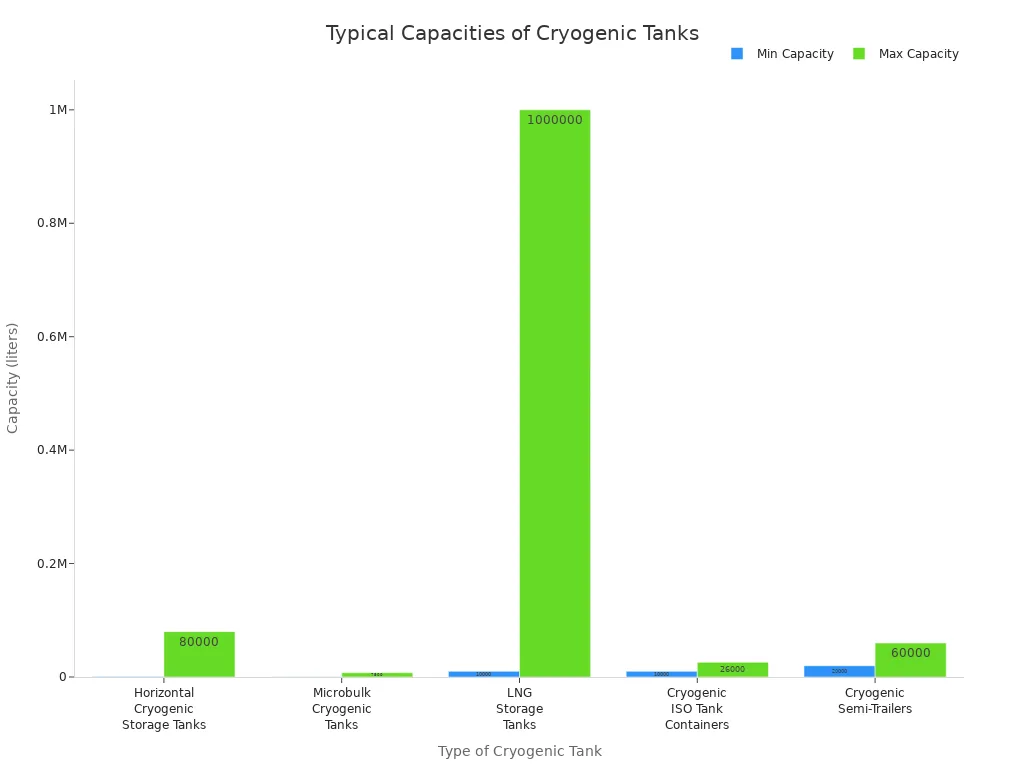
Horizontal tanks are used at factories and plants. Microbulk tanks are good for smaller users. LNG storage tanks hold lots of liquefied natural gas. ISO tank containers help ship cryogenic liquids to other countries. Semi-trailers carry large amounts far away.
Cryogenic tanks store many liquefied gases. Each liquid has its own boiling point and use. The table below shows the most common cryogenic liquids, their uses, and their boiling points:
Cryogenic Liquid | Common Uses | Boiling Point (Approx.) |
|---|---|---|
Liquid Oxygen (LOX) | Steelmaking, chemical processes, medical applications | -183°C |
Liquid Nitrogen (LIN) | Industrial processes, medical cryopreservation, laboratory research | -196°C |
Liquid Argon (LAR) | Welding, steel production, specialized lighting | -186°C |
Liquefied Natural Gas (LNG) | Power generation, heating, vehicle fuel | -162°C |
Liquid Carbon Dioxide (LCO2) | Food freezing, beverage carbonation, fire suppression | -78.5°C |
Liquid Hydrogen (LH2) | Clean energy carrier, rocket propellant | -253°C |
Liquid oxygen is used in hospitals and factories. Liquid nitrogen is needed for freezing and science. Liquid argon helps with welding and lighting. LNG is used for power and fuel. Liquid carbon dioxide is used in food and fire safety. Liquid hydrogen is a clean energy source and rocket fuel.
Note: The global market for cryogenic tanks is growing fast. More people need LNG and industrial gases. New technology helps this growth. Experts think the market will be worth over 9 billion dollars by 2030.
Cryogenic tanks help many industries by storing these important liquids safely and efficiently.
Cryogenic tanks use special vacuum insulation to keep gases cold. The temperature inside stays below -150°C. There is a vacuum between two walls. This vacuum stops heat from getting in. Inside the vacuum, there are shiny layers. These layers reflect heat away. This design keeps the gas from warming up. It also keeps the boil-off rate low. The table below shows how vacuum insulation works:
Mechanism | Description |
|---|---|
Vacuum Insulation | A near-perfect vacuum between the inner and outer vessels eliminates heat transfer by conduction and convection. |
Multi-Layer Insulation | Multiple reflective layers, often super-insulation, are used within the vacuum space to block radiant heat transfer. |
Gansu Shenleng Cryogenic Equipment Co., Ltd. uses double-wall vacuum insulation in every tank. This makes the tanks strong and efficient. These tanks work well for big engineering systems.
Engineers pick special materials for cryogenic tanks. These materials help the tanks stay safe and last long. Nickel alloys and aluminum alloys are good choices. They stay strong and bendy in the cold. Steel is also used because it is tough and does not rust easily. The inside part often uses SS304 or SS316 stainless steel. The chart below shows which materials are used most in cryogenic tanks:
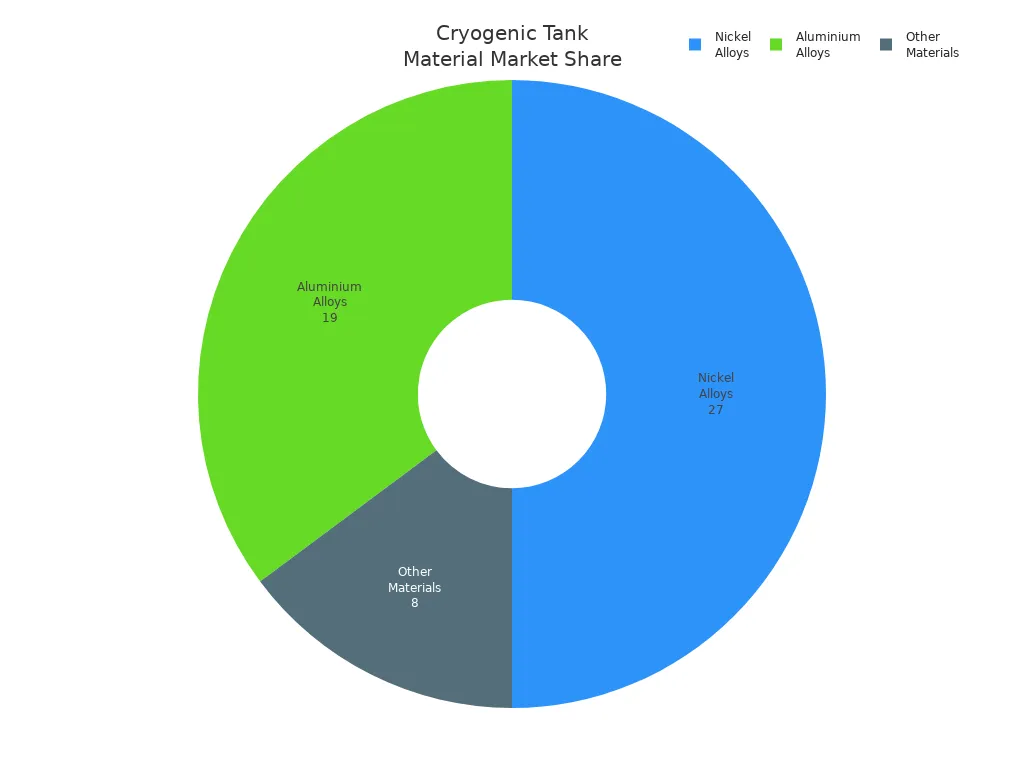
Strong tanks need thick walls and good support. They also need protection from rust. These things help the tanks last longer. They also keep the gases safe inside.
Designing a cryogenic tank is hard work. Engineers must pick materials that stay strong in the cold. They must control how heat moves in the tank. They make sure the tank does not get brittle. Safety systems are added to protect the tank. Automation helps control the tank better. Gansu Shenleng tanks have IoT monitoring. This gives real-time data and alerts for maintenance. Their tanks come in many sizes, from 3m³ to 10m³. This helps meet different needs.
Customers get everything from one place, from planning to start-up. This makes every project safe and reliable.
Good engineering means every cryogenic tank is safe and works well. These tanks help industries that need strong and advanced storage.
Many businesses use cryogenic tanks to hold and move gases. These tanks keep gases like oxygen, nitrogen, and LNG very cold. Factories and power plants use these tanks every day. Chemical companies also need them for their work. The table below shows which industries use different gases:
Gas Stored | Industries Relying on It | Additional Notes |
|---|---|---|
LNG (Liquefied Natural Gas) | Energy, Chemicals, Healthcare | Stored in cryogenic tanks to keep it cold and safe. |
Liquid Oxygen | Energy, Chemicals, Healthcare, Manufacturing | Used in factories and hospitals for many jobs. |
Liquid Nitrogen | Energy, Chemicals, Healthcare, Manufacturing, Food Processing | Helps with keeping things fresh and in industry. |
Liquid Hydrogen | Energy, Chemicals, Healthcare | Stored for energy and chemical uses. |
Gansu Shenleng Cryogenic Equipment Co., Ltd. makes tanks for factories, food companies, and power plants. Their tanks help businesses work better and keep gas supplies steady.
Hospitals and labs need safe oxygen and nitrogen. Cryogenic tanks store these gases as liquids. Hospitals use vaporizers to turn liquid oxygen into gas for patients. This helps people who need to breathe better. Labs use cryogenic tanks to keep gases cold for tests and research. Healthcare uses these tanks for organ transplants, vaccines, and blood banks.
Advanced medical care needs good cryogenic storage. Gansu Shenleng gives tanks that meet strict safety rules for hospitals and labs.
LNG cryogenic tanks are important for clean energy projects. These tanks keep LNG cold and safe. They use vacuum insulation to stop heat from getting in. Power plants and big factories use these tanks to switch from coal and oil to cleaner fuels. Countries like China and places in Southeast Asia build new LNG storage to help clean energy goals. Cryogenic tanks also help with hydrogen research and new fuel ideas.
LNG cryogenic tanks help move to cleaner energy.
Research centers use cryogenic tanks for hydrogen and other new uses.
Gansu Shenleng makes special cryogenic tanks for energy, research, and industry. Their engineering makes sure storage is safe, efficient, and reliable for every job.
Modern cryogenic tanks have many safety features. These features help keep people safe and protect the tanks. Engineers build these tanks with two walls and vacuum insulation. This stops heat from getting inside and keeps the liquids cold. The tanks are made to handle high pressure and follow strict rules like iso and ASME codes. Sensors check the pressure and temperature all the time. Pressure relief valves and alarms stop the tanks from getting too full or too hot. These alarms warn workers if something changes.
Safety Feature | Description |
|---|---|
Double-walled construction | Minimizes heat transfer through a vacuum-insulated space. |
Pressure-rated designs | Complies with safety standards for secure lng storage. |
Real-time monitoring | Uses sensors for pressure and temperature checks. |
Safety devices | Includes pressure relief valves and alarms. |
Personal protective equipment | Operators wear insulated gloves, face shields, and protective clothing. |
Ignition source control | Reduces fire risks during operation and transport. |
Safety valves and other tools are very important. Level measurement devices stop the tanks from getting too full. High and low alarms protect the tanks and the gas inside. Temperature indicators watch how much gas turns into vapor. Pressure safety valves let out extra gas if needed. Flow control valves help move the cold liquids safely.
Regular maintenance helps cryogenic tanks work well and last longer. Workers check welds, joints, and insulation for any damage or rust. They also watch how the tank is working by checking boil-off rates and temperatures. Preventive maintenance means fixing things before they break. This includes checking pressure relief valves and vent lines. Keeping good records helps follow safety rules.
Regular checks find problems early.
Watching how the tank works makes it better.
Preventive maintenance stops long breaks.
Good records help meet safety rules.
IoT monitoring makes maintenance easier and smarter. Sensors check liquid nitrogen temperature, tank temperature, pressure, and gas levels. Cloud dashboards send alerts if something is wrong. Automatic pressure releases work in emergencies. AI can look at data to help refill tanks at the right time. Automatic logs help follow the rules and keep tanks safe.
Cryogenic tanks must follow strict rules to stay safe and protect nature. DOT Hazardous Materials Regulations cover how tanks are packed, pressure is controlled, and workers are trained. Tanks also follow ASME, GB150, and iso rules to make sure they are strong. These rules make sure tanks and pipes can handle very cold temperatures and do not break. Safety rules keep workers safe and make sure lng stays secure.
Evidence Description | Source |
|---|---|
Compliance with DOT Hazardous Materials Regulations ensures safe packaging, pressure control, and personnel training for cryogenic tanks. | Beardown Logistics |
Cryogenic tanks are manufactured under strict compliance with ASME, GB150, and ISO 21009 standards, ensuring structural integrity and safety. | Gases China |
Workers use steel hoses made for cryogenic liquids. They make sure not to trap liquid nitrogen between valves. Pressure relief devices stop the tanks from getting too much pressure. These steps help tanks work well and stay safe.
Tip: Following good maintenance and safety rules keeps cryogenic tanks safe and working for every job.
Cryogenic tanks are very important for many industries. They store and move liquefied gases safely. These tanks help hospitals, food companies, and energy plants. They keep food fresh, help make products, and let scientists do safe research. Good engineering makes these tanks strong and safe. Tanks use tough materials and special ways to control heat. Safety systems help stop accidents fast.
Aspect | Contribution to Reliability |
|---|---|
Material Selection | Handles very cold temperatures |
Thermal Management | Stops heat from getting in and saves power |
Structural Integrity | Keeps the tank safe in tough places |
Safety Mechanisms | Acts fast if there is a problem |
It is smart to pick a tank company with good insulation and strong parts. Gansu Shenleng Cryogenic Equipment Co., Ltd. gives custom tanks, expert help, and quick service for all jobs.
Cryogenic tanks hold and move very cold liquefied gases. People use them in hospitals, factories, and energy plants. These tanks keep gases like oxygen and nitrogen cold and safe.
Cryogenic tanks must follow strict rules. Engineers design tanks to meet ISO, ASME, and GB150 standards. These rules make sure tanks are safe, strong, and work well. Following standards keeps people and nature safe.
Cryogenic tanks have two walls and vacuum insulation. Safety valves and sensors watch pressure and temperature. Engineers use safety rules to stop leaks and accidents. Regular checks and repairs keep tanks safe.
Manufacturers use stainless steel and carbon steel for these tanks. These metals are strong and do not break in the cold. Good materials help tanks last longer and keep gases safe.
Following standards helps cryogenic tanks work safely everywhere. Standards tell how to design, build, and test each tank. Meeting rules stops accidents and follows the law.

 yongy0223@gmail.com
 +86-17693104145
 Lanzhou New Area, Lanzhou City, Gansu Province, on the second floor to the east of New Harbor Road, to the east of Building Materials Road No. 2, to the west of Qilian Mountain Avenue (Jingqi Road)


