


Views: 0 Author: Site Editor Publish Time: 2026-03-18 Origin: Site


Liquid nitrogen boil-off slowly drains your operational budget. Every wisp of escaping vapor represents lost capital. It also compromises efficiency in your lab or facility. Liquid nitrogen (LN2) evaporation remains an unavoidable operational cost. However, you can control it. Evaluating cryogenic storage requires moving past manufacturer "static holding times." You must understand dynamic, real-world consumption. You also need to grasp the physical variables governing retention. A poorly chosen vessel bleeds money daily.
Selecting the right storage solution balances process accessibility and minimal evaporation loss. This balance ensures a low Total Cost of Ownership (TCO) over your equipment's lifecycle. In this guide, you will discover how engineering variables impact evaporation rates. You will learn to spot failing equipment early. Finally, we will cover safe handling protocols to protect your personnel and your investment.
Holding time hinges on volume-to-neck-diameter ratios and vacuum integrity (standardized at $10^{-6}$ Torr).
"Static holding time" overstates real-world working time by 30–50% due to lid removal and ambient thermal transfer during operation.
A compromised vacuum is the primary cause of rapid boil-off—verifiable via exterior frosting or abnormal hissing.
The expansion ratio of LN2 (1:696) means improper sealing or makeshift storage presents catastrophic safety and facility compliance risks.
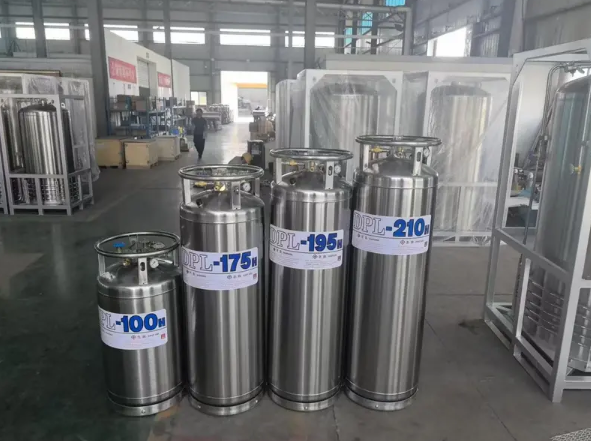
Understanding storage efficiency begins by separating theoretical limits from practical reality. Manufacturers test their equipment under ideal conditions. You operate your equipment under demanding conditions. You must differentiate between static benchmarks and dynamic losses.
Static holding time measures evaporation in an unopened vessel. Testers place the vessel in a standardized ambient temperature room. Nobody opens the lid. Nobody inserts samples. The liquid sits undisturbed. This metric provides a baseline for insulation quality. A high-quality 10L unit featuring a narrow 50mm neck statically holds for roughly 100 days. A larger 80L unit featuring a 125mm neck holds for approximately 135 days. These numbers represent the absolute maximum lifespan.
Opening the vessel instantly introduces thermal exchange. Warm ambient air rushes inside. This air transfers heat into the cryogenic liquid. Inserting room-temperature samples causes immediate boiling. Dynamic loss reflects your actual operational consumption. "Static holding time" generally overstates real-world working time by 30 to 50 percent.
Consider a practical scenario application. A lab uses a 10L flask regularly for sample retrieval. A machine shop uses the same size for metallurgical cold-treating. Both users will typically deplete their liquid in 8 to 9 weeks. The constant opening and inserting of items destroys the static benchmark.
Benchtop lifespans face even harsher realities. Small 1L to 7L portable units see frequent use. Technicians carry them across facilities. They generally last between 24 and 90 hours during active use. You must plan your refill schedules around dynamic loss.
Physics governs liquid nitrogen retention. You cannot bypass thermodynamics. Three core engineering variables dictate how long your liquid survives. Understanding these variables helps you make better purchasing decisions.
The neck serves as the primary avenue for radiant heat. Radiant heat enters directly through the top opening. A wider opening invites more heat. Neck diameter dramatically alters holding time. Increasing a 10L flask's neck from 50mm to 80mm cuts the static holding time by nearly 50 percent. The lifespan drops from 100 days down to just 56 days. You must balance accessibility against evaporation. Choose the narrowest neck your daily operations allow.
A high vacuum environment eliminates convective heat transfer. Convection requires gas molecules to move heat across space. Removing the gas removes the convection. The standard industrial requirement is an internal vacuum of $10^{-6}$ Torr. Manufacturers create this deep vacuum between the inner and outer walls. This invisible barrier serves as your primary defense against ambient heat.
The container material directly impacts thermal efficiency. Manufacturers choose materials based on durability and thermal limits. Different materials yield different evaporation rates.
Aviation-grade 6061 aluminum: This material offers high strength-to-weight ratios. It possesses optimal thermal limits for cryogenic storage. Aluminum remains the industry standard for mid-sized units.
Stainless steel: This metal is highly durable. It survives rough industrial environments easily. However, it can be up to 30 percent less thermally efficient than glass-lined alternatives in smaller capacities.
Glass-lined interiors: These offer exceptional thermal resistance. They stop heat transfer effectively. Unfortunately, they remain extremely fragile. A minor drop can shatter the inner lining.
Best Practice: Always evaluate the volume-to-neck-diameter ratio. If you only store thin cryogenic vials, a 50mm neck provides plenty of clearance while maximizing your retention time.
Equipment degrades over time. Cheap equipment degrades almost immediately. Recognizing the symptoms of failing insulation saves money. It also prevents catastrophic sample loss.
A healthy storage unit remains room temperature on the outside. A visibly frosty, cold exterior on a Dewar Flask indicates a broken vacuum layer. Cheaply manufactured equipment often exhibits micro-leaks. Salvaged scrap-yard equipment shares this exact flaw. These micro-leaks destroy the vacuum. Once the vacuum fails, ambient heat rushes in. Holding time plummets to mere days. You might also hear an abnormal hissing sound from the shell. This sound confirms a structural leak.
Pouring LN2 into a warm operational container causes violent boiling. The liquid hits the warm surface and instantly vaporizes. We call this the Leidenfrost effect. The vapor creates an insulating gas cushion. Massive fluid loss occurs during this chaotic transfer. Implementing slow, staged pre-cooling protocols is mandatory. Pre-cooling protects your liquid yield.
Follow these steps to pre-cool your transfer containers properly:
Slowly pour a tiny splash of liquid into the empty container.
Wait for the violent boiling to subside.
Listen for the loud hissing to soften into a quiet hum.
Slowly add a slightly larger splash, letting it coat the bottom.
Once the interior walls reach cryogenic temperatures, fill the container completely.
Many facilities try to cut costs using makeshift containers. Relying on thick Styrofoam or consumer thermal cups is highly dangerous. Styrofoam cannot handle prolonged cryogenic exposure. It develops pinhole leaks from extreme cold after a few cycles. Hold times drop to a dismal 1.5 days. Furthermore, you risk structural collapse. A collapsing Styrofoam cooler dumps $-196^\circ\text{C}$ liquid onto your floor. This creates severe freeze-burn hazards for anyone standing nearby.
Common Mistake: Never buy second-hand equipment from scrap yards. The internal vacuum seals usually fail during rough transit. A cheap initial purchase leads to massive monthly refill bills.
Purchasing the correct size minimizes your Total Cost of Ownership. You must analyze your daily workflow. You must align your container volume with your usage frequency.
TCO optimization requires matching capacity to usage frequency. Over-sizing your container wastes valuable floor footprint. It also increases your baseline evaporation volume. A massive tank boils off more liquid per day than a small tank. Under-sizing creates a different financial burden. Small containers force frequent, costly refill minimums. Delivery fees often exceed the cost of the nitrogen itself. You need the perfect middle ground.
Laboratories or industrial shops often need extended retention. They also need to preserve limited floor space. For these environments, a Compact 100L Mini Dewar Flask balances long static hold times with manageable physical dimensions. This size supports regular decanting. It holds enough liquid to survive delivery gaps. It remains small enough to fit neatly under standard workbenches. You get enterprise-level insulation without enterprise-level space requirements.
Large facilities require centralized decanting hubs. They supply dozens of workstations daily. These high-volume operations should evaluate a Large-Capacity 1000L Cryogenic Dewar Flask. These massive systems operate differently than handheld flasks. They utilize self-pressurizing systems. Operators typically set the head pressure between 22 and 35 psi. This internal pressure safely drives liquid into smaller hand-held distribution vessels. It eliminates dangerous manual pouring. It speeds up the filling process dramatically.
Liquid nitrogen demands immense respect. Mishandling it causes catastrophic accidents. Safety protocols protect your facility from structural damage. They protect your staff from lethal hazards.
Liquid nitrogen expands to gas at a staggering 1:696 ratio. One liter of liquid becomes nearly 700 liters of gas. Completely sealing a vessel traps this expanding gas. This causes rapid over-pressurization. The vessel will eventually explode with bomb-like force. A catastrophic 2006 university incident perfectly illustrates this danger. Someone sealed a storage tank using a solid brass plug. The resulting explosion destroyed the laboratory floor. Always use appropriately vented caps. Never seal a cryogenic container tightly.
Ambient moisture creates hidden dangers. Humid air can freeze around venting ports. Moisture also freezes around loose-fitting caps if left exposed. This gathering frost creates an unintended ice seal. The ice seal disables internal pressure relief mechanisms. The tank becomes sealed despite your intentions. Inspect your venting ports daily. Clear away any frost buildup immediately.
You must follow strict facility storage rules. Storage locations require careful planning.
Ventilation requirements: LN2 must only be stored in well-ventilated areas. Normal air currents disperse the evaporating nitrogen safely.
Walk-in freezers: Storing containers in closed walk-in freezers creates severe hazards. The nitrogen gas displaces oxygen quickly in sealed rooms. This creates a lethal asphyxiation environment. Cold rooms lack adequate air exchange.
Elevator transport: Elevator transport must strictly follow unaccompanied protocols. Load the vessel into the elevator. Press the destination button. Step out of the elevator. Use the stairs to meet the vessel on the target floor. If the elevator stalls, a venting tank will suffocate anyone trapped inside.
Controlling liquid nitrogen loss requires smart purchasing and disciplined handling. Your choice of equipment dictates your baseline evaporation rate. Your daily workflow determines your dynamic losses. Do not ignore the physical variables governing cryogenic retention.
Base your procurement decisions on verified vacuum warranties. Check for appropriate neck diameters. Request documented daily evaporation rates. Do not evaluate equipment based on total volume alone. A massive tank featuring poor insulation costs more to operate than a premium mid-sized unit.
Audit your current storage containers today. Look for exterior frosting or cold spots. Assess your monthly refill costs against dynamic loss rates. Standardize transfer pre-cooling procedures across your team. These immediate action steps will extend your current LN2 lifespans. They will protect your budget. They will ensure your laboratory operates safely and efficiently.
A: Yes. Even after the liquid pool is gone, the vapor phase inside an insulated container remains extremely cold. The internal temperature usually stays between $-160^\circ\text{C}$ and $-140^\circ\text{C}$. This vapor phase remains entirely viable for short-term biological preservation. It also works for residual metal treating. Monitor the internal temperature closely during this phase.
A: Yes. A professional unit can safely store dry ice ($-90^\circ\text{C}$). Due to the higher temperature of dry ice, the holding time generally extends by about 25 percent compared to liquid nitrogen in the exact same container. Always handle dry ice carefully and ensure the lid remains properly vented.
A: No. The minimal temperature difference a cold room provides will not noticeably extend holding time. However, the lack of active ventilation presents a lethal asphyxiation hazard. As the nitrogen gas slowly boils off, it aggressively displaces ambient oxygen. You must always store cryogenic liquids in highly ventilated spaces.

 yongy0223@gmail.com
  +86-17693104145
 Lanzhou New Area, Lanzhou City, Gansu Province, on the second floor to the east of New Harbor Road, to the east of Building Materials Road No. 2, to the west of Qilian Mountain Avenue (Jingqi Road)

