


Views: 0 Author: Site Editor Publish Time: 2026-04-01 Origin: Site


Transitioning from small-scale lab storage to industrial cryogenic management requires a crucial perspective shift. You must re-evaluate thermal efficiency, site safety, and total cost of ownership (TCO). Upgrading capacity means more than simply buying a larger container. Relying on dry ice (-78°C) or ULT freezers (-80°C) is insufficient. It becomes incredibly cost-prohibitive for operations requiring stable -196°C environments. Traditional cooling methods expose sensitive biological materials to rapid temperature fluctuations. They also drain facility operating budgets over time. This guide breaks down the structural, technical, and compliance factors necessary. You will learn to confidently select the right Dewar flask. We cover essential requirements for high-volume research, metal processing, or bio-banking applications.
Material Selection Dictates Lifespan: Stainless steel eliminates the implosion risks of glass, while structural design directly impacts long-term TCO through reduced liquid nitrogen (LN2) evaporation.
Capacity Must Match Workflow: Scaling up to a Cryogenic 195L Industrial Dewar Flask or a 450L Industrial Dewar Flask requires distinct handling infrastructure compared to benchtop units.
Safety is Non-Negotiable: Proper venting and loose-fitting lids are critical to prevent localized oxygen enrichment and dangerous pressure buildup.
Accessories Drive Efficiency: Integrating withdrawal devices and tipping stands drastically reduces handling time and physical risk.
Facilities often outgrow their initial cooling solutions. You might currently rely on mechanical freezers or dry ice shipments. Upgrading to a dedicated liquid nitrogen Dewar flask offers distinct operational advantages.
Mechanical ULT freezers typically bottom out around -80°C. Dry ice provides a baseline temperature of -78°C. Both fall short of true cryogenic preservation. A liquid nitrogen dewar flask maintains a stable -196°C environment. This extreme cold halts all biological activity. You eliminate the risk of sample degradation during long-term storage. Sensitive cell lines, enzymes, and tissue samples demand this level of absolute thermal stability.
Dry ice presents significant supply chain vulnerabilities. It sublimates continuously during transit. You pay for bulk weight lost before it even reaches your loading dock. Relying on dry ice means managing constant, recurring purchase orders. Bulk liquid nitrogen storage offers total budget predictability. A high-quality insulated flask minimizes daily evaporation. You can schedule bulk LN2 deliveries reliably. This predictable schedule lowers overall facility expenses.
Different industries leverage cryogenic temperatures for varying goals. You must map your equipment directly to your process scale.
Bio-banking: Preserving sensitive reagents and genetic materials safely.
Cryo-EM: Executing large-scale vitrification without ice crystal formation.
Food Processing: Flash-freezing gourmet ingredients to lock in cellular structure.
Metal Processing: Shrink-fitting heavy machinery parts on factory floors.
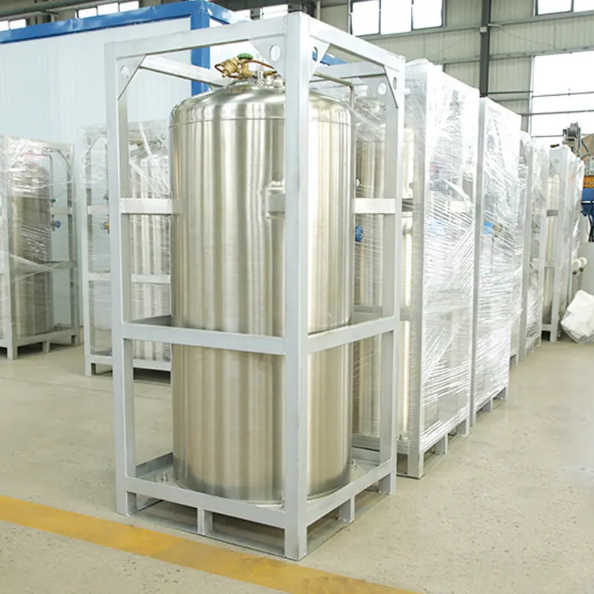
The core material of your flask dictates its lifespan. It also determines operator safety and daily thermal efficiency.
Glass units offer excellent visibility. They feature a double-walled construction separated by a vacuum.
Use Case: They work best for short-term, high-visibility transfers inside controlled labs.
Risk Factor: Glass remains highly vulnerable to vacuum breaches. A minor physical shock can trigger a catastrophic physical implosion. The inward collapse forces high-velocity glass fragments outward. Many technicians wrap glass units in tape. However, external tape wrapping does not mitigate high-velocity fragmentation risks.
Stainless steel represents the absolute standard for heavy usage.
Use Case: You need this material for high-volume, long-term storage and rugged environments.
Advantage: Steel delivers maximum durability. It offers zero implosion risk. Manufacturers apply rigorous vacuum baking processes. They often use 10^-5 torr bakeout procedures. This intense manufacturing step pulls trapped gases from the metal matrix. It guarantees superior vacuum insulation over a decades-long lifespan.
Modern closed-cell foam containers provide a unique alternative for specific tasks.
Use Case: They excel during short-distance manual transport across a campus.
Advantage: Foam possesses a naturally low thermal mass. It absorbs very little heat. This low thermal mass prevents excessive LN2 boiling upon filling. You minimize initial liquid loss. You also eliminate external condensation and severe surface frosting.
Selecting the right size prevents bottlenecks. You must evaluate technical data sheets carefully.
Many buyers confuse static evaporation rate (SER) and holding time. Holding time represents the theoretical maximum lifespan of the liquid. It assumes nobody ever opens the lid. However, the daily evaporation rate (Liters/day) reveals true manufacturing quality. A lower evaporation rate indicates superior internal construction. It proves the absence of internal support pads touching the inner wall. Internal pads create unwanted heat transfer bridges.
Transitioning beyond benchtop vessels requires facility adjustments. Adopting a Cryogenic 195L Industrial Dewar Flask demands specific workflow changes.
Footprint Audits: Verify clearance around the vessel for safe operator maneuvering.
Refill Scheduling: Calculate weekly consumption to establish a vendor delivery rhythm.
Mobility Upgrades: Ensure floors can support loaded caster wheels without grooving the epoxy.
Scaling up to massive capacities changes your entire infrastructure. Implementing a 450L Industrial Dewar Flask requires heavy engineering oversight. You must integrate hard-piped plumbing for automated filling. Facilities require specialized bulk transfer protocols. Engineers must verify structural floor load capacities. A fully loaded 450L tank poses significant weight challenges for older concrete slabs.
The diameter of the neck opening influences daily operation heavily. Wide-mouth designs offer easier access. Operators can immerse large physical tools or biological racks easily. However, a wide mouth causes higher daily evaporation. Narrow-neck configurations restrict physical access. Yet, they provide maximum thermal retention. You must balance ergonomic access against your liquid nitrogen budget.
Handling fluids at -196°C introduces severe environmental, health, and safety (EHS) risks. Strict protocols prevent workplace disasters.
Liquid nitrogen boils at -196°C. Oxygen boils at -183°C. When ambient air contacts exposed liquid nitrogen, oxygen condenses. It literally rains into the vessel. This creates localized liquid oxygen pooling. Liquid oxygen creates severe, highly reactive fire hazards. Organic materials saturated by liquid oxygen can combust explosively. You must keep the atmosphere above the liquid properly flushed and shielded.
You must never completely seal a Dewar flask. Domestic vacuum flasks feature tight screw caps. Applying a tight seal to a cryogenic container guarantees an explosion. Liquid nitrogen expands by a ratio of nearly 700:1 as it vaporizes. This rapid expansion creates immense internal pressure. Industrial units require properly vented lids. Manufacturers supply specially vented stoppers. Large tanks incorporate calibrated pressure relief valves. These mechanisms safely bleed off expanding gas.
Moving liquid between vessels requires caution. You must follow best practices for filling open containers from pressurized sources.
Pre-cooling: Always chill the receiving vessel slowly to prevent structural thermal shock.
Phase Separators: Attach sintered bronze phase separators to transfer hoses. They reduce violent splashing.
PPE Enforcement: Mandate cryogenic gloves, face shields, and closed-toe leather footwear.
Ventilation: Perform transfers only in areas featuring active oxygen monitoring sensors.
A bare storage tank represents only part of your investment. Accessory ecosystems drive daily efficiency. They drastically lower your total cost of ownership.
Dipping manually wastes time and exposes operators to splashing. Pressurized liquid withdrawal devices solve this problem. These tools seal the neck and build slight internal pressure. They force liquid up a dip tube safely. They achieve specific flow rates, often measuring several liters per minute. This minimizes atmospheric exposure. It also eliminates dangerous manual lifting.
A full tank becomes dangerously heavy. Moving it manually invites severe ergonomic injuries. Facility managers must calculate the ROI of mobility accessories. Tipping stands allow operators to pour safely from mid-sized units. Cushioned roller bases protect the internal vacuum layer. They absorb floor vibrations during transit. Preventing a single dropped flask easily justifies the cost of a roller base.
Emptying a tank leaves internal surfaces extremely cold. Atmospheric moisture immediately condenses inside the chamber. This moisture freezes into hard ice layers. Waiting for a tank to dry passively causes massive workflow bottlenecks. Active drying racks force heated, filtered air into the vessel. This active filtration drying prevents cross-contamination between uses. It puts equipment back into service rapidly.
Selecting the right industrial cryogenic equipment requires strategic planning. It is a delicate balance. You must weigh calculating static evaporation rates against your daily access needs. Do not buy based on upfront capacity alone.
Base final decisions on strict EHS approval and realistic facility footprint constraints. Build realistic TCO models first. Factor in long-term LN2 consumption heavily over the initial hardware cost.
Take proactive steps today. Consult your facility engineer and EHS coordinator immediately. Audit your available floor space and ventilation capacities. Review your current bulk LN2 delivery contracts thoroughly before requesting a manufacturer quote.
A: Holding time calculates the absolute maximum lifespan of the liquid nitrogen. It assumes the flask is never opened or disturbed. Static evaporation rate provides a daily baseline of LN2 loss. You use the evaporation rate to calculate actual operational liquid loss accurately.
A: External frosting indicates a catastrophic vacuum failure. The protective vacuum insulation layer has degraded or breached. The intense cold now transfers directly to the outer metal shell. You cannot repair a broken vacuum easily. This condition requires immediate equipment replacement.
A: You should never ride in a closed elevator alongside a filled tank. The liquid continuously evaporates into nitrogen gas. Confined spaces lack adequate ventilation. If the elevator stalls, the expanding gas rapidly displaces oxygen. This creates a severe, invisible asphyxiation hazard.
A: High-grade industrial vessels feature highly advanced getters. These internal materials absorb stray gas molecules. A premium stainless steel unit typically maintains its vacuum for five to ten years. You only need to repump the vacuum if you observe sudden external frosting.

 yongy0223@gmail.com
  +86-17693104145
 Lanzhou New Area, Lanzhou City, Gansu Province, on the second floor to the east of New Harbor Road, to the east of Building Materials Road No. 2, to the west of Qilian Mountain Avenue (Jingqi Road)

