


Views: 0 Author: Site Editor Publish Time: 2026-04-15 Origin: Site


Medical and clinical cryogenic storage operates in a high-stakes reality. Sample viability demands absolute perfection. Even minor temperature fluctuations can destroy years of irreplaceable research. Facilities rapidly transition away from traditional mechanical ultra-low temperature (ULT) freezers toward advanced cryogenic solutions. A robust liquid nitrogen ecosystem eliminates greenhouse gas emissions. It also delivers extended hold times during catastrophic power failures. You need resilient infrastructure to maintain stringent regulatory compliance and protect highly sensitive biomaterials. This guide provides a strictly objective, criteria-based evaluation framework. We will help you procure the ideal medical-grade Liquid Nitrogen Tank for your specific facility needs. You will learn how to balance payload capacity, evaluate total cost of ownership, and seamlessly integrate essential safety accessories.
Application Dictates Design: The choice between narrow-neck and wide-neck tanks requires balancing static holding time against sample retrieval efficiency.
Payload Over Volume: True tank capacity should be measured in 1.2ml/2.0ml cryovials or 1/2cc straws, not just overall liter volume.
Ecosystem Integration: A complete setup requires evaluating the primary storage vessel alongside self-pressurized supply tanks and discharge equipment.
TCO vs. Upfront Cost: High-end vacuum insulation significantly lowers long-term liquid nitrogen consumption and mitigates catastrophic sample loss risk.
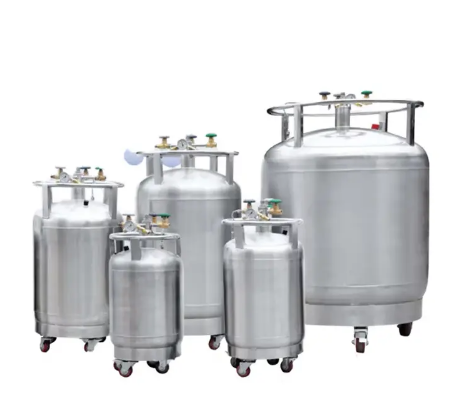
Standard industrial units serve different purposes than clinical vessels. Medical facilities handle IVF embryos, stem cells, and highly sensitive biologics. You must differentiate standard containers from a purpose-built Lab Liquid Nitrogen Tank designed for zero-tolerance environments.
Material integrity matters immensely in cryogenic applications. Look for aerospace-grade aluminum construction. Some facilities prefer high-grade stainless steel. These premium materials prevent sample contamination. They easily withstand daily facility transport. They also resist micro-cracking during extreme temperature cycling between ambient conditions and -196°C.
Regulatory compliance forms your operational baseline. Check for FDA-compliant manufacturing standards. International shipments require IATA and UN approvals. Ensure your digital data logging strictly aligns with 21 CFR Part 11 rules. This guarantees secure, tamper-proof temperature records.
You must address the evaporation versus accessibility trade-off before purchasing. Facility managers constantly balance these two opposing factors:
Narrow-neck designs: These units feature smaller openings. They offer lower evaporation rates and extended static holding times. We highly recommend them for long-term archiving where you rarely disturb samples.
Wide-neck designs: These models consume more liquid nitrogen. The larger opening inherently increases daily evaporation. However, they remain absolutely necessary for frequent sample retrieval. They also accommodate high-density, modular rack systems.
Best Practice: Always audit your team’s weekly access frequency. If technicians open the unit daily, prioritize wide-neck accessibility. If you archive samples for years, choose a narrow-neck model.
No single vessel handles every cryogenic task. A functioning laboratory requires distinct architectures working in harmony. Evaluate these three primary solution categories for your workflow.
Long-Term Storage Dewars (Stationary): These high-capacity systems sit permanently in your facility. Engineers design them for maximum static hold times. Depending on the model, they range from 20 to over 300 days of holding capacity. They come equipped with advanced rack systems. This allows for systematic vial cataloging and rapid retrieval.
Portable Transfer Vessels & Dry Shippers: Facilities rely on these lightweight units for secure transit. They utilize advanced hydrophobic absorbent materials. This material traps the liquid nitrogen internally. It maintains internal temperatures between -150°C and -190°C without free-spilling liquid. You guarantee safe intra-facility or global cold-chain transit.
Supply Tanks: You cannot run a large facility using only storage dewars. You must integrate a Self-pressurized Liquid Nitrogen Tank into your ecosystem. These 50L to 230L stainless steel cylinders function as your local base station. They safely store bulk LN2. You actively dispense from them into smaller benchtop dewars and active freezing systems.
Common Mistake: Many procurement teams buy storage dewars but forget the supply tank. You cannot safely pour liquid nitrogen directly from a delivery truck into a narrow-neck storage unit. You need the pressurized supply base station to manage distribution.
Evaluating cryogenic equipment requires objective metrics. Discard marketing jargon. Focus purely on functional data. Use the following framework to compare manufacturers accurately.
Cryogenic Tank Evaluation Matrix Evaluation Criteria Focus Area Metric to Request 1. Payload Capacity Actual sample storage Exact count of 2.0ml cryovials or 1/2cc straws 2. Thermal Insulation Vacuum chamber quality Daily evaporation rate (L/day) 3. Holding Time Functional operational window Working Time (not just Static Holding Time) 4. Active Monitoring System failure alerts Ultrasonic low-level alarms & redundant sensors 5. Security Features Chain-of-custody Biometric or advanced physical locking systems
Discard raw liter volume during your evaluation. A 50-liter tank tells you nothing about storage density. Insist on specific payload metrics. Ask the manufacturer for the exact count of 2.0ml cryovials the internal canisters accommodate. For veterinary or agricultural clinics, request the capacity for standard 1/2cc straws.
Manufacturers advertise massive Static Holding Times (SHT). They test these under perfect laboratory conditions. The tank remains closed in a climate-controlled room. You must calculate functional working time instead. Factor in your specific facility’s daily opening frequency. Real-world access dramatically reduces the holding duration.
Evaluate the vacuum-insulated chamber quality. Premium insulation minimizes daily evaporation rates. Engineers measure this in liters per day (L/day). A lower number indicates superior engineering. High-quality vacuum layers protect against external heat transfer effectively.
You cannot compromise on active monitoring. Modern clinical environments require ultrasonic low-level liquid alarms. Avoid mechanical float switches, as they frequently freeze. Mandate digital LED readouts. Include redundant temperature sensors to verify thermal stability independently.
Genetic and clinical materials hold immense value. Unrestricted access threatens chain-of-custody compliance. Implement biometric scanners, digital keypads, or advanced physical locking systems. These tools prevent unauthorized personnel from compromising highly sensitive specimens.
Procurement departments often fixate on the initial purchase price. This mindset creates severe financial consequences. You must evaluate the Total Cost of Ownership (TCO) over a ten-year lifecycle.
Model the financial impact of replacing evaporated LN2. Liquid nitrogen costs add up rapidly. A cheap tank might lose an extra two liters per day compared to a premium model. Over a 5-to-10-year lifecycle, this wasted nitrogen costs thousands of dollars. Investing in premium vacuum technology upfront yields massive long-term savings.
Factor in the unrecoverable cost of degraded biomaterials. Thermal failure destroys clinical trial samples permanently. Pressure build-up ruins priceless IVF embryos. The financial liability of lost genetic material dwarfs the price difference between a budget tank and a medical-grade unit. Premium tanks function as vital insurance policies.
Select modular storage rack systems carefully. Good racks allow your facility to expand sample density seamlessly. You optimize the existing tank footprint. You delay purchasing entirely new physical units. Modular inventory systems grow alongside your clinical volume.
Highlight the energy efficiency of LN2 storage. Compare it to compressor-based cryogenic freezers. Mechanical freezers consume massive amounts of electricity. They require expensive HVAC support to offset heat output. Liquid nitrogen storage operates entirely off the electrical grid. This provides a near-zero electrical TCO.
Buying the tank represents only the first step. You must prepare your facility for safe implementation. A complete accessory ecosystem protects your staff and your samples.
Address the severe expansion properties of liquid nitrogen immediately. One liter of liquid nitrogen expands into nearly 700 liters of gas upon warming. This extreme expansion creates enormous pressure. You must install reliable pressure relief valves on all sealed containers. Never trap LN2 in a completely airtight, unvented space.
Fully charged dewars weigh hundreds of pounds. Dragging them across the floor damages the vacuum seal. The mandatory inclusion of heavy-duty roller bases solves this. Buy roller bases for any tank 35L and above. They prevent accidental spillage. They eliminate occupational lifting injuries among your laboratory technicians.
You need specific tools to transfer liquids safely. Procure specialized discharge equipment. Use closed-system pumps and insulated hoses. They safely transfer LN2 from supply cylinders to benchtop dewars. You prevent splashing. You eliminate the risk of severe cryogenic burns during daily operations.
Facility requirements dictate strict environmental controls. You must install automated room ventilation systems. The rapid expansion of nitrogen gas displaces breathable oxygen. Implement permanent oxygen depletion monitors prior to equipment installation. Tie these monitors directly to visual and auditory facility alarms.
Best Practice: Schedule comprehensive staff safety training before the first liquid nitrogen delivery arrives. Ensure every technician possesses properly rated cryogenic gloves and full face shields.
Purchasing cryogenic equipment requires a structured critical path. First, audit your current sample volume thoroughly. Next, determine your realistic daily access frequency. Select the appropriate neck size and tank category based on those operational answers. Calculate your complete ten-year TCO. Finally, ensure you possess full accessory compatibility.
We highly recommend a specific shortlisting action. Demand precise daily evaporation rates from manufacturers. Ask for actual vial capacity charts rather than raw liter measurements. Request this documentation prior to finalizing your formal RFP submission. Proper planning guarantees you select resilient infrastructure capable of protecting your most valuable clinical assets.
A: Static holding time assumes you never open the tank. It reflects maximum laboratory-condition performance. Working time factors in real-world access. It accounts for daily opening frequency, ambient room temperature, and sample retrieval duration. Always use working time for accurate facility planning.
A: You must clean the vessel entirely at room temperature. First, ensure it is completely empty of liquid and gas. Use mild, manufacturer-approved disinfectants. Crucially, dry the interior completely before reintroducing LN2. Any remaining moisture turns to ice, causing severe expansion damage to the vacuum chamber.
A: Fully charged dewars are incredibly heavy. Dragging or tilting them creates a severe tipping hazard. A specialized roller base evenly distributes the weight load. It prevents cryogenic splashing, protects the tank's fragile vacuum integrity, and eliminates occupational lifting injuries for your staff.
A: No. Pressurized cylinders serve strictly for LN2 supply and dispensing. They function as a base station to refill other equipment. They do not house cryogenic racks, canisters, or biomaterials. You must use designated unpressurized storage dewars to house actual clinical samples.

 yongy0223@gmail.com
  +86-17693104145
 Lanzhou New Area, Lanzhou City, Gansu Province, on the second floor to the east of New Harbor Road, to the east of Building Materials Road No. 2, to the west of Qilian Mountain Avenue (Jingqi Road)

