


Views: 0 Author: Site Editor Publish Time: 2026-06-03 Origin: Site


Procuring a cryogenic storage solution represents a high-stakes capital investment. Getting the core specifications wrong creates serious problems. It directly leads to excessive boil-off gas (BOG) losses. Poor selection also introduces critical safety hazards and severe operational bottlenecks. Storage requirements vary wildly across different sectors. Handling medical oxygen demands different parameters than industrial liquefied natural gas (LNG). Specialized aerospace applications require even more distinct setups. Simply put, understanding baseline equipment architecture remains absolutely non-negotiable.
This comprehensive guide breaks down the primary storage configurations available today. We explore various insulation technologies in detail. We also outline critical evaluation criteria. These insights help procurement and engineering teams effectively shortlist the right solution. You will learn how to balance capacity needs against thermal performance. Ultimately, you can ensure safe, efficient, and highly reliable long-term gas storage for your facility.
Cryogenic tanks are primarily categorized by mobility and scale: stationary bulk, microbulk, transport cylinders (Dewars), and custom-engineered spheres.
Insulation choice (Vacuum Jacketed vs. Perlite) directly dictates thermal efficiency and long-term operational costs (OPEX).
Modern procurement heavily favors telemetry; integrating solutions like an IoT-Monitored 7.5m³ Industrial Cryogenic Tank prevents costly gas run-outs and optimizes delivery routes.
Selecting a qualified cryogenic tank manufacturer requires evaluating their adherence to global pressure vessel codes (ASME, PED) and their aftermarket support capabilities.
Many buyers focus exclusively on initial capital outlay. This approach frequently backfires. Selecting equipment based purely on upfront hardware expense ignores long-term efficiency. Poor insulation choices cause high boil-off rates (BOR). Improperly sized vessels similarly waste valuable product. Gas vents into the atmosphere when pressure builds up too quickly. This wastes money and creates potential environmental hazards. Relying on an undersized vessel essentially guarantees operational stress.
A successful deployment requires balancing multiple technical variables. You must consider rigid footprint constraints at your site. Required continuous flow rates dictate your necessary vaporizer capacity. The maximum allowable working pressure (MAWP) must match your distribution piping. Furthermore, thermal holding time determines how long liquid gas remains stable without venting. Balancing these elements ensures safe daily operations. It also safeguards your initial hardware investment.
Operational reality heavily influences equipment selection. Equipment choices must align perfectly with supply chain logistics. How often do your local gas suppliers deliver? What specific transfer methods do they utilize? A massive vessel might seem ideal for bulk delivery discounts. However, it fails if your supplier cannot deliver large enough batches. Conversely, undersized vessels force frequent deliveries. Frequent deliveries increase logistical friction and dramatically inflate vendor delivery fees. You must bridge the gap between engineering ideals and logistical realities.
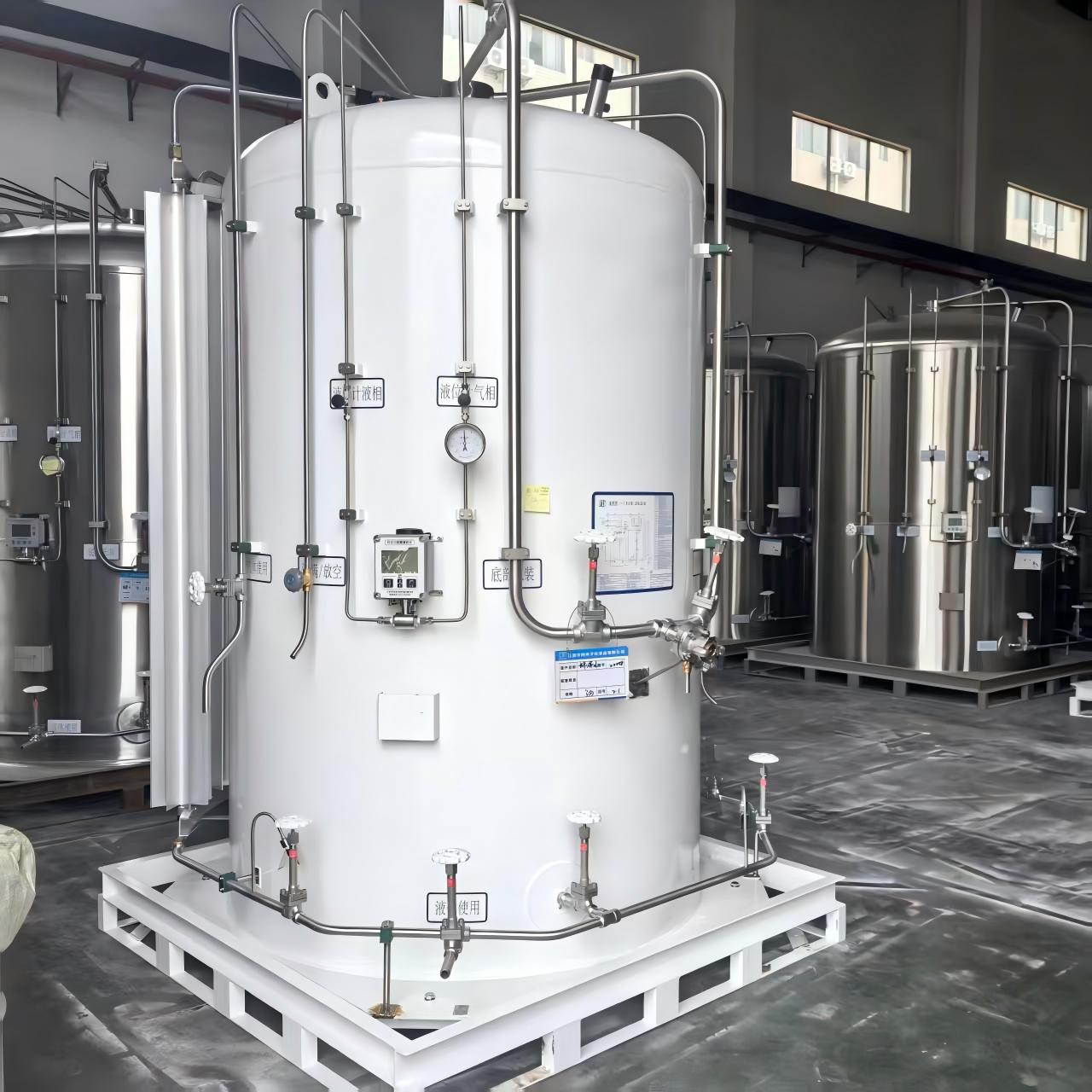
Engineers categorize deep-cold storage vessels primarily by mobility and total volume capacity. The right configuration depends entirely on your consumption rate and application environment. We outline the primary classifications below.
Stationary bulk vessels typically range from 1,000 to over 100,000 liters. They represent the standard storage method for heavy industrial plants. You will find them powering laser cutting operations and supplying large healthcare facilities. These stationary units remain permanently fixed to concrete foundations. Delivery trucks arrive periodically to refill them on-site. This eliminates the physical hazards associated with moving heavy cylinders.
Modern variations emphasize smart storage and digital integration. Facilities increasingly abandon analog gauges for digital oversight. The shift toward connected infrastructure is accelerating rapidly. For instance, an IoT-Monitored 7.5m³ Industrial Cryogenic Tank serves as an ideal mid-market solution. It perfectly balances a compact physical footprint with automated inventory tracking. This smart integration guarantees uninterrupted supply for critical industrial processes.
Transportable vessels are designed specifically to withstand intense dynamic loads. Transporting heavy cryogenic liquids subjects the inner vessel to severe sloshing forces. Engineers incorporate specialized internal baffles to mitigate these kinetic stresses. ISO containers represent a standardized version of these transportable tanks. They fit perfectly onto standard flatbed trucks, railcars, and container ships.
Their primary use case involves intermodal logistics. They are absolutely critical for serving remote locations lacking pipeline access. Mining camps and remote research facilities rely heavily on these robust containers. They allow global gas distributors to move product across continents safely. The robust structural frame protects the sensitive vacuum piping during rough transit.
Liquid cylinders and Dewar flasks represent the smallest scale of liquid gas storage. They are highly mobile containers. Typical capacities remain strictly under 500 liters. They come in open-neck configurations for dipping applications or pressurized versions for dispensing gas. A single operator can usually move them using a specialized hand truck.
These units serve laboratories, bio-banking facilities, and small-scale welding operations. Their portability makes them incredibly versatile. However, their smaller volume means they suffer from higher relative boil-off rates. They cannot hold liquid as long as a massive bulk vessel. Facilities typically use them for short-term storage or point-of-use applications.
Engineered-to-Order (ETO) tanks are massive, field-erected structures. Manufacturers build them directly on the final installation site. They are simply too large for highway transportation. These include towering flat-bottom structures and massive spherical vessels. They often hold millions of liters of product.
You typically see these structures at import/export terminal storage facilities. They store vast quantities of LNG or liquid hydrogen. Their primary use case involves utility-scale power generation. Massive industrial chemical plants also rely on them as base-load reservoirs. Building these structures requires complex civil engineering and localized metallurgical fabrication.
Insulation dictates how well the equipment maintains ultra-low temperatures. It represents the primary driver of overall manufacturing cost. Heat leak from the ambient environment constantly threatens to vaporize the stored liquid. Engineers deploy three main defense mechanisms against this thermal transfer.
Vacuum Jacketed vessels use Multi-Layer Insulation (MLI), often called super insulation. The mechanism involves wrapping the inner vessel in multiple layers of highly reflective material. Manufacturers typically use alternating layers of Mylar and a non-conductive spacer material. They then pull a high vacuum in the annular space between the inner and outer walls. This eliminates convective heat transfer.
This technology offers the absolute highest thermal performance available. It also allows for the smallest physical footprint. However, it demands the highest initial manufacturing cost. It remains the best choice for storing high-value gases like liquid Helium and Hydrogen. The high cost of these specific gases easily justifies the premium insulation expense.
Perlite insulation provides a more economical alternative to MLI. The mechanism involves filling the annular space with expanded perlite powder. The manufacturer then draws a vacuum on this powder-filled space. The powder physically blocks radiant heat transfer. The vacuum prevents convective heat transfer.
This method proves highly reliable and incredibly cost-effective. It serves as the industry standard for medium-to-large bulk tanks. It works perfectly for standard industrial gases like liquid nitrogen (LIN), liquid oxygen (LOX), and liquid argon (LAR). One minor drawback involves perlite settling over decades of use. This settling occasionally creates cold spots near the top of older vessels.
Polyurethane Foam (PUF) represents a non-vacuum insulation approach. The mechanism involves applying rigid foam directly to the exterior of a vessel. Alternatively, manufacturers inject it between dual steel walls without drawing a vacuum. It relies entirely on the foam's inherent thermal resistance.
This provides much lower thermal efficiency than vacuum-based methods. Therefore, engineers typically reserve it for specific large-scale, low-temperature applications. It works well for large liquid carbon dioxide (CO2) storage. Liquid CO2 does not require true deep cryogenic temperatures. Using vacuum insulation for CO2 often represents an unnecessary over-engineering expense.
Insulation Type | Primary Mechanism | Relative Cost | Best Application / Gas Type |
|---|---|---|---|
Super Insulation (MLI) | Reflective layers in a high vacuum | High | High-value gases (Helium, Hydrogen), Medical environments |
Perlite + Vacuum | Expanded powder in a vacuum | Medium | Standard bulk gases (LIN, LOX, LAR), Industrial processing |
Polyurethane Foam | Rigid thermal barrier (No vacuum) | Low | Low-temperature bulk storage (Liquid CO2, Nitrous Oxide) |
Engineers and buyers must utilize a strict decision framework when evaluating potential specifications. Choosing the right cryogenic tank involves careful mathematical analysis. You cannot simply guess your facility's requirements.
Calculating proper volume requires distinguishing between gross volume and usable volume. A vessel cannot safely operate at 100% liquid capacity. It requires a dedicated gaseous headspace to accommodate natural expansion. Planners must factor in future facility expansion. Purchasing a vessel that barely meets current demand guarantees premature equipment obsolescence. You should follow a clear sizing methodology:
Audit current daily gas consumption rates across all operational shifts.
Determine peak flow requirements during maximum production hours.
Calculate the required buffer stock to survive missed deliveries.
Project your facility's consumption growth over the next five years.
Real-time pressure and liquid level monitoring are rapidly becoming industry standard. Legacy systems forced operators to read analog dials manually. Modern telemetry systems eliminate this dangerous guesswork. They transmit critical data directly to cloud dashboards. We strongly advise adopting IoT integration for all new deployments. IoT directly reduces vendor delivery fees by optimizing truck routing. It prevents emergency deliveries. More importantly, it prevents catastrophic operational downtime caused by sudden gas run-outs.
Matching the equipment to regional safety codes is a strict legal requirement. Ignoring compliance leads to heavy fines and facility shutdowns. You must verify local pressure vessel codes before procurement. The US requires ASME Section VIII compliance. Europe mandates PED or TPED certification. China utilizes specific GB standards. Furthermore, specific industries demand targeted compliance. For instance, engineers must follow API 620 guidelines for low-pressure storage applications. Never compromise on verified metallurgical certifications.
Successful deployment involves more than just signing a purchase order. Significant implementation risks exist. Careful planning mitigates these operational threats.
High-quality pressure vessels require incredibly long manufacturing lead times. Fabrication often takes several months. Planners must carefully align site preparation with anticipated delivery schedules. Site prep includes complex foundation pouring. It also involves intricate cryogenic piping integration. Misaligning these schedules causes massive project delays. You do not want heavy equipment arriving before the concrete foundation cures.
Installation carries hidden costs that surprise many procurement teams. You must account for reinforced concrete pads. Liquid gas is exceptionally heavy. You also need precise vaporizer sizing. Undersized vaporizers freeze solid during high-demand periods. This completely chokes off the gas supply to your facility. Proper cryogenic piping integration requires specialized welding teams. Standard industrial plumbers cannot handle deep-cold piping safely.
Finding a reliable cryogenic tank manufacturer requires intense scrutiny. Do not confuse a basic metal fabricator with a specialized pressure vessel engineer. Specialized manufacturers understand thermodynamics deeply. You must evaluate suppliers based on specific criteria:
Documented QA/QC Processes: Demand X-ray testing reports for all pressure-bearing welds.
Metallurgical Expertise: Ensure they use appropriate stainless steel grades that resist cold embrittlement.
Localized Service Networks: Confirm they can dispatch technicians quickly if a safety relief valve fails.
Transparent Vacuum Warranty Terms: Distinguish between a standard 5-year and a premium 10-year vacuum guarantee.
A reputable supplier acts as an engineering partner. They will help you review flow rates and site constraints before accepting your order.
Selecting the right deep-cold storage architecture protects your operational profitability. The "best" type is strictly dictated by your specific gas, required volume, and facility footprint. Stationary bulk units serve heavy industry perfectly, while transportable ISO containers dominate remote logistics. Remember that insulation choice directly impacts your daily evaporation losses. Do not compromise on vacuum integrity to save upfront capital.
We encourage you to move from general research to precise specification. Take immediate action by conducting a comprehensive site flow-rate audit. Document your peak demand hours and delivery frequencies. Next, reach out to a qualified application engineer. Request technical datasheets, footprint schematics, and professional sizing recommendations. Proper planning today guarantees decades of reliable gas supply.
A: Typically 15 to 30 years. This lifespan relies heavily on the integrity of the vacuum seal. Routine maintenance of safety relief valves and pressure regulators is also essential. Well-maintained vessels with intact vacuum spaces often exceed 30 years of safe operation.
A: It includes integrated differential pressure sensors and telemetry modules. These sensors transmit real-time liquid levels and internal pressure data to a cloud dashboard. This technology enables predictive deliveries, prevents product run-outs, and allows for rapid leak detection.
A: Generally, no. Tanks are specifically engineered, cleaned, and calibrated for a single type of gas. For example, oxygen tanks require strict "cleaned for oxygen service" protocols. Mixing gases or ignoring these protocols introduces severe combustion hazards.
A: Liquid cylinders are mobile containers swapped out manually when empty. Microbulk tanks are permanently installed on-site and refilled directly by a delivery truck. Microbulk systems eliminate manual handling risks and significantly reduce ongoing cylinder rental fees.

 yongy0223@gmail.com
 +86-17693104145
 Lanzhou New Area, Lanzhou City, Gansu Province, on the second floor to the east of New Harbor Road, to the east of Building Materials Road No. 2, to the west of Qilian Mountain Avenue (Jingqi Road)


