


Views: 0 Author: Site Editor Publish Time: 2026-07-22 Origin: Site


Specifying the correct capacity for a cryogenic storage system is a high-stakes engineering decision. Under-sizing leads to production bottlenecks and premium emergency delivery fees, while over-sizing traps capital and accelerates product loss through boil-off. Facility engineers and procurement teams must balance volatile consumption rates, strict delivery logistics, footprint constraints, and thermal performance to determine the exact storage volume required. This guide breaks down the technical evaluation dimensions of sizing a cryogenic tank, from micro-bulk applications to million-liter bulk storage, providing a framework to align capacity with operational demands.
Capacity vs. Usable Volume: Gross water capacity does not equal usable gas volume; sizing must account for the required vapor space (ullage) to safely manage expansion.
Logistics Dictate Scale: Optimal tank size is heavily influenced by supplier delivery schedules, minimum drop sizes, and truck access, not just internal consumption rates.
Thermal Efficiency Matters: Larger tanks generally offer better surface-area-to-volume ratios, reducing the percentage of daily evaporation, but require higher upfront capital and larger footprints.
Telemetry is Essential: Integrating IoT monitoring allows facilities to operate with tighter capacity margins by predicting exact refill intervals based on real-time liquid levels and pressure data.
Establishing the foundational metrics required to communicate effectively with tank manufacturers and gas suppliers prevents costly specification errors. You need a firm grasp of volume definitions, pressure ratings, and specific gas properties before breaking ground on a new installation.
A frequent oversight in facility planning is confusing a vessel's water capacity with its functional storage limit. Water capacity refers to the total internal volume of the inner vessel. Net capacity typically represents 90% to 95% of that gross volume. This mandatory 5% to 10% vapor space, known as ullage, provides a safety buffer for liquid expansion as heat enters the system.
Specific gravity and expansion ratios of different gases directly impact the actual standard cubic feet (SCF) or normal cubic meters (Nm³) of gas available. Nitrogen, oxygen, argon, and liquefied natural gas (LNG) behave differently under thermal load. Industry conversion standards size systems in both US Gallons (ranging from 300 to 264,000 gallons) and Liters (1,000 to 1,000,000+ liters) to align with global procurement specifications.
Cryogenic Liquid | Boiling Point (1 atm) | Liquid-to-Gas Expansion Ratio | Density (Liquid at Boiling Point) |
|---|---|---|---|
Liquid Nitrogen (LN2) | -320°F / -196°C | 1:696 | 6.74 lbs/gal |
Liquid Oxygen (LOX) | -297°F / -183°C | 1:860 | 9.52 lbs/gal |
Liquid Argon (LAR) | -302°F / -186°C | 1:840 | 11.63 lbs/gal |
Liquefied Natural Gas (LNG) | -260°F / -162°C | 1:600 (approx) | 3.5 - 4.0 lbs/gal |
Pressure requirements intersect heavily with tank size and wall thickness. Standard industrial applications typically demand a Maximum Allowable Working Pressure (MAWP) ranging from 175 to 500 psig. High-pressure applications require heavier, thicker inner vessels constructed from high-grade stainless steel.
This creates a direct trade-off in system design. Heavier vessels increase manufacturing complexity and limit the maximum feasible size due to highway transportation weight restrictions. You must calculate the minimum pressure required to push gas through the facility's piping network without over-specifying the MAWP.
Physical properties drastically alter storage requirements. Liquid argon features a high density, meaning a tank holding argon will weigh significantly more than the exact same volume of liquid nitrogen. Liquid nitrogen has a lower boiling point, making it more susceptible to rapid boil-off if insulation degrades.
Analyzing liquid-to-gas expansion ratios determines the accurate equivalent gas storage volume. A 5,000-liter vessel yields vastly different volumes of usable gas depending on the specific molecule stored inside. You must size the vessel based on the required gaseous flow rate converted back into its liquid equivalent.
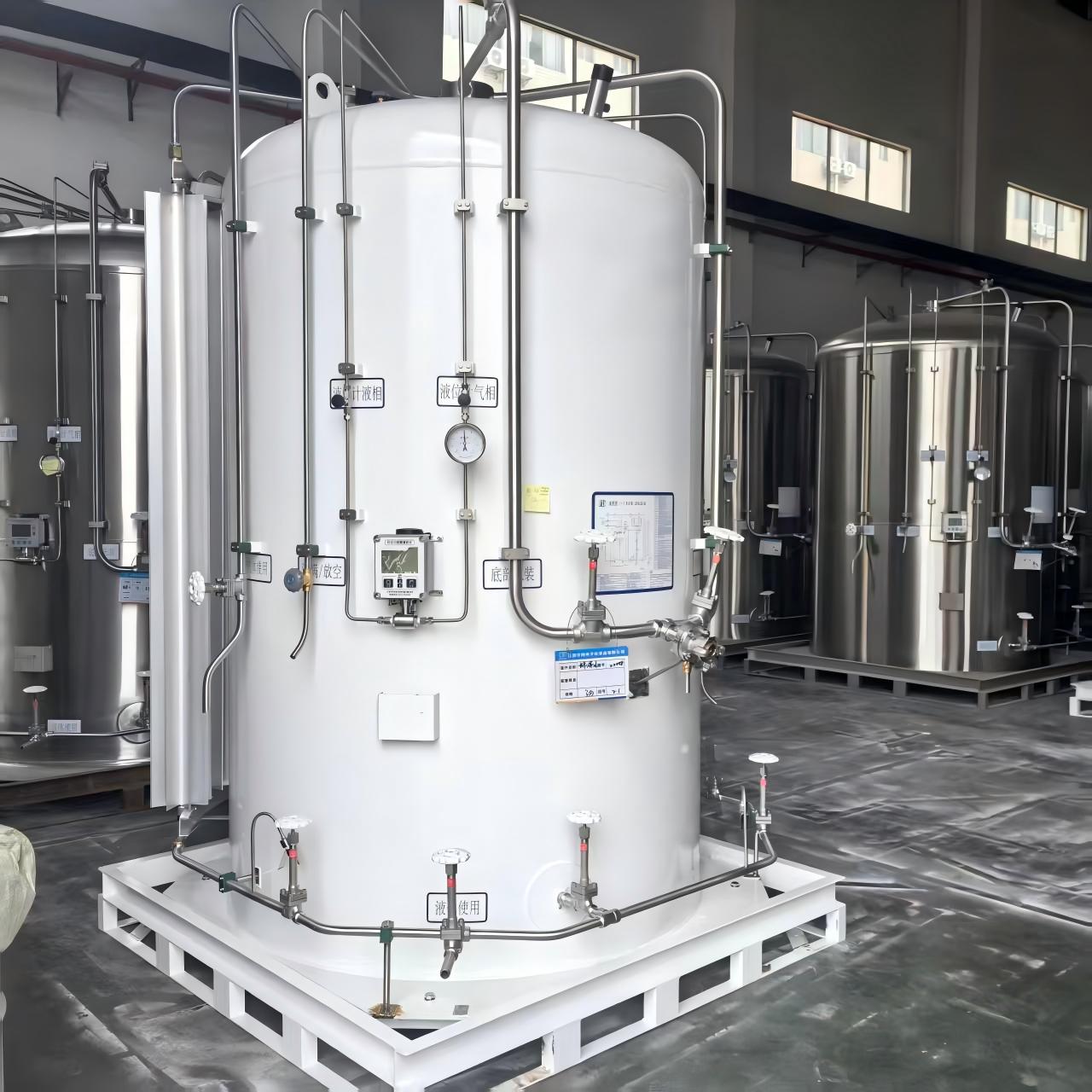
Mapping available tank volumes to specific industrial use cases helps narrow down the selection process. Storage systems fall into distinct tiers based on capacity, footprint, and mobility requirements.
Micro-bulk systems bridge the gap between high-pressure cylinders and permanent bulk installations. They are ideal for laboratories, small manufacturing sites, and medical facilities looking to eliminate the labor-intensive process of swapping individual cylinders.
Evaluation dimensions for this tier prioritize mobility, footprint, and the ability to be refilled on-site via specialized micro-bulk delivery trucks. These vessels often feature integrated casters or forklift pockets, allowing them to be positioned directly next to the point of use.
This is the standard range for laser cutting operations, metal fabrication shops, and mid-sized chemical processing plants. Facilities in this tier consume enough gas to justify permanent outdoor installations but lack the footprint for massive bulk storage.
For operations with strict space constraints but critical continuous flow needs, utilizing a Low-Evaporation 5m³ Liquid Oxygen Cryogenic Tank ensures medical or welding applications remain online without excessive boil-off losses. In high-uptime manufacturing environments, deploying an IoT-Monitored 7.5m³ Industrial Cryogenic Tank automates the reordering process. Telemetry prevents run-outs by alerting suppliers exactly when the liquid level drops below a predefined threshold.
Designed for heavy industry, aerospace testing, air separation units (ASUs), and LNG bunkering, these massive vessels serve as the primary gas supply for major industrial complexes. Sizing at this scale requires meticulous long-term capacity planning.
Implementation realities for large-scale bulk storage are complex. They require extensive civil engineering for deep foundations, specialized heavy-lift rigging for installation, and long-lead manufacturing times. Delivery logistics often involve dedicated fleets of 10,000-gallon trailers arriving daily or weekly.
The mathematical and operational variables used to calculate exact size requirements go far beyond simple daily consumption averages. You must evaluate peak demands, thermal efficiency, and external supply chain constraints.
Auditing baseline daily consumption against peak intermittent demand is the first step in sizing. A facility might average 100 cubic meters per hour but experience sudden spikes of 500 cubic meters per hour during specific batch processes. The storage system must handle these spikes without suffering massive pressure drops.
The role of ambient vaporizers is equally critical. You must size the tank and vaporizer in tandem. If the vaporizer is undersized, it will freeze solid during peak flow, blocking the gas supply regardless of how much liquid remains in the tank.
Analyzing the Normal Evaporation Rate (NER) is essential for facilities with sporadic consumption. NER is heavily dependent on the insulation type, typically comparing standard perlite under vacuum against advanced multi-layer super-insulation.
For operations where gas sits unused for days, specifying a High-Precision Liquid Gas Cryogenic Tank with advanced vacuum insulation minimizes BOG. If the evaporation rate exceeds the facility's baseline consumption, the internal pressure will build until the safety relief valves open, venting valuable product directly into the atmosphere.
Calculating sizing based on the "days of supply" rule is standard industry practice. Engineers typically size the system to hold 7 to 14 days of peak storage. This buffer protects the facility against regional supply chain disruptions, severe weather events, or unexpected production surges.
Supplier delivery constraints also dictate minimum tank sizes. A tank must be large enough to accept a standard bulk delivery, such as a 4,000-gallon trailer drop, while still retaining a 20% to 30% reserve buffer. If the tank is too small, the supplier cannot unload a full trailer.
Physical limitations of the installation site often force compromises in tank selection. Assessing ground conditions, overhead clearance, and vehicle access is just as important as calculating the required volume.
Vertical tanks are the standard choice to minimize the ground footprint. They require strict evaluation of wind loads, seismic zone requirements, and overhead clearance for installation cranes. Tall vertical vessels act as sails in high-wind areas, necessitating deeper, heavier concrete foundations.
Horizontal tanks are necessary for sites with strict height restrictions, indoor installations, or specific center-of-gravity requirements. They typically range from 300 to 2,000-liter capacities for liquid nitrogen and argon applications. Adding specialized piping manifolds, pressure-building circuits, and customized valve packages affects the ultimate footprint of a horizontal configuration.
Risk mitigation begins with assessing soil bearing capacity. Engineers must design reinforced concrete pads capable of supporting the massive weight of a fully loaded bulk vessel. A 10,000-gallon tank filled with liquid argon presents an immense point load that standard industrial paving cannot support.
Site access is another critical failure point. Facilities must ensure adequate turning radii, reinforced access roads, and clear overhead paths for 80,000+ lb delivery trailers. If the delivery truck cannot safely maneuver into the fill station, the tank size becomes irrelevant.
Managing the technical process of bringing a newly sized tank online requires accounting for initial gas losses. The first fill behaves very differently from standard operational refills.
The physical process of structural cooling consumes a significant amount of product. The inner stainless steel vessel must be chilled from ambient temperature down to cryogenic temperatures. The heat energy stored in the metal causes rapid, violent boiling of the initial liquid introduced into the system.
Engineers must quantify this cool-down gas loss. A measurable portion of the initial fill volume is consumed solely to absorb the heat of the metal components. If you order exactly the volume of the tank for the first delivery, you will end up with a partially empty vessel once thermal equilibrium is reached.
Sizing the initial gas delivery must accommodate both vessel cooling and the purging of atmospheric moisture from downstream supply lines. Before connecting to sensitive production equipment, the entire piping network must be flushed with dry, pure gas to eliminate contaminants.
This purging process requires high flow rates and consumes substantial volume. Planners must coordinate with gas suppliers to ensure the commissioning delivery includes enough excess product to cool the tank, purge the lines, and leave the facility with a fully operational liquid level.
Selecting the right size requires precise data and forward-looking facility planning. Follow these actionable steps to finalize your specification:
Audit your facility's peak hourly flow rate and baseline daily consumption over a 30-day period.
Calculate the required days of supply buffer, factoring in your local supplier's standard delivery truck capacity.
Assess your physical site constraints, including soil bearing capacity, overhead clearance, and trailer turning radii.
Select insulation and telemetry options based on your tolerance for boil-off losses and need for automated reordering.
A: Gross capacity is the total internal volume of the tank's inner vessel. Net capacity is the usable volume for liquid storage, typically 90% to 95% of the gross capacity. The remaining 5% to 10% is left empty to provide a vapor space (ullage) that safely accommodates liquid expansion as pressure builds.
A: Industry best practice is to size a storage system to hold 7 to 14 days of your facility's peak gas consumption. This buffer ensures continuous operation during unexpected delivery delays, severe weather, or sudden spikes in production demand.
A: They have different physical properties. Liquid argon is significantly denser than liquid nitrogen, meaning the same volume of argon weighs much more. This impacts foundation design and maximum transportable tank sizes. Additionally, their liquid-to-gas expansion ratios differ, altering the total volume of usable gas yielded.
A: Indoor installations are generally avoided for large bulk tanks due to severe safety risks associated with oxygen displacement (asphyxiation) or oxygen enrichment. If an indoor installation is absolutely required, it mandates horizontal configurations, extensive mechanical ventilation, and strict adherence to local fire and building codes.
A: If your tank cannot accept a full standard delivery, the supplier must perform a partial fill. This often results in short-fill penalties, higher delivery frequencies, and increased logistical complexity, ultimately disrupting your facility's supply chain.
A: During the first fill, the inner vessel is at ambient temperature. A significant amount of the initial cryogenic liquid boils off immediately just to cool the stainless steel down to operating temperatures. You must order extra product during commissioning to account for this cool-down loss and line purging.

 yongy0223@gmail.com
 +86-17693104145
 Lanzhou New Area, Lanzhou City, Gansu Province, on the second floor to the east of New Harbor Road, to the east of Building Materials Road No. 2, to the west of Qilian Mountain Avenue (Jingqi Road)


