| Application Overview
The DYZ06A series cryogenic combi-pressure regulator is a three-in-one pressure management unit engineered specifically for liquid cylinders and mini-bulk cryogenic containers (both static and transportable tanks). It integrates a pressure build-up regulator and an economizer within a single compact valve body. Via a spring-loaded diaphragm mechanism, it automatically senses the container's gas-phase pressure and controls the pressure build-up circuit, maintaining the operating pressure within the set range. Compatible with air gases, vapors, and all cryogenic liquefied gases (LNG / LO₂ / LN₂ / LAr, etc.). Factory-cleaned and degreased per CGA G-4.1 for liquid oxygen service. Compliant with TSG 23 and GB/T 34530.1. All models feature brass body + SS springs + bronze diaphragm + PTFE seat, temperature range −196°C ~ +85°C.
Working Principle
The DYZ06A is a self-operated (no external power) pneumatic pressure regulator that senses tank vapor pressure via a diaphragm and automatically controls the pressure build-up circuit, performing three functions within a single valve body:
Stage 1 — Pressure Below Setpoint → Build-Up Mode: Tank vapor pressure acts on the diaphragm underside. When spring preload > vapor pressure × diaphragm area, the diaphragm pushes downward → the stem opens the disc → high-pressure liquid enters from PB IN, flashes to gas through the orifice, and returns to the tank vapor space via PB OUT → tank pressure rises.
Stage 2 — Pressure Reaches Setpoint → Shut-Off Mode: Vapor pressure × diaphragm area > spring preload → diaphragm lifts → disc seals against the PTFE seat → PB circuit closes, pressurization stops.
Stage 3 — Pressure Above Setpoint → Economizer Mode: EC OUT directly draws vapor from the tank headspace for downstream gas supply, preferentially consuming gas-phase pressure rather than evaporating additional liquid. If vapor pressure drops → diaphragm descends again → PB circuit reopens → returns to Stage 1.
This "build-up → shut-off → economize → rebuild" self-regulating cycle requires no external power or manual intervention — fully autonomous pressure management via force balance between tank vapor pressure and the adjustment spring.
|
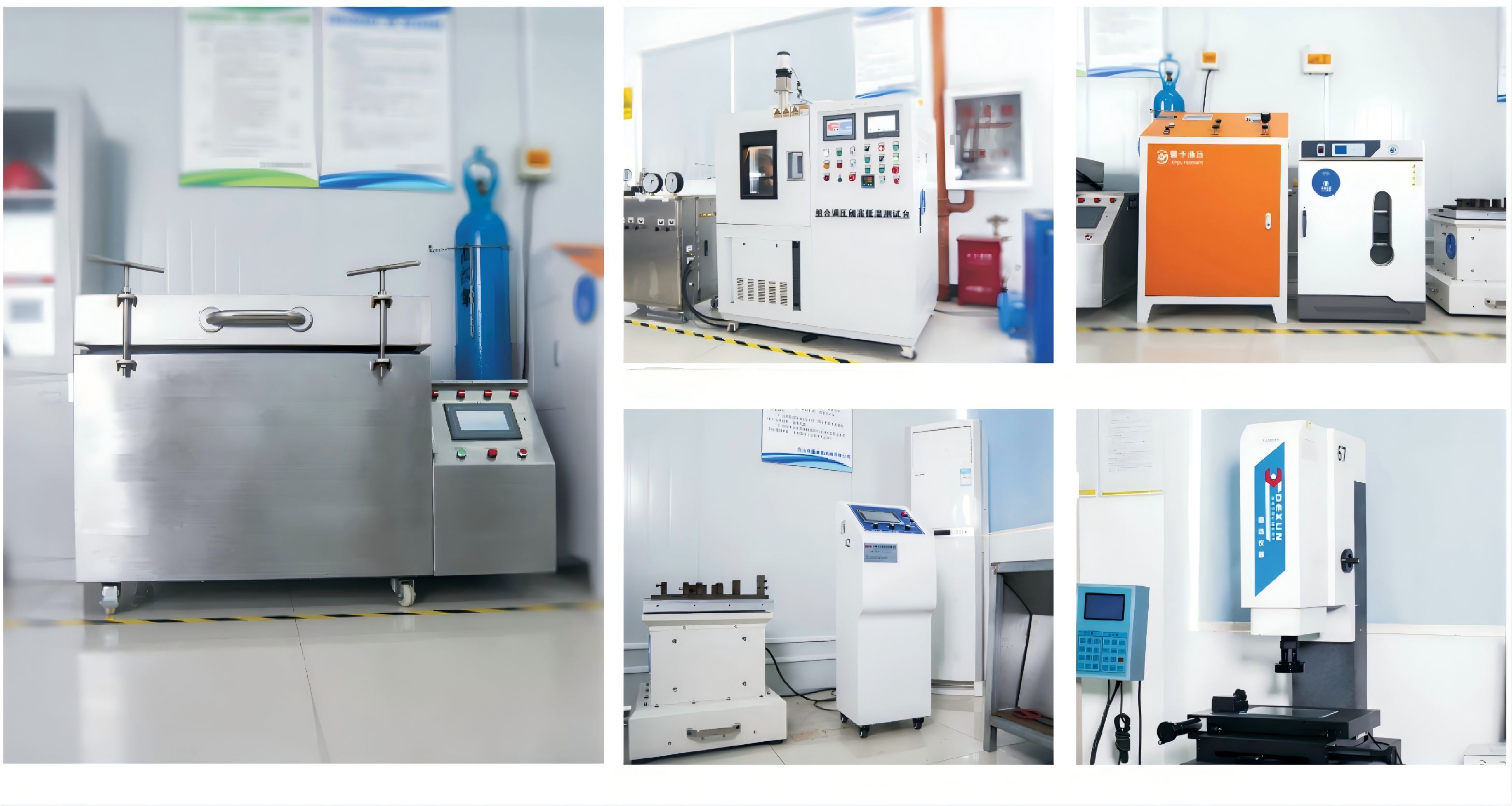
Factory Shoot
1: What's the difference between the DYZ06A and a regular pressure regulator?
A: A regular regulator performs downstream pressure control — it only maintains constant outlet pressure. The DYZ06A performs tank-side pressure control — it directly senses and regulates the tank's own vapor pressure by cycling the pressure builder on and off. It also includes a built-in economizer that preferentially draws vapor for gas supply when pressure is adequate, reducing wasteful liquid evaporation. It's a multi-function pressure management unit, not a simple single-function regulator.
2. Where is the regulator mounted on the tank?
A: The DYZ06A is typically mounted on the tank top or side valve panel with hard-piped connections. Key points: ① Orientation is flexible, but ensure the diaphragm chamber cannot trap liquid (avoid diaphragm face-down vertical mounting). ② PB IN must be a liquid-phase line drawn from the tank bottom — if it carries gas instead, the PB circuit is completely ineffective. ③ For LOX service, the valve is factory-degreased; do not use any oil-based sealant or anything other than PTFE tape during installation.
3. Why aren't the adjustment ranges continuous?
A: Are gaps normal? The upper limit of DYZ-06A1 (230 PSIG) overlaps with the lower limit of A2 (145 PSIG), providing overlapping coverage across common industrial pressure ranges. A2→A3 and A3→A4 transition smoothly around 300 and 350 PSIG. Simply choose the model whose range contains your target operating pressure — this tiered approach is intentional: each spring works only in its optimal range, ensuring regulation precision and diaphragm longevity.
4. Why bronze for the diaphragm instead of stainless steel?
A: Bronze diaphragms offer superior fatigue life and elastic recovery under repeated flexing, plus they share a similar thermal expansion coefficient with the brass body — minimizing interfacial stress during thermal cycling. Stainless steel diaphragms offer better corrosion resistance but inferior flexing life and cryogenic elastic recovery. In the DYZ06A design, corrosion resistance is handled by the brass body and SS springs; the diaphragm is dedicated to mechanical sensing, for which bronze is optimal.
5. How does the economizer "save energy"?
A: When the tank vapor pressure is adequate, the EC OUT port draws gas-phase medium directly for downstream supply without running the pressure builder to evaporate more liquid. In systems without an economizer, the PB circuit may keep evaporating liquid even when demand is low and pressure is already sufficient — wasting liquid inventory. The economizer implements a "gas first, liquid only when needed" strategy, substantially reducing unnecessary boil-off and liquid waste.
A:Standard safety valves are for compressible media only. For liquid service, you need a relief valve or safety relief valve specifically rated for liquid.


 yongy0223@gmail.com
 +86-17693104145
 Lanzhou New Area, Lanzhou City, Gansu Province, on the second floor to the east of New Harbor Road, to the east of Building Materials Road No. 2, to the west of Qilian Mountain Avenue (Jingqi Road)