

 |


loading


DH15F
SLDW
| Size: | |
|---|---|
| Availability: | |
| Quantity: | |
| Application Overview
In an LNG fueling line, the check valve is the last silent goalkeeper. Its job is straightforward — let liquid pass freely in the forward direction, cut it off instantly in reverse. But "instantly," for an ambient-temperature valve, is a mechanical poppet-drop action. At LNG temperatures it becomes a simultaneous superposition of three phenomena: seal thermal contraction altering fit clearances, media viscosity dropping sharply and doubling the slam force, and metal cold-shrinkage drifting the spring preload. Handle any one of these wrong, and the check valve either fails to seal at −162°C or slams so hard it deforms the seat.
The DH15F design path is a head-on collision with these problems. At its core is a brass poppet, inverted in the body flow path and held against a PTFE sealing face by an axial stainless steel spring. Under forward flow, fluid pressure overcomes the spring and lifts the poppet; liquid passes through the annular passage around the poppet. The moment reverse flow begins, dynamic pressure collapses and the spring instantly drives the poppet back onto the PTFE face — the blind zone between poppet touchdown and seal establishment is minimal, thanks to the low inertia of the lightweight brass poppet and PTFE's low-temperature resilience.
Six parts in minimalist architecture: brass body + brass poppet + brass cover + stainless steel spring + two PTFE pieces (one dynamic seal face, one cover static gasket). The two variants differ only in top-end connector adaptation — DH-15F1 with M30×1.5 metric internal thread, DH-15F2 with M36×2, both sharing NPT 1/2" at the bottom. This tells you they are not "small and large" variants but rather interface-paired to different LNG nozzle standards — M30 commonly found on European-style nozzles, M36 on certain ANSI and domestic Chinese nozzles.
100% factory tested. Compatible with LNG, LN₂, LO₂, LAr, and other cryogenic liquefied gases, and LNG fueling lines.
| Working Principle
The DH15F is a classic poppet-type (lift-type) check valve. Unlike a swing-type check valve, which suspends its disc from a hinge on the body, a poppet-type valve's disc is a cylindrical plug that moves freely along the axis, supported by a spring behind it. The key structural advantages: no hinge wear, no gravity dependency — the poppet's motion is governed solely by the two axial forces of fluid pressure differential and spring force, independent of installation orientation. Vertical, horizontal, inverted — the actuation logic is identical.
The forward-flow force balance is simple:
Fluid thrust > spring preload → poppet lifts → fluid flows through the annular channel around the poppet's periphery
The moment reverse flow begins, fluid thrust collapses to zero. The spring force is now the only force on the poppet, driving it toward the seat. But the check valve's greatest vulnerability appears precisely here — between the moment flow drops to zero and the moment the poppet contacts the seat, there exists a reverse-leakage window. Within this window, lasting milliseconds to tens of milliseconds, downstream liquid backflows until the poppet touches the PTFE sealing face.
The width of this window is determined by two factors: poppet mass (inertia) and spring stiffness. The DH15F optimizes both: the brass poppet measures only 17 mm in diameter and masses under 30 g — lightweight for its bore class; the stainless steel spring is stiff enough to return the poppet to the seat within milliseconds. The window is narrow enough that reverse-leakage volume under normal operating conditions is practically negligible.
Three physical power struggles at cryogenic temperatures
Struggle 1: PTFE thermal contraction vs. sealing reliability. PTFE's linear contraction from ambient to −162°C is approximately 1.5–2.0%. For a sealing ring of Φ26 mm (F1) or Φ30 mm (F2), that translates to about 0.4–0.6 mm of shrinkage. If the seal ring were a standalone insert, cooling would open a microscopic cold-shrinkage gap between ring and body — gas would leak straight through. The DH15F's solution is to structurally trap the PTFE sealing face between the cover and the brass body in an axial pre-compression state. As temperature drops, although PTFE shrinks radially, the axial pre-compression forces the material into radial expansion at the sealing contact — compensating dimensional loss in one direction with force applied in another.
Struggle 2: LNG's low viscosity vs. closing impact. Ambient water has a dynamic viscosity of ~1 mPa·s; LNG is ~0.12 mPa·s — a difference of nearly an order of magnitude. Low viscosity means the fluid's damping effect on the poppet is drastically reduced, leaving almost no hydraulic cushion during seating impact. If the spring were too stiff, the poppet would hammer the PTFE seat like a nail, and after repeated cycles PTFE would develop permanent indentation. The DH15F's spring stiffness is calibrated so that, after reverse-flow pressure vanishes, the poppet seats at a velocity just sufficient to overcome PTFE friction and establish a seal — not at maximum spring force slamming the seat.
Struggle 3: Brass body contraction vs. spring preload. Brass has a low-temperature linear contraction of ~1.6%, stainless steel ~1.0%. Body and spring shrink by different amounts — as the body cavity shortens under cold, the spring's room-temperature pre-compression actually increases at cryogenic temperatures (the body shrinks more than the spring). This means spring preload at low temperature is about 5–8% higher than at ambient. This is not a flaw: that extra 5–8% precisely compensates for the additional contact pressure needed as the PTFE seat stiffens — what appears to be a disadvantageous physical phenomenon actually provides automatic compensation in the real system.*
|
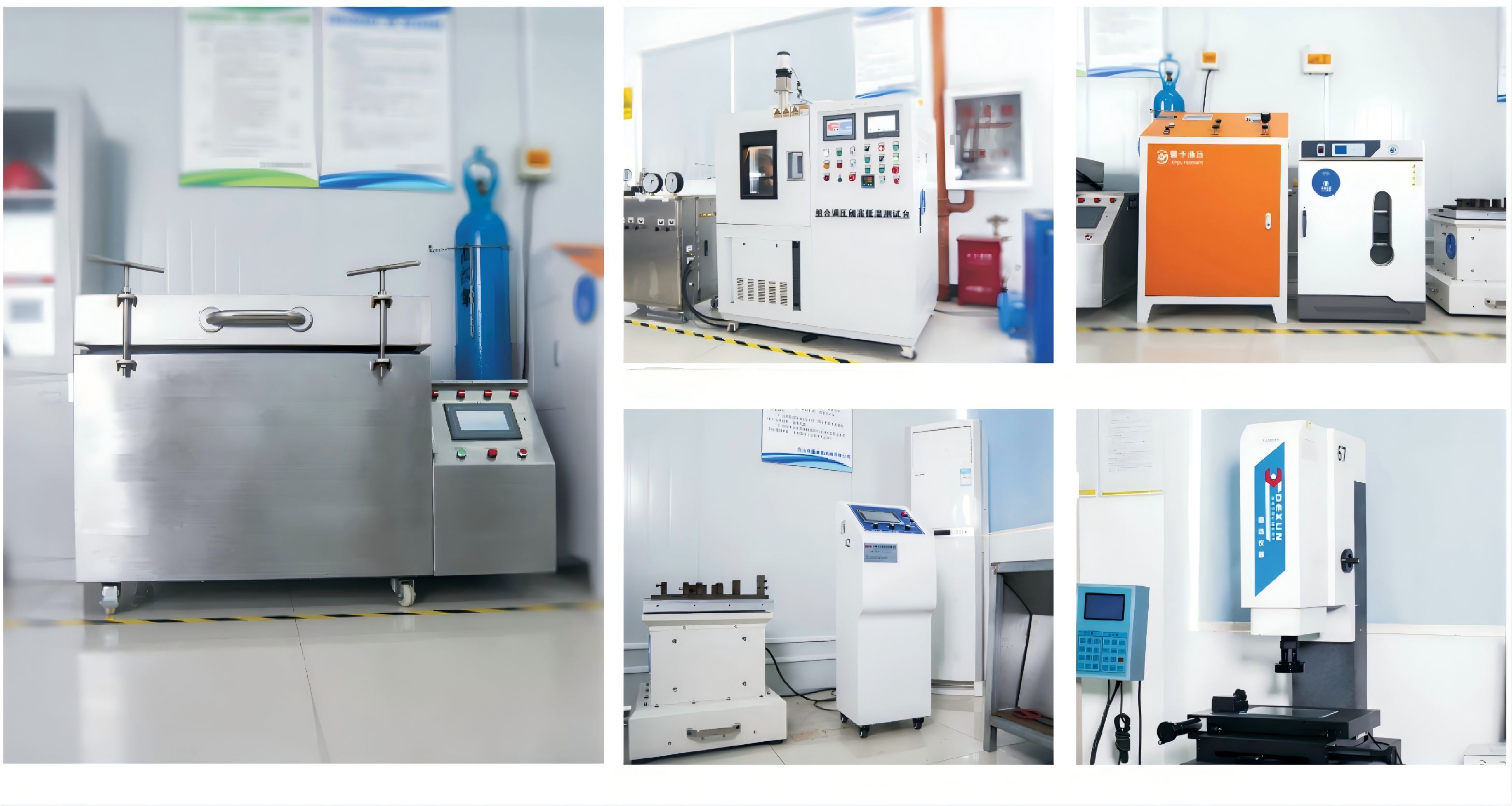
Factory Shoot


|
Application Video
|
Product parameters


| Data Sheet

|
Comment & FAQ
1: Is there any performance difference between DH-15F1 and DH-15F2 beyond the connector dimensions?
A: Flow performance and check function are identical — the bore diameter D is Φ17 mm for both, and the spring, poppet, and seal structure are exactly the same. The only performance difference: F2's seat ID D1 (Φ30) is 4 mm larger than F1's (Φ26), meaning F2's PTFE seal face has a slightly larger area and marginally lower contact pressure at equal differential — still well within the design safety envelope, with no perceptible impact on check-sealing performance. Selection comes down to one question: does your LNG nozzle mate with M30×1.5 or M36×2? Beyond that, the two models are directly interchangeable (both bottom NPT 1/2").
2. Can the check valve be installed upside down (body up, cover down)?
A: Yes. A poppet-type check valve does not rely on gravity for seating — the closing force is provided entirely by the spring. Inverted installation does not affect opening pressure or closing speed. But note: upside down, any residual liquid trapped in the valve cavity may warm up and vaporize after shutdown; the resulting gas will be trapped at the cavity top (now the cover end) and cannot naturally escape — on the next liquid fill, a brief gas-lock may produce a momentarily reduced flow that normalizes after a few seconds. This is not a fault; it is a vapor pocket, and it clears on its own.
3. What happens if the check valve is installed backward? How to confirm flow direction?
A: Installed backward, the valve stays permanently closed — when fluid enters from the intended downstream end (NPT 1/2"), the thrust direction pushes the poppet against the seat rather than lifting it. The harder it pushes, the tighter the seal, zero flow. The DH15F body usually carries a cast arrow marking indicating forward-flow direction. If worn or illegible, remember this rule: the spring side faces downstream — fluid enters past the poppet's conical head (pushing it open), then exits through the spring cavity. The spring always sits on the side the fluid is leaving from.
4. Can this check valve be used for LOX? Any special treatment required?
A: Yes — brass has no ductile-to-brittle transition issue at LOX temperatures; PTFE and 316 are incompatible but the DH15F contains no 316 internals; both poppet and body are brass. However, note that the product description only explicitly covers LNG compatibility — for LOX service, two items must be confirmed: (1) whether the unit was factory-degreased to CGA G-4.1. LNG lines have less stringent grease requirements than LOX. If "Oxygen Clean" was not specified at order, factory default may not be oxygen-grade. Always note O2 CLEAN / CGA G-4.1 on the PO. (2) Secondary contamination during installation. Even if the valve leaves the factory clean, wrench oil, skin oil from hands, or residual cutting fluid on fitting threads can reintroduce grease. LOX check valve installation must be done in a clean environment with degreased tools.
5. How much distance is needed between the DH15F and an upstream shut-off valve?
A: Poppet-type check valves are insensitive to upstream straight-pipe length — they do not open using fluid dynamic pressure (unlike swing-type check valves, which depend on the fluid's forward impact surface on the disc) but instead use static pressure differential to lift the poppet. As long as the upstream line has no severe blockage or partially closed valve, the DH15F can be installed immediately adjacent to an upstream shut-off valve with no straight-run requirement. One exception: if the upstream device is a solenoid valve or pneumatic quick-acting shut-off valve — these open in milliseconds, generating an instantaneous pressure wave (hammer). When the wave reaches the DH15F, it can slam the poppet against the cover. In this case, maintain at least 300 mm of straight pipe between the quick-acting valve and the check valve to attenuate the wave front.
6.Can the DH15F cover be opened for cleaning or internal-part replacement?
A: Yes. The cover threads into the body; removing it allows access to the poppet, spring, and PTFE sealing face. Two details: (1) the PTFE gasket (item 5) must be replaced after cover removal — it was compression-formed during initial assembly and cannot guarantee the same seal after reinstallation; (2) on reassembly, cover torque should not exceed 25 N·m — brass thread torque tolerance is lower than stainless steel; over-tightening can deform threads or even crack the body. Finger-tight plus 1/8 turn is sufficient. For each overhaul, keep one service kit on hand (PTFE seal face + PTFE gasket + spring); the body and poppet normally do not need replacement.

 yongy0223@gmail.com
 +86-17693104145
 Lanzhou New Area, Lanzhou City, Gansu Province, on the second floor to the east of New Harbor Road, to the east of Building Materials Road No. 2, to the west of Qilian Mountain Avenue (Jingqi Road)


