

 |


loading


DQS25B
SLDW
| Size: | |
|---|---|
| Availability: | |
| Quantity: | |
| Product Overview
The DQS25B is a cryogenic T-pattern three-way (3-Way) diverter ball valve engineered for flow routing and relief-device integration in deep-cryogenic systems operating from −196°C to +85°C. As the 25-series (DN25, Φ25 mm bore) member of the DQS diverter family, it delivers the three-way switching logic of the compact DQS15-series at a larger line size for higher-flow service on cryogenic piping, storage vessels, transport trailers, and LNG systems. With a simple quarter-turn (90°) rotation of the manual handle, the T-shaped ball passages redirect the cryogenic flow among the ports—diverting, blending, or isolating flow from a single valve.
The valve covers the full industrial gas spectrum—LOX (liquid oxygen), LIN (liquid nitrogen), LAr (liquid argon), and LNG (liquefied natural gas)—rated for working pressures up to 600 psig (41.37 bar). Its stainless steel body provides cryogenic toughness and corrosion resistance, paired with PCTFE seat rings and a brass seat for the conformable, low-leakage sealing required at −196°C where metal-to-metal seats fail through differential thermal contraction. Graphite packing seals the stem, and the spring-return handle returns the valve to a defined position for repeatable, fail-safe operation.
Several design features matter most in field service. First, the anti blow-out stem is mechanically retained so the stem cannot be ejected by internal pressure—a critical safety requirement for pressurized liquefied-gas service. Second, the full bore (full port) flow path keeps the flow area equal to the line size, minimizing pressure drop and maximizing flow for high-capacity cryogenic transfer. Third, the swivel nut connections allow the inlet/outlet to be rotationally adjusted during installation, easing alignment and protecting the body from torsional stress caused by pipe contraction and expansion.
The DQS25B's most distinctive feature is its integrated relief-device provisions: a top threaded relief-valve port and a bottom rupture-disc connection (with an optional plug configuration for installations without a rupture disc) are built into the T-pattern. Combined with the diverter's flow-routing capability, this allows multiple safety valves or rupture discs to be switched and serviced quickly—permitting fast selection and replacement of relief devices without draining the line, which greatly reduces downtime and product loss. The anti-misalignment handle design with "OPEN"/"CLOSE" markings ensures the handle is always fitted correctly and its position can be read at a glance. Every valve is 100% factory tested and manufactured in compliance with CGA G-4.1 oxygen service requirements, qualifying it for oxygen and medical oxygen applications where material compatibility, cleanliness, and ignition safety are critical.
| Working Principle
A cryogenic diverter ball valve is a multi-port rotary control device. Its core component is a ball with internal passages, mounted on a stem and sealed between seat rings. Rotating the stem rotates the ball; rotating the ball aligns different passages with different ports, switching the flow path. The DQS25B uses a quarter-turn (90°) actuation: each rotation of the manual handle by 90° moves the ball between defined positions, giving fast, repeatable, and visually verifiable switching.
The T-Pattern Three-Way (Diverter) Principle:
The DQS25B's ball carries passages arranged in a T pattern—the classic three-way diverter arrangement. In a T-pattern three-way valve, the ball has an L-shaped or T-shaped internal flow path, and different 90° rotational positions connect the common port to different branches. When the handle is turned to one position, the inlet connects to the first outlet; turned to another position, it connects to the second outlet; in the intermediate/isolating position, flow can be shut off. This is the essence of the "three-way switching" principle: one compact valve replaces two or more two-way valves, letting the operator divert cryogenic flow between branches, blend flows, or isolate a line—reducing leaks, space, and cost in cryogenic manifolds.
Flow Position — Aligned Passages and Full Bore Flow:
When the handle is rotated to a selected position, the ball's T-passage aligns with the chosen ports, and flow passes through. The full bore (full port) design keeps the flow area equal to the line size, so the liquid passes with minimal turbulence and pressure drop—important for high-flow cryogenic transfer where throttling would cause flashing and pressure loss. The PCTFE seat rings and brass seat press against the ball surface, forming the tight, low-leakage seal around the flow path that keeps the closed ports dry and leak-free.
Closed / Isolated Position — Passages Turned Away:
When the ball is rotated to the isolating position, the passage through the ball turns away from the open ports, and the solid face of the ball presents itself to the flow. The seat rings seal against the ball's spherical surface, blocking flow through the closed ports while the selected port remains open—or isolating the entire valve in the fully closed position. This gives the operator both flow diversion and isolation capability from a single handle.
Quarter-Turn Manual Operation, Spring Return, and Anti-Misalignment Handle:
The valve is operated manually: rotating the handle through 90° moves the ball between positions. The spring-return handle returns the valve to a defined (fail-safe) position when released, supporting repeatable and safe operation. The anti-misalignment handle design with "OPEN"/"CLOSE" markings ensures the handle can only be fitted in the correct orientation and that the selected position can be read at a glance, preventing incorrect installation that could mislead the operator about the flow path. The anti blow-out stem keeps the stem mechanically retained within the body under all operating pressures, preventing hazardous stem ejection.
Relief-Device Integration — Top Safety-Valve Port and Bottom Rupture-Disc Port:
The DQS25B's T-pattern body integrates two relief provisions: a top threaded port for mounting a safety/relief valve, and a bottom connection for a rupture disc (with an optional plug configuration for installations without a rupture disc). Using the diverter's flow-routing capability, the operator can quickly switch between multiple safety valves or rupture discs and isolate the branch being serviced while the main flow continues—permitting fast selection, inspection, or replacement of relief devices without draining or venting the system. On cryogenic vessels and transport trailers, where relief devices are safety-critical, this greatly reduces downtime and operator exposure to cryogenic fluid.
Leak-Proof Sealing at Cryogenic Temperature:
At −196°C, metal components contract at different rates, which is why the valve relies on PCTFE for its seat rings: PCTFE remains resilient and conformable at cryogenic temperatures, pressing tightly against the ball to seal even when the metal dimensions shift. The graphite packing seals the stem through thermal cycling, and the brass seat provides a stable, machined seating surface. Together they maintain the leak-tight switching that cryogenic vessels, trailers, and manifolds require across the full −196°C to +85°C range.

|
Factory Shoot


|
Application Video
|
Product parameters


| Data Sheet
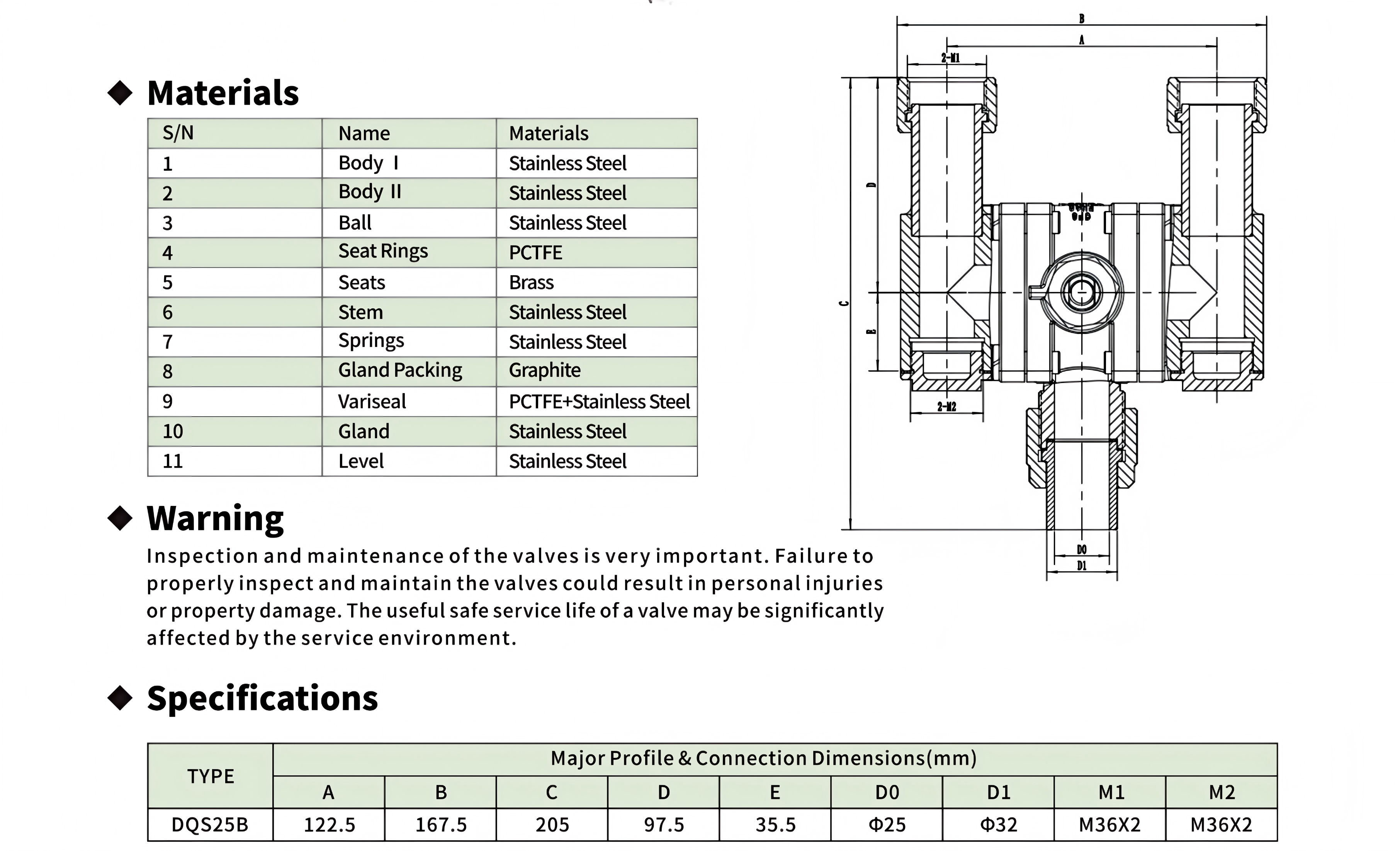
|
Comment & FAQ
1: What is the DQS25B and how does it differ from the DQS15-series diverters?
A: The DQS25B is a cryogenic T-pattern three-way (3-Way) diverter ball valve for multi-port flow routing in deep-cryogenic service. It shares the same core technology as the DQS15-series diverters (quarter-turn ball, anti blow-out stem, full bore, PCTFE seat rings, brass seat, stainless body, −196°C to +85°C, up to 600 psig) but is a 25-series member with a larger bore (DN25, Φ25 mm) sized for higher-flow service on cryogenic piping, vessels, transport trailers, and LNG systems. It also integrates a top relief-valve port and a bottom rupture-disc port in its T-pattern body for quick relief-device switching. Choose the DQS25B where a larger line size and integrated relief provisions are needed; choose the compact DQS15F for lighter, space-constrained manifolds.
2. What does "3-Way T-pattern diverter" mean?
A: "3-Way" means the valve has three connection ports, and "T-pattern" describes how the ball's internal passages are arranged. In a T-pattern three-way valve, the ball carries an L-shaped or T-shaped internal flow path, and different 90° rotational positions connect the common port to different branches: one position routes flow from the inlet to the first outlet, another routes it to the second outlet, and an intermediate position can shut flow off. This lets one valve divert, blend, or isolate cryogenic flow among branches. It is the same "multi-way switching" principle as other diverter valves, configured here in the classic T arrangement—one DQS25B replaces multiple two-way valves, reducing leaks, space, and cost in cryogenic manifolds, vessels, and trailer installations.
3. What are the top relief-valve port and bottom rupture-disc port for?
A: These are integrated relief-device provisions built into the T-pattern body. The top threaded port is designed to mount a safety/relief valve, and the bottom connection is designed to mount a rupture disc (with an optional plug configuration for installations without a rupture disc). Their purpose is twofold. First, they allow the valve to integrate over-pressure protection directly at the switching point, so the protected branch always has a working relief device. Second, combined with the diverter's flow-routing capability, they allow multiple safety valves or rupture discs to be switched and serviced quickly—the branch being serviced can be isolated while the main flow continues, permitting relief-device selection, inspection, or replacement without draining or venting the system. This is especially valuable on cryogenic vessels and transport trailers, where relief devices are safety-critical and downtime is expensive.
4. What are the typical applications of the DQS25B?
A: Typical applications include: flow routing and changeover on cryogenic piping systems, storage vessels, and transport trailers (loading, unloading, and vaporizing-system changeover); LNG systems—directing LNG to a selected tank, vaporizer, or loading arm; cryogenic manifold flow routing, where one valve replaces multiple two-way valves; multi relief-device integration—using the T-pattern's top safety-valve port and bottom rupture-disc port, together with branch isolation, to switch and service relief devices without draining; and oxygen/medical oxygen transfer lines, thanks to its CGA G-4.1 compliance. In short, any DN25 cryogenic system that needs to switch, divert, or isolate flow among branches—and keep its safety valves and rupture discs serviceable without draining—from −196°C to +85°C and up to 600 psig, is a fit for this valve.
5. What is an anti blow-out stem and why is it critical?
A: An anti blow-out stem is a stem whose shoulder is mechanically trapped inside the valve body, so internal pressure cannot push the stem out of the valve. In cryogenic service this is critical because the media is a liquefied gas under high pressure: a conventional stem held only by a gland can be ejected if the gland loosens under thermal cycling or vibration, releasing a violent jet of liquid that flashes to gas and can cause severe injury, equipment damage, and fire hazards. The DQS25B's stem is retained by design, guaranteeing the stem stays in place even if the packing is compromised. This is a fundamental safety requirement for pressurized cryogenic service, especially on transport trailers where vibration is continuous.
6. What are swivel nut connections and why do they help in cryogenic installation?
A: Swivel nut connections are inlet/outlet joints that can be rotationally adjusted during installation—the connection hardware rotates to align with the mating pipework before being tightened. This matters in cryogenic systems for two reasons. First, it eases alignment: the installer can rotate the connections to match the pipe axis without bending the valve or forcing the pipe, simplifying installation and saving time. Second, it prevents torsional stress: thermal contraction and expansion in cryogenic piping create large load paths, and a fixed connection forces these loads through the valve body. A swivel lets the connection absorb the rotation, protecting the body from stress-induced distortion or failure—particularly important on vessels and transport trailers where the connected piping moves with thermal cycles and road vibration.

 yongy0223@gmail.com
 +86-17693104145
 Lanzhou New Area, Lanzhou City, Gansu Province, on the second floor to the east of New Harbor Road, to the east of Building Materials Road No. 2, to the west of Qilian Mountain Avenue (Jingqi Road)


