

 |


loading


DJ61F-40P
SLDW
| Size: | |
|---|---|
| Availability: | |
| Quantity: | |
| Application Overview
The model number still reads DJ61F-40P — identical to the P1 written in the previous round — but this is the P series' all-stainless variant. Body, bonnet, and bonnet nut are all ASTM A351 CF8 cast stainless steel, no longer using brass at the bonnet and nut positions as P1 does. This is a materials split within the DJ61F-40P platform: P1 takes the cost-efficiency route (pressure-bearing stainless, non-pressure-bearing brass); P takes the all-stainless route (all metal parts in stainless). Both share identical weld-end geometry, top-entry serviceable design, PCTFE soft seat, Cv 5/14 flow grading, and 580 PSI pressure class.
Why two materials strategies? The answer lies in corrosion environments and certification costs. P1 (stainless + brass hybrid) performs well in dry LN₂/LAr/LNG boil-off gas environments — these media are inert, and a brass bonnet faces no chemical corrosion. But in coastal LNG receiving terminals or chemical park settings, atmospheric salt spray or trace acid gases (SO₂, H₂S) attack the brass surface — selective dezincification of brass goes from "won't appear in a decade" to "reddish copper spotting in two years." The P series' all-stainless approach eliminates this weak point — bonnet and bonnet nut converted to CF8, fully homogeneous with the body material, simultaneously eliminating galvanic corrosion and selective dezincification, stepping up the valve's weathering life and adaptability to corrosive atmospheric environments.
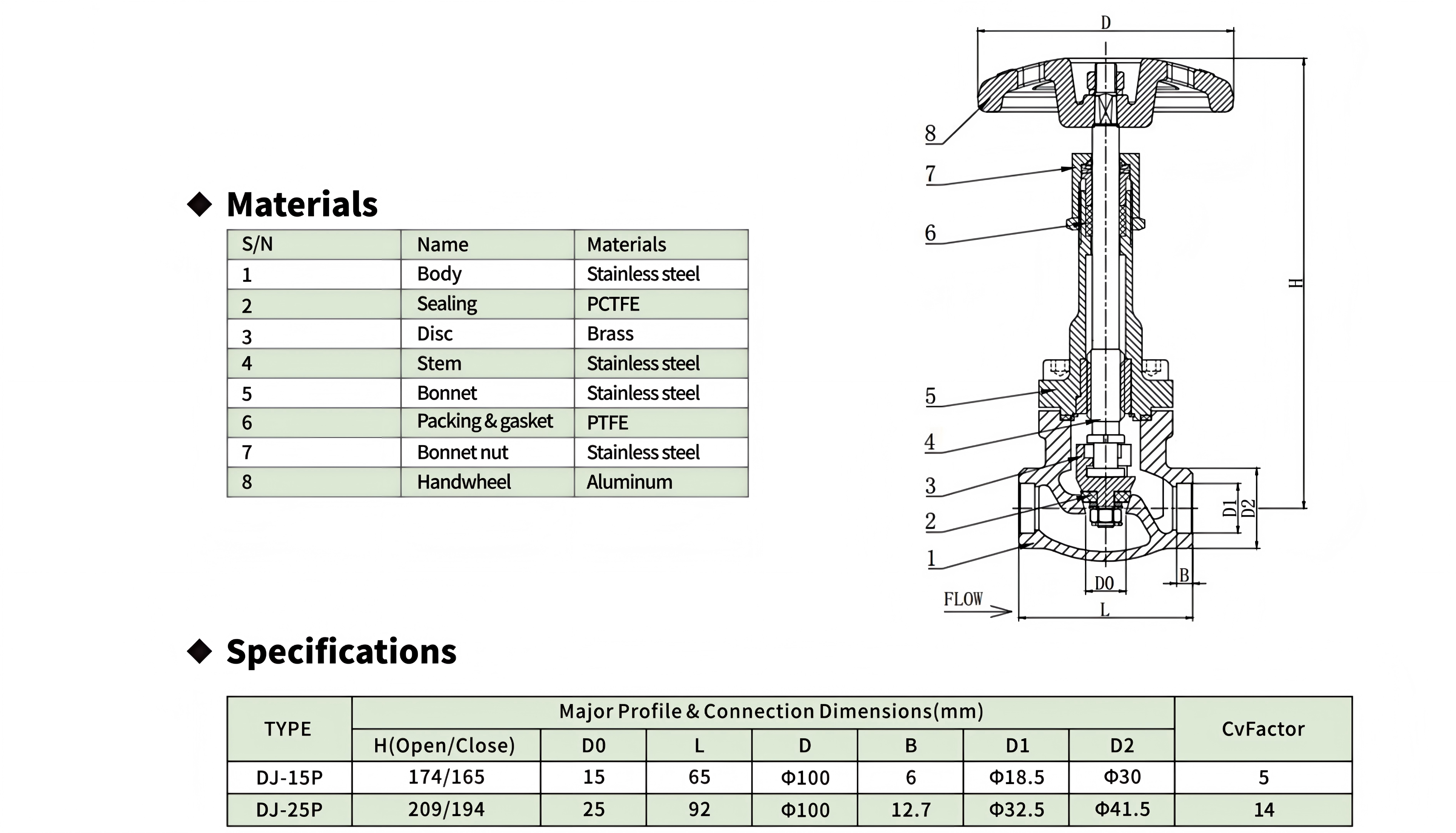
The two sub-models DJ-15P (DN15, Cv=5) and DJ-25P (DN25, Cv=14) share identical interface dimensions (L/D0/D/D1/D2), flow coefficients, and pressure-temperature ratings with the P1 series DJ-15P1/DJ-25P1 — meaning P and P1 can be drop-in swapped on the same line. Materials upgrade without piping modification.
| Working Principle
Three engineering consequences of full stainless steel
The DJ61F-40P (P Series) shares the same actuation mechanism as the P1 series — handwheel rotation → stem axial travel → brass disc taper contacts or separates from the PCTFE seat. Weld ends, top-entry serviceable architecture, geometrically scaled flow-path design — these are all shared functional layers between P and P1. The P series' core change happens at the materials layer, with three engineering consequences worth unpacking.
Consequence 1: galvanic corrosion risk removed from bonnet threads. The P1's stainless body + brass bonnet combination is safe in dry inert gas environments — a galvanic potential difference of only ~0.15V between the two, with near-zero corrosion rate in the absence of electrolyte. But if the valve is installed on an outdoor pipe rack, the body-bonnet thread gap can develop condensation from day-night temperature cycling — liquid water enters as electrolyte, and selective dezincification of the brass (anode) begins. The P series' stainless bonnet + stainless body is same-material, zero potential difference — even with long-term standing water in the thread gap, no galvanic corrosion driver exists. For coastal LNG receiving terminals and outdoor pipe-rack applications, this is a structural long-term reliability upgrade.*
Consequence 2: the larger B (flange thickness) value — not a typo, a design choice. DJ-25P's B=12.7 mm vs. DJ-25P1's B=8 mm. 12.7 mm is exactly 1/2 inch — likely corresponding to an ANSI 150# flange dimension. This is not the P series being "thicker"; rather, the P1 series' brass bonnet scheme made B thinner at DN25 (because the brass bonnet's threaded engagement length needed to match a thinner bonnet flange), while the P series' all-stainless approach can directly adopt the standard flange thickness. A 12.7 mm flange thickness provides greater thermal mass and lower welding-distortion risk during weld installation.*
Consequence 3: the all-stainless bonnet's greater thermal mass provides more generous temperature management during welding. Brass thermal conductivity is ~109 W/(m·K); stainless 304 is ~16 W/(m·K) — nearly 7× difference. When welding heat travels upward along the bonnet, the brass bonnet (P1) rapidly carries heat to the packing area — without active cooling control, PTFE packing can exceed rated temperature within seconds. The stainless bonnet (P) conducts heat far more slowly, producing a gentler packing-area temperature rise and providing a wider safety window for welding procedure. In field installations with constrained conditions (e.g., no circulating water cooling, only passive wet-rag cooling), the P series holds a distinct advantage in this regard.*
P vs. P1: two materials strategies on one platform.
From a product-matrix perspective, P and P1 are not upgrade/legacy — they are two materials strategies on the same platform, analogous to choosing between 304 and 316L stainless. P1 is positioned for indoor tank bays, dry pipe galleries, vaporizer downstream — mild environmental conditions, cost-sensitive procurement. P is positioned for outdoor pipe racks, coastal terminals, chemical parks — severe environmental conditions, long-term reliability priority. Both strategies use identical installation envelopes and piping interfaces — fully interchangeable.*

|
Factory Shoot


|
Application Video
|
Product parameters


| Data Sheet
|
Comment & FAQ
1: How much more does P cost vs. P1? Is the premium worth it?
A: The DJ61F-40P all-stainless scheme (P series) versus the brass-bonnet scheme (P1 series) has a material-cost increase mainly from two stainless bar-stock pieces — one for the bonnet, one for the bonnet nut. CF8 cast stainless billet cost is roughly 1.5–2× brass; machining cost is similar (both are free-machining materials); assembly cost is identical. Total manufacturing cost difference typically falls in the 15%–25% range.
Whether it's worth it depends on the valve's replacement cost upon failure. If the valve is installed on an indoor clean pipe gallery, shut-down-and-replace in 30 minutes with easy access — P1 is fully adequate. If the valve is installed in a location requiring scaffolding, hot-work permits, and a half-day shutdown to replace (e.g., a 12-meter elevated platform on a trailer loading arm), one replacement's indirect cost (downtime loss + labor + scaffolding + NDT) can be 50–100× the valve purchase price. The decision logic in such cases is straightforward: the P series' all-stainless bonnet lets the valve run five extra years before needing its first seal replacement, whereas P1's brass bonnet may develop thread corrosion earlier in salt-spray environments, increasing replacement frequency. Quick math: assume valve purchase at ¥2,000 (P1) vs. ¥2,500 (P), one replacement's total cost at ¥50,000 (downtime + labor + consumables). If the P series' ¥500 premium defers one replacement, ROI is 9,900%. The caveat: the environment must genuinely be corrosive — in dry indoor settings, the two have near-identical service lives and the premium produces no return.
2.What does B=12.7 mm (DJ-25P) actually mean for welding?
A: The flange thickness increase from 8 mm (P1) to 12.7 mm means three actionable improvements: interpass temperature control — cooling time between butt-weld passes is proportional to base-metal thermal mass; 12.7 mm flange has ~60% greater heat capacity than 8 mm, reducing the wait for interpass temperatures to drop below the limit (typically 150°C). Angular distortion resistance — weld shrinkage during butt welding bends the flange face (angular distortion); the thinner the flange, the worse. A 12.7 mm flange's bending stiffness is roughly (12.7/8)³ ≈ 4× that of 8 mm — for the same welding parameters, angular distortion is about 1/4 of P1's. Butt-weld gap tolerance — the 12.7 mm end face is thicker, providing more material for pre-weld dressing and leveling; if the pipe cut is not perfectly square, those extra 4.7 mm are your adjustment margin.
3. Why is the P series disc still brass? Why not go stainless and make it truly "all-stainless"?
A: This is a deliberate functional choice. PCTFE soft-seal sealing relies on a hard-soft pair: the soft seat (PCTFE) + a slightly harder but still compliant disc. Brass disc hardness is ~80–100 HB; stainless is ~150–200 HB. Under repeated closing impact loading, a brass disc taper undergoes controllable micro-plastic deformation, forming complementary conformal contact with the PCTFE sealing face for uniformly distributed sealing pressure. Switch to a stainless disc and hardness doubles — the disc taper no longer deforms plastically, and the PCTFE sealing face absorbs all deformation alone, essentially shoving the seal system's entire "bedding-in" burden onto the PCTFE side. The long-term consequence: deeper ring-shaped indentations on the PCTFE seat, faster loss of recovery, shorter seal life.
This is not theoretical — field experience in industrial cryogenic valve engineering has validated this rule of thumb: PCTFE + brass disc yields ~5–8 years of room-temperature gas-tight life under periodic cycling; PCTFE + stainless disc yields ~3–5 years. So at this specific friction-pair position, brass is not a cost-cutting measure — it is a seal-life-extending material-selection strategy.
4. The DJ61F-40P has a stainless body and brass bonnet — won't they seize after long-term service?
A: This is a question the engineer must answer at the design stage. The galvanic potential difference between stainless steel and brass is about 0.15V; in dry environments, the galvanic corrosion rate is extremely low — brass-to-stainless threaded joints with over ten years of field service have been disassembled to find bright thread surfaces. However, if the valve is shut down in a humid environment (e.g., line drained, internal condensation forming, moisture penetrating the body-to-bonnet thread gap), the brass may undergo selective dezincification — reddish-brown copper-colored spots on thread surfaces, enlarged thread clearances. The DJ61F-40P's countermeasure is a factory-applied layer of oxygen-compatible anti-seize grease on the body-bonnet thread faces. This grease simultaneously serves three functions: blocks moisture, reduces thread tightening torque, and protects the brass threads from being galled by the stainless threads during disassembly. If the valve has been idle for an extended period and needs re-servicing, before loosening the nut, drip a few drops of anhydrous ethanol onto the threads to soak (not WD-40 — prohibited for oxygen service), wait several minutes, then proceed.
5. Are DJ-15P and DJ-15P1 interchangeable? Are mounting bolt holes and flange faces identical?
A: Yes, interchangeable. DJ-15P and DJ-15P1 share identical interface dimensions: D0=Φ15, L=65, D=Φ100, D1=Φ18.5, D2=Φ30. The two are identical in all connection dimensions — swap requires no pipe modification, no reducer, no re-welding. The only difference is the DJ-15P's total height (H) being roughly 4–5 mm shorter than the DJ-15P1 (174/165 vs. 179/169), a minor height variation from the stainless bonnet's machining process — small enough to avoid interference with surrounding structures in the vast majority of piping configurations. DJ-25P vs. DJ-25P1 are similarly interchangeable, identical interfaces (D0=Φ25, L=92, D=Φ100, D1=Φ32.5, D2=Φ41.5).

 yongy0223@gmail.com
 +86-17693104145
 Lanzhou New Area, Lanzhou City, Gansu Province, on the second floor to the east of New Harbor Road, to the east of Building Materials Road No. 2, to the west of Qilian Mountain Avenue (Jingqi Road)


