| Product Overview
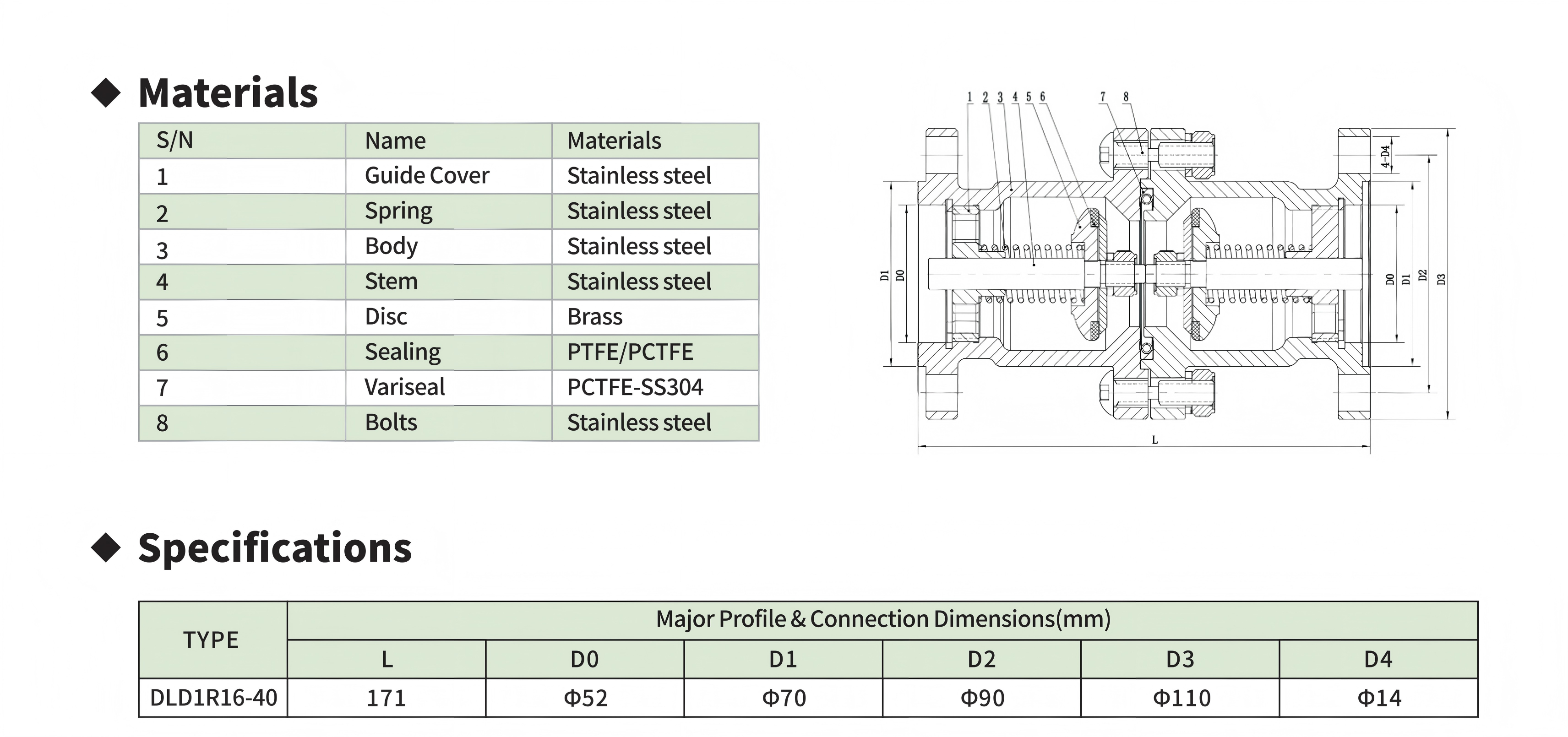
The DLD1R16040 is a cryogenic breakaway coupling (emergency release coupling) — a safety device installed in a liquid cryogen transfer line to protect personnel, equipment, and the environment in the event of an accidental pull-away. It is a double-valve design: both ends contain an automatically closing valve, so when the coupling is forcibly separated, both halves seal off instantly, minimizing or eliminating the spill of LNG, LOX, LN2, or other cryogenic media. The coupling is constructed with a stainless steel body (ASTM A182) and features spring-loaded valve discs with PCTFE/PTFE sealing elements, delivering reliable sealing at cryogenic temperatures. Rated for a maximum working pressure of 580 PSIG (4.0 MPa) with a Φ70 mm coupling bore, it connects to piping via flanged ends. It is manufactured in compliance with CGA G-4.1 (oxygen-service cleanliness) and tested per GB/T 38520 and GB/T 13927, ensuring safe, leak-free performance. By acting as a controlled failure point, the DLD1R16040 converts a potentially dangerous uncontrolled line separation into a controlled, sealed disconnection.
| Working Principle
The breakaway coupling is designed to allow normal flow during routine operation, but to separate into two sealed halves when an excessive tensile force is applied. Its core components are two spring-loaded valve assemblies (one at each end), PCTFE/PTFE sealing seats, and a mechanical frangible/retention structure that holds the two halves together under normal service loads.
Normal operation (flowing state):
The two coupling halves are held together by the retention mechanism. Both internal valves are held open by the assembled coupling, so cryogenic liquid flows freely through the bore from one side to the other with minimal pressure drop.
Breakaway activation (over-pull condition):
When the transfer line is pulled beyond the design force — for example, if a tanker truck drives away while still connected, or a hose is snagged — the retention structure reaches its separation threshold and the coupling breaks apart at the designed separation plane.
Instantaneous sealing (both ends):
At the moment of separation, each half's spring-loaded valve disc is released and driven onto its PCTFE/PTFE seat by spring force. Both valves close almost simultaneously, sealing the two ends independently. This double-valve sealing action prevents cryogenic liquid from spraying out of either side, protecting personnel from cold burns and reducing product loss and vapor generation.
Reconnection:
After a breakaway event, the two halves can be inspected and re-assembled with fresh sealing elements (as applicable per the manufacturer's instructions), restoring the line for continued service.

|
Factory Shoot
1: What is the DLD1R16040 and what is it used for?
A: The DLD1R16040 is a cryogenic breakaway coupling (emergency release coupling) installed in liquid cryogen transfer lines. It is used to protect personnel, equipment, and the environment when an accidental pull-away occurs — for example, when a tanker truck drives away while still connected, or a loading hose is over-pulled. Both halves close automatically and seal off the line upon separation, preventing cryogenic liquid spillage.
2. How does the double-valve sealing work?
A: The coupling contains a spring-loaded valve assembly in each half. During normal operation both valves are held open so media flows through. When the coupling separates under excessive tension, each valve disc is released and driven onto its PCTFE/PTFE seat by spring force, closing both ends almost simultaneously. This double-valve action independently seals both sides, minimizing product loss and preventing spray of cryogenic liquid.
3. What are the working pressure and bore size?
A: The DLD1R16040 has a maximum working pressure of 580 PSIG (4.0 MPa) and a coupling bore of Φ70 mm. Verify the exact rating with the manufacturer's datasheet before installation.
4. What materials are used in the DLD1R16040?
A: The body is made of ASTM A182 stainless steel for strength and low-temperature toughness, with PCTFE/PTFE used for the valve sealing elements to provide reliable sealing at cryogenic temperatures.
5. What standards does the DLD1R16040 comply with?
A: The DLD1R16040 is manufactured with CGA G-4.1 (oxygen-service cleanliness) and tested in accordance with GB/T 38520 and GB/T 13927. These cover cleanliness for oxygen service and general pressure/leak testing of valves.
6. Does the DCK40 meet any national standards? How is the coupling connected to the piping?
A: The coupling is connected by flanged ends, each with bolt holes for bolting to mating pipe flanges. This provides a rigid, repeatable, and leak-tight connection suitable for transfer-line service.
7. How should a breakaway event be handled?
A: After a breakaway, follow these steps: (1) isolate the line and confirm both halves have sealed; (2) safely purge and warm the affected sections as per site procedure; (3) inspect both halves for damage; (4) replace sealing elements as recommended by the manufacturer; (5) re-assemble and leak-test the coupling before returning to service. Always follow the manufacturer's manual.
8. Can the coupling be reused after separation?
A: Yes, in most cases the DLD1R16040 can be re-assembled after inspection. The two halves are designed to be reconnected; sealing elements should be inspected and replaced as needed, and the coupling leak-tested, before the line is returned to service. Always follow the manufacturer's re-use instructions.


 yongy0223@gmail.com
 +86-17693104145
 Lanzhou New Area, Lanzhou City, Gansu Province, on the second floor to the east of New Harbor Road, to the east of Building Materials Road No. 2, to the west of Qilian Mountain Avenue (Jingqi Road)