

 |


loading


DXK-40
SLDW
| Size: | |
|---|---|
| Availability: | |
| Quantity: | |
| Product Overview
The DXK40 is a cryogenic charging quick-connect joint (charging joint)—a dedicated liquid-fill coupling designed to connect a cryogenic filling line to a cryogenic storage vessel, tank, or filling station under controlled, leak-tight conditions. It is the connection point through which liquid cryogen (LOX, LIN, LAr, LNG) is charged into a vessel, engineered for the deep-cryogenic temperature range and the cleanliness requirements of industrial gas service. With a DN40 nominal bore (Φ40 mm feature size) and a stainless steel construction, it is built for reliable, repeated filling operations at working pressures up to 4.0 MPa.
The joint is designed as a flange-mounted assembly so it can be secured to a vessel neck, tank connection, or filling-line panel. Its base carries four mounting bolt holes, letting the installer fix it firmly in place with standard bolting; the rigid flange mounting guarantees stable alignment of the filling connection and prevents loosening under repeated coupling cycles and vibration. The spring-loaded, push-button seal mechanism at the top provides positive opening and closing of the fill passage: pressing the spring-loaded cover/seal opens the flow path for charging, and releasing it allows the spring to return the seal to the closed position, giving a fast, convenient, and repeatable connect/disconnect action.
Two features address the real-world needs of cryogenic filling. First, the dust-cap with lanyard protects the open end of the joint when it is not connected: the dust cover keeps out moisture, dirt, and contaminants that could otherwise freeze, contaminate the product, or cause contamination in oxygen service—and the lanyard keeps the cap attached and ready to use. Second, the joint's design supports the clean, dry, leak-tight connection that cryogenic filling demands, where any leak would vent valuable product or draw in atmospheric moisture that freezes and blocks the line.
The DXK40 is manufactured in accordance with GB/T 24925 (Chinese cryogenic valve general specification) and is available with CGA G-4.1 oxygen-service cleaning, qualifying it for oxygen and medical-oxygen filling where material compatibility, cleanliness, and ignition safety are critical. Every unit is 100% factory tested to confirm pressure integrity and leak-tightness before shipment.
| Working Principle
A cryogenic charging joint is a coupling device that connects a filling source to a vessel and controls the passage of liquid cryogen during charging. Unlike a fully rotating or permanently welded fitting, it is designed as a connectable, sealable interface: mounted on the vessel side, it receives the filling-line coupler, provides a leak-tight path during the charge, and protects itself when idle. The DXK40 realizes this with a flanged base, a spring-loaded push-button seal, and a dust-cap lanyard.
Mounting and Alignment:
The joint is fixed to the vessel neck or filling panel through its flanged base with four mounting bolt holes. The flange provides a rigid, repeatable mounting datum so that the joint's axis is always correctly aligned with the mating coupler. This alignment is essential for a good seal: a misaligned connection distorts the sealing surfaces and causes leaks under pressure.
Opening the Fill Passage (Push-Button Principle):
At the top of the joint, the spring-loaded, push-button seal mechanism closes the fill passage when idle and opens it when actuated. To charge, the operator presses the spring-loaded cover/seal (or connects the mating coupler, which actuates the mechanism), compressing the spring and lifting the seal to open the bore. Liquid cryogen then flows through the open passage from the filling line into the vessel. When charging is complete, releasing the pressure on the mechanism lets the spring push the seal back to the closed position, sealing the passage and stopping the flow. This spring-return action gives fast, positive open/close behavior that is easy to operate and inherently returns to the safe closed state.
Sealing During the Charge:
While the passage is open, sealing is maintained at the joint interfaces: the spring-loaded seal presses against its seat under spring force, and the connected coupler/interface completes the pressure boundary. The joint is engineered to hold the working pressure (up to 4.0 MPa) without external leakage, so the full flow reaches the vessel with no product loss and no air ingress.
Protection When Idle (Dust-Cap and Lanyard):
When the joint is not connected, the dust cap closes over the open end and is retained by the lanyard. The cap keeps out moisture, dirt, and contaminants, preventing ice formation and contamination of the fill bore—critical both for flow reliability and for oxygen-service cleanliness. On the next charging operation, the operator removes the cap (kept within reach by the lanyard), connects the coupler, and presses the seal open to begin filling.
Pressure Integrity and Quality Verification:
Every DXK40 is 100% factory tested to verify pressure integrity and leak-tightness. Manufactured to GB/T 24925 and available with CGA G-4.1 oxygen-service cleaning, the joint delivers the reliable, contamination-free, leak-tight liquid-fill connection that LOX, LIN, LAr, and LNG filling operations require.

|
Factory Shoot


|
Application Video
|
Product parameters


| Data Sheet
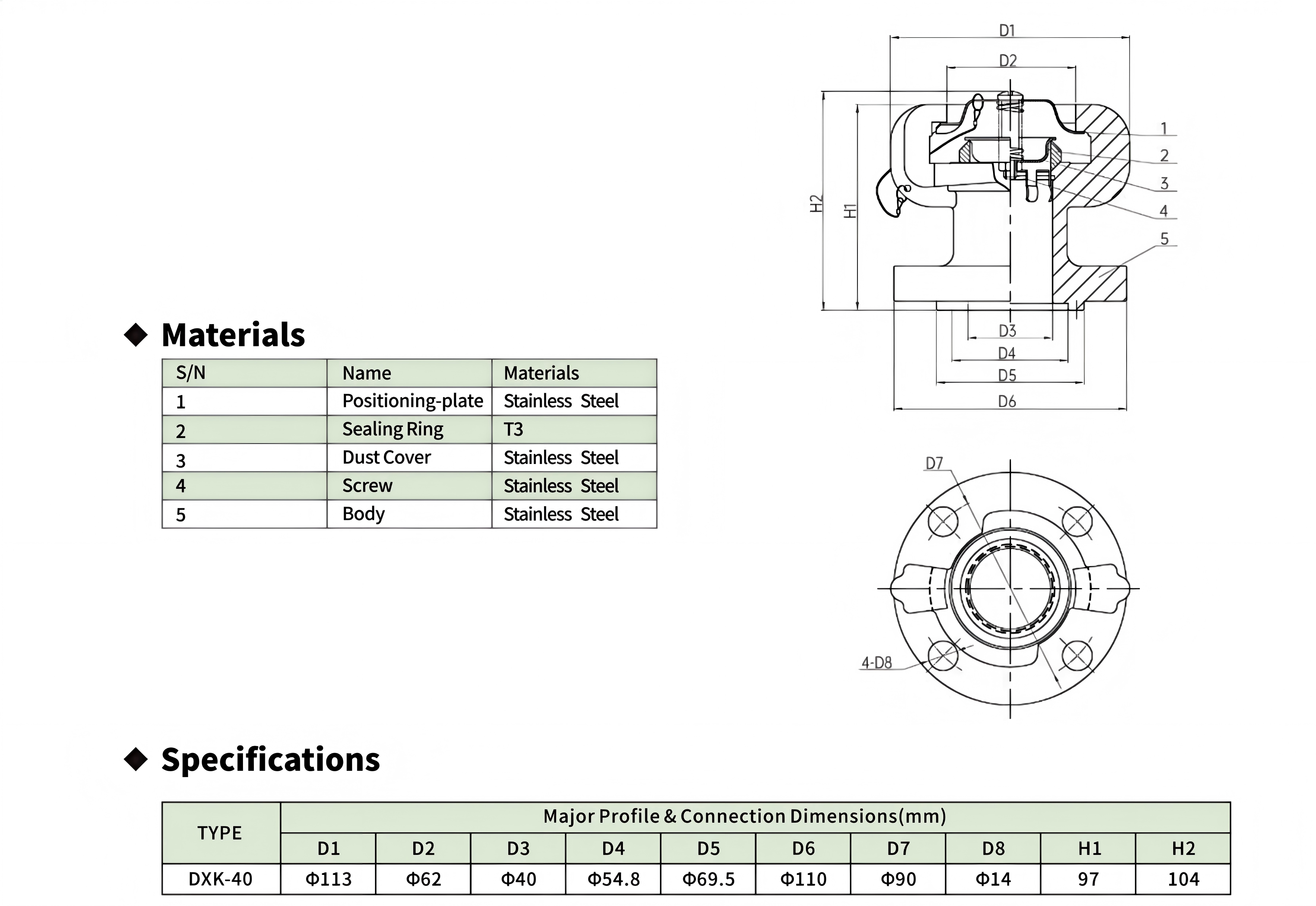
|
Comment & FAQ
1: What is the DXK40 and why is it called a "charging joint"?
A: The DXK40 is a cryogenic charging quick-connect joint (charging joint)—a flange-mounted, sealable coupling used to connect a cryogenic filling line to a storage vessel or tank for liquid filling. It is called a "charging joint" because its function is to charge (fill) liquid cryogen such as LOX, LIN, LAr, or LNG into a vessel: it provides a leak-tight passage while filling and protects itself when idle. It has a DN40 nominal bore, a stainless steel body, a flanged base with four mounting bolt holes, and a spring-loaded, push-button seal with a dust-cap lanyard. It is rated for working pressures up to 4.0 MPa, is manufactured to GB/T 24925, and is available with CGA G-4.1 oxygen-service cleaning.
2. How is the DXK40 installed?
A: The DXK40 is installed as a flange-mounted assembly. Its base carries four mounting bolt holes, so it is bolted to the mating flange of a vessel neck, tank connection, or filling-line panel using standard fasteners. Installation should: (1) use a flange gasket and bolting suitable for cryogenic service and the 4.0 MPa working pressure; (2) align the joint so no bending or torsional stress is imposed on the body; (3) tighten the four bolts evenly to the specified torque to ensure a uniform seal; (4) support the adjacent piping so no stress transfers to the joint; (5) after installation, perform a leak test per the manufacturer's procedure before first use. For oxygen service, maintain CGA G-4.1 cleanliness during handling and installation.
3. How does the spring-loaded push-button seal work?
A: The spring-loaded, push-button seal mechanism is the joint's opening/closing device at the top of the body. When the joint is idle, the spring holds the seal in the closed position, sealing the fill bore and preventing any flow or contamination. To charge, the operator presses the spring-loaded cover/seal (or connects the mating coupler, which actuates the mechanism): this compresses the spring and lifts the seal to open the bore, allowing liquid cryogen to flow from the filling line into the vessel. When charging is complete, releasing the pressure lets the spring return the seal to the closed position, stopping the flow and re-sealing the joint. The spring-return design gives fast, positive open/close action and inherently returns to the safe closed state.
4. What is the dust-cap lanyard for?
A: The dust-cap lanyard serves two purposes. First, it keeps the dust cap attached to the joint at all times, so the cap cannot be lost or misplaced between fills. Second, it keeps the cap immediately available when the operator is about to connect or disconnect the filling line. The dust cap itself protects the open end of the joint when it is not connected: it keeps out moisture, dirt, and contaminants that could freeze, contaminate the product, or cause contamination—especially important in oxygen service. With the lanyard, the operator removes the cap, connects the coupler, fills, disconnects, and replaces the cap in a quick, orderly sequence without hunting for a loose component.
5. What are the typical applications of the DXK40?
A: Typical applications include: connecting a filling line to cryogenic storage vessels and tanks for liquid LOX, LIN, LAr, and LNG charging; vessel/tank filling stations where a repeatable, leak-tight fill connection is required; filling-line quick connections where the line is coupled and uncoupled repeatedly; and oxygen / medical-oxygen filling, thanks to the available CGA G-4.1 oxygen-service cleaning. It is a fit wherever a cryogenic vessel needs a flange-mounted, DN40 liquid-fill connection with spring-loaded sealing and dust protection at working pressures up to 4.0 MPa—combining clean, leak-tight charging with fast, convenient operation and reliable idle protection.
6. What should I consider during filling operations?
A: General considerations: (1) confirm the joint and vessel are within the rated working pressure (max 4.0 MPa) before opening the fill passage; (2) keep the dust cap in place until immediately before connection, and replace it right after disconnection, to keep the bore clean and dry; (3) open the fill passage (press the spring-loaded seal / connect the coupler) in a controlled manner to limit surge and flash-gas generation; (4) monitor the vessel level and stop the charge when the target level is reached—do not overfill; (5) after disconnection, check the seal closes positively and the bore is dry before replacing the dust cap; (6) use dry, clean connections and purge lines to keep moisture out of the cryogenic system; (7) for oxygen service, follow CGA G-4.1 cleanliness and handling requirements. Always follow your site procedures and the manufacturer's manual.

 yongy0223@gmail.com
 +86-17693104145
 Lanzhou New Area, Lanzhou City, Gansu Province, on the second floor to the east of New Harbor Road, to the east of Building Materials Road No. 2, to the west of Qilian Mountain Avenue (Jingqi Road)


