

 |


loading


DJ61F-40P
SLDW
| Size: | |
|---|---|
| Availability: | |
| Quantity: | |
| Application Overview
By the fourth round of DJ61F-40P documentation, each series carries a clear identity marker. P1 is the first production platform — stainless body + brass bonnet + screw connection. P is the all-stainless screw-bonnet upgrade. G/D is the −40°C cold-gas bolted-bonnet large-bore branch. The D series' marker is three words: extended, deep-cryogenic, liquid-phase.
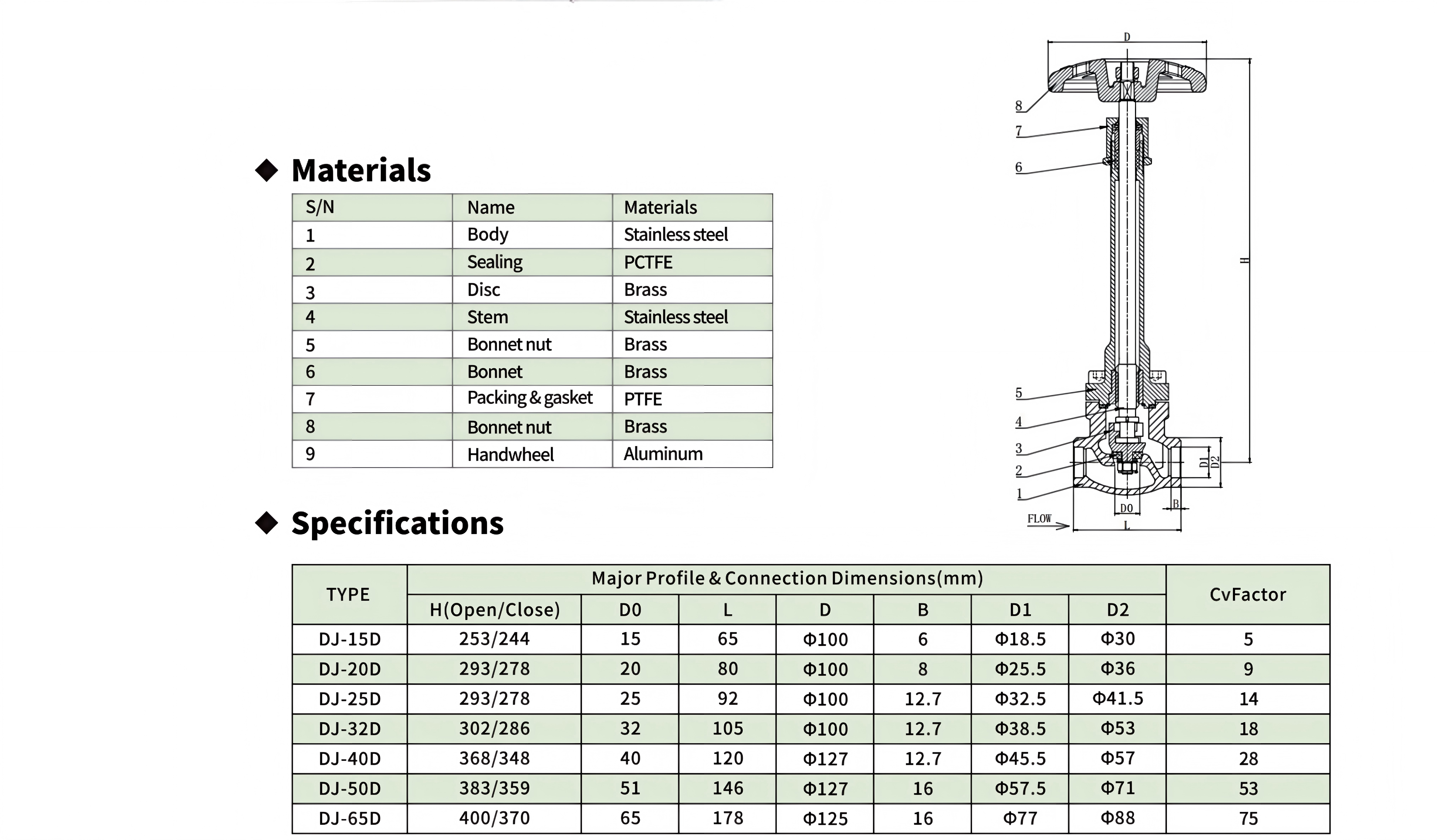
"Extended" is this image's central word. What's extended is not just the overall height but the brass bonnet extension between the body flange face and the handwheel. D series H values exceed G/D series at the same bore by roughly 100–120 mm: DJ-15D at 253 mm open vs DJ-15G at 154 mm. That extra ~100 millimeters is not waste — it creates a sufficiently long thermal isolation path between the body and the stuffing box, solving a fundamental contradiction every deep-cryogenic valve must confront: inside the body is liquefied gas at −198°C; atop the stem, the handwheel is operated by personnel at ambient temperature; only tens of centimeters of metal and a few seals separate them. If the bonnet is too short, cold conducts through the metal to the packing zone; PTFE packing below −100°C shrinks and embrittles rapidly and the seal fails. An extended bonnet lengthens the conduction path and increases thermal resistance, keeping the packing zone above 0°C — this design principle is known in the cryogenic valve industry as the "cold box extension" or "thermal standoff."
The second core feature is brass bonnet and bonnet nut. This is a unique material decision within the DJ61F-40P family. The P series uses stainless (CF8) bonnets; P1 uses brass bonnet but stainless bonnet nut; G/D series uses all-stainless bolted bonnet. The D series: stainless body + brass bonnet + brass bonnet nut — both bolted interfaces are brass. Three engineering reasons for brass bonnet. First, the extended bonnet requires deep-hole machining — from the body flange face to the handwheel connection, a hollow bar longer than a hand must be internally bored for the stem passage and stuffing-box cavity. Brass machinability is far superior to CF8 (brass's machining index ~3–4× that of CF8), a meaningful cost and quality-control lever for volume production of extended bonnets. Second, the stem's anti-galling performance in a stainless-brass thread pair exceeds that of stainless-stainless. The D series stem (stainless) rotates up and down thousands of times inside the brass bonnet bore — the risk of cold welding and seizure in a steel-steel thread interference pair is significantly higher than in a steel-brass pair. Third, the bonnet nut is also brass, creating an all-brass bolted joint between nut and bonnet — bolt preload distributes more uniformly between identical materials, avoiding localized overload from thermal expansion coefficient mismatch.
Temperature range −198°C to +85°C; medium explicitly includes "Liquefied and vaporized atmospheric gases, LNG, LO2, LN2, LAr" — a full deep-cryogenic liquid-phase valve. The application scenario shifts from G/D's "vaporizer downstream" directly to "trailer, bulk-tank and piping system" — tank outlets, liquid loading arms, LNG tanker bottom piping — these are the D series' positions.
Seven sub-models DJ-15D to DJ-65D, Cv from 5 to 75, sharing the identical bore sequence and Cv values with the G/D series — meaning the two series are fully interchangeable at the pipe-flange interface. The difference: D series' long bonnet carries the same flow capacity down to −198°C.
| Working Principle
Thermal standoff: the physics of the extended bonnet
Over ninety percent of cryogenic valve packing failures are not due to PTFE aging or wear but because the packing freezes. PTFE is soft and elastic at room temperature; it begins to stiffen at −50°C, then shrinks and embrittles rapidly below −100°C. Sealing-face contact stress can drop over 50% after a single cold cycle. If the bonnet is short, cold conducts from the body to the stuffing box through a short path — the temperature difference along the conduction path exceeds 200°C (body at −198°C, ambient air at +20°C), but the heat flow along the brass wall is large, and the stuffing-box temperature may reach −80°C to −100°C — PTFE is already failing.
The D series extended bonnet lengthens the conduction path from ~60 mm (estimated for standard non-extended bolted bonnet) to ~150 mm. One-dimensional steady-state conduction: Q = kAΔT/L. Doubling L from 60 to 150 reduces conduction loss to 40% of the original. But this is linear analysis only — there is a stronger nonlinear mechanism at work: surface convection cooling along the bonnet length. The brass bonnet exterior is cold at the cryogenic end and near-ambient at the warm end — along the entire length, the bonnet's outer surface continuously rejects heat to the air. The closer to the stuffing box, the closer the wall temperature approaches ambient — because all the cold conducted from the body end has been gradually dissipated to convection passing through the bonnet.
The result: on a D series valve, the actual stuffing-box temperature in steady-state operation typically remains between 0°C and +10°C — PTFE stays soft and elastic in this range, the seal reliable. This is the extended bonnet's core value.
The dimensional logic behind seven models
From DJ-15G to DJ-65D, this is a carefully spaced dimensional sequence. Look at Cv progression: 5 → 9 → 14 → 18 → 28 → 53 → 75. Adjacent model Cv ratios fall roughly between 1.4 and 1.9 — a reasonable engineering gradient ensuring each step up delivers a meaningful flow gain without the redundancy of two adjacent models being nearly equivalent in flow capacity.
More interesting is the B-value (flange height) step behavior: DN15/20 use B=68 mm, DN25/32/40 use B=12.7 mm, DN50/65 use B=16 mm. B does not grow continuously with bore; it steps discontinuously across three bore clusters. This aligns with pipe flange standard classification logic — DN1520 typically correspond to small-bore low-pressure flanges, DN2540 to ANSI 150# standard flanges, DN5065 to thicker reinforced flanges. The G/D series follows standard flange classification on B-value rather than self-defining — good news for procurement and spare-parts management, meaning on-site flange gaskets and bolts can be ordered as standard items.
The brass bonnet's thermal paradox — and why it remains correct
The P1 series uses a screw bonnet; the P series the same. Screw bonnets offer compact structure and fewer parts; the disadvantage is that the thread sealing path's preload is difficult to control precisely — 1/8 turn too much can go from a good seal to over-torqued thread damage. DN1525 can tolerate this uncertainty, but on DN5065 large-bore valves, the bonnet's loaded area is 6–18× that of DN15, and thread sealing-face specific pressure control can leak with the slightest mismatch.
From a pure conduction standpoint, using brass for an extended bonnet appears to be a "mistake" — brass thermal conductivity (~120 W/m·K) is ~8× that of stainless CF8 (~15 W/m·K). Higher conductivity → faster cold conduction → stuffing box freezes sooner → wouldn't a stainless bonnet be better?
This logic is thermodynamically correct — if the sole objective were "keep the stuffing box as warm as possible." But a valve is not a heat exchanger; it's a mechanical device. The bonnet has several mechanical constraints:
Deep-hole machining: the extended bonnet stem bore is a 100–150 mm deep hole demanding extremely high interior surface finish and concentricity. Machining this deep hole in brass yields far superior tool life and dimensional stability vs stainless. Stainless deep-hole machining requires multiple peck-retraction cycles, specialized coolant, and longer cycle times.
Stem-bonnet thread anti-galling: the stem (external thread, stainless) rotates inside the bonnet bore. In a steel-steel pair under marginal boundary lubrication (cryogenic valves cannot use conventional grease; oxygen service absolutely forbids it), cold welding and seizure are known failure modes. Steel-brass pairs have naturally superior self-lubrication.
Economics:yes, brass material cost exceeds CF8, but in extended bonnet manufacturing, machining cost dominates total cost far more than material cost. Brass machinability yields cycle-time advantages sufficient to cover the material price difference.
Thus, the brass bonnet choice reflects "machinability priority" prevailing over "pure thermal priority." And in extended design, the extension length itself already provides sufficient thermal resistance — even with 8× higher conductivity, the 2.5× length increase from 60 to 150 mm plus external convection is enough to keep the stuffing box warm. What brass cannot do, the extension compensates.
Stainless body behavior at −198°C
Body material CF8 stainless undergoes no ductile-brittle transition at −198°C — austenitic stainless steels' DBTT (ductile-brittle transition temperature) lies far below this temperature, retaining the face-centered cubic structure at −198°C. No body-centered cubic low-temperature embrittlement issue exists. One notable detail: CF8 yield strength increases significantly at low temperatures, roughly 1.5–1.8× room-temperature value. This means the body's pressure-bearing safety margin at cryogenic conditions exceeds design values — 580 PSI with safety factor ~3.0 at room temperature becomes safety factor ~4.5–5.4 at cryogenic temperature. This is not a negative — it's simply that the low-temperature strengthening effect is not typically factored into design safety margin calculations since the valve must ultimately pass room-temperature hydrostatic testing anyway.
The mirror correspondence between D and G/D series
The two series share identical model lineups — seven models, matching DN, L, D, D1, D2, Cv values. Differences: H (D ~100 mm taller), bonnet material (D brass vs G/D SS), temperature range (D −198°C vs G/D −40°C). This mirror correspondence reveals a fact: D and G/D series very likely share the same body casting blanks and the same disc/seal/stem sub-assembly. The sole differentiating part is the bonnet assembly — two bonnet variants (brass extended vs stainless standard length) share the same body flange interface. This is supremely efficient for production management: one body line simultaneously supplies two temperature zones and two applications, switched by swapping bonnet assemblies.*

|
Factory Shoot


|
Application Video
|
Product parameters


| Data Sheet
|
Comment & FAQ
1: The D extended and G/D standard series — which to choose at the same bore?
A: Example: DN25 line, LNG liquid medium, −162°C. If the medium is LNG liquid-phase (−162°C), the G/D series (temperature floor −40°C) is inapplicable; only D extended applies. G/D's PCTFE seat has only undergone low-temperature validation at −40°C; there is no certified data for cold-contraction compensation and sealing specific pressure at −162°C — you might install it and it seals now, but nobody can guarantee its state after repeated cold cycles. The D series' design temperature of −198°C comfortably encompasses LNG's −162°C, with a complete low-temperature certification chain. Conversely, if the same line downstream of the vaporizer is now cold gas (−20°C to −40°C), swapping from D to G/D is a safe cost-reduction strategy — G/D costs less (stainless bonnet is cheaper; no extended brass bar machining), and its performance is fully adequate in the −40°C zone.
2: The D series bonnet is brass, bolted to the stainless body — won't differential thermal expansion at cryogenic temperature pull the flange face open and cause a leak?
A: This question targets the core risk of bolted connections. CF8 stainless (~16 × 10⁻⁶ /°C) and brass (~19 × 10⁻⁶ /°C) do have an ~18% difference in thermal expansion coefficient. From room temperature to −198°C, ΔT ≈ 220°C; brass contracts more than stainless — but several offsetting factors are at play: The flange gasket is PTFE, not a metal gasket. Although PTFE also contracts at low temperature, it's a soft gasket — sealing relies on elastic deformation, not precise metal face-contact clearance. As long as bolt preload hasn't completely vanished (it won't — stainless bolts also contract at low temperature, just less than brass), PTFE gasket rebound compensates for micron-scale gap changes between flange faces. The bonnet nut is also brass — the bolt-nut pair is material-matched and expands/contracts synchronously. The issues concentrate at two interfaces: nut-bonnet (same material, no differential) and bonnet flange-body flange (differential absorbed by PTFE gasket). All valves undergo cryogenic cycle testing before leaving the factory — the flange sealing face behavior through −198°C to +85°C cycles has been verified; if differential expansion caused leaks, −198°C would not appear on the spec sheet.
3 : Is there an upper limit on extended bonnet length? Is 100 mm of extension sufficient — would 200 mm be even better?
A: Extended bonnet length follows a "sufficient and stop" principle. What determines extension length is not linear extrapolation of the conduction formula but the measured stuffing-box temperature. Once the extension length stabilizes stuffing-box temperature above 0°C, further lengthening yields rapidly diminishing gains — at this point, the bonnet exterior's convective heat transfer is near equilibrium; an extra 50 mm of brass raises stuffing-box temperature by only 3–5°C, but the additional overall height may exceed physical installation envelope constraints. D series' ~100 mm extra extension is a field-validated empirical value that keeps the stuffing box in the safe temperature range at −198°C. If service is more extreme — e.g., liquid helium (−269°C) — the current extension is insufficient; additional vacuum jacketing or finned heat-sink structures would be required. But for atmospheric gas temperatures (−183°C to −196°C), 100 mm-level extension is adequate.
4: DJ-15D H = 253 mm; DJ-15G H = 154 mm — a 99 mm difference. If my installation space only allows 180 mm height, can I swap D extended for G/D standard?
A: No — not because of dimensional incompatibility but because your medium dictates valve type. If your line medium is liquefied gas (LNG/LO2/LN2) and you genuinely need D extended — that means your service is deep-cryogenic liquid-phase, and G/D series' −40°C temperature floor does not meet the requirement. However, there is a workaround: if your space constraint comes solely from obstacles directly above the pipeline (e.g., pipe-support beams, cable trays), consider using an offset mounting bracket to install the valve horizontally offset — as long as the actuator (handwheel) doesn't point straight up, the space constraint is bypassed. Extended valves occupy large vertical space above the handwheel but are no different from standard valves horizontally. If the constraint is overall pipe-rack height, you need a shorter deep-cryogenic valve from another manufacturer or a piping redesign.
5: Both D and P/P1 series serve deep-cryogenic liquid-phase — one bolted bonnet DN15–65, one screw bonnet DN15–25. Selection principle?
A: Three dimensions: Bore — DN15–25 all three work; DN32–65 only D series available. Maintenance frequency and method — if the valve is easily accessible and requires periodic bonnet removal for PCTFE seat replacement, P/P1 screw bonnet disassembles faster: unscrew the entire bonnet assembly. D series bolted bonnet requires removing 4–6 bolts, taking longer, but the bonnet won't seize on threads during removal (thread seizure after cryogenic cycling is a common problem). Cost — P1 (SS body + brass screw bonnet) is structurally simplest, lowest cost. P (all-SS screw bonnet, no brass, no galvanic corrosion concern in oxygen service) costs more than P1. D extended (brass bolted bonnet) costs the most — select only when large bore (DN32+) or extended thermal standoff is required. Below DN25, prefer P1 or P.
6: Can the extended valve be installed horizontally? Are there orientation restrictions?
A: Yes to horizontal, with caveats. Extended bonnet thermal standoff performs best with the bonnet axis pointing vertically upward — external air's natural convection along the bonnet surface flows vertically upward, carrying away cold. With the bonnet horizontal, natural convection weakens; stuffing-box temperature drops somewhat (roughly 5–10°C). For the D series at −198°C, a 5–10°C drop is still within the safe zone, so horizontal installation is acceptable. One orientation must be avoided: bonnet pointing downward. With bonnet down, body on top, bonnet and handwheel below — as cold conducts down the bonnet, PTFE packing at the low point reaches far lower temperature than in upright orientation because natural convection no longer aids heat dissipation (cold air sinks, won't flow upward along the bonnet exterior to remove heat). Field-measured stuffing-box temperatures with bonnet-down installation can be 20–30°C lower than upright, highly likely to enter the PTFE embrittlement zone. If piping layout genuinely requires valve-down orientation, a vacuum-jacketed extended variant must be used (non-standard, custom order).

 yongy0223@gmail.com
 +86-17693104145
 Lanzhou New Area, Lanzhou City, Gansu Province, on the second floor to the east of New Harbor Road, to the east of Building Materials Road No. 2, to the west of Qilian Mountain Avenue (Jingqi Road)


