

 |


loading


DJ61F-40P
SLDW
| Size: | |
|---|---|
| Availability: | |
| Quantity: | |
| Application Overview
The DN series is the sixth — and to date the most elegant — variant in the DJ61F-40P family. The first five rounds covered deep-cryogenic screw-bonnet (P1/P), deep-cryogenic ANSI extended-bonnet (D), gas-phase ANSI (G/D), and gas-phase Chinese-standard compact (GN). The DN series fills the last gap in the product matrix: deep-cryogenic + Chinese-standard flange.
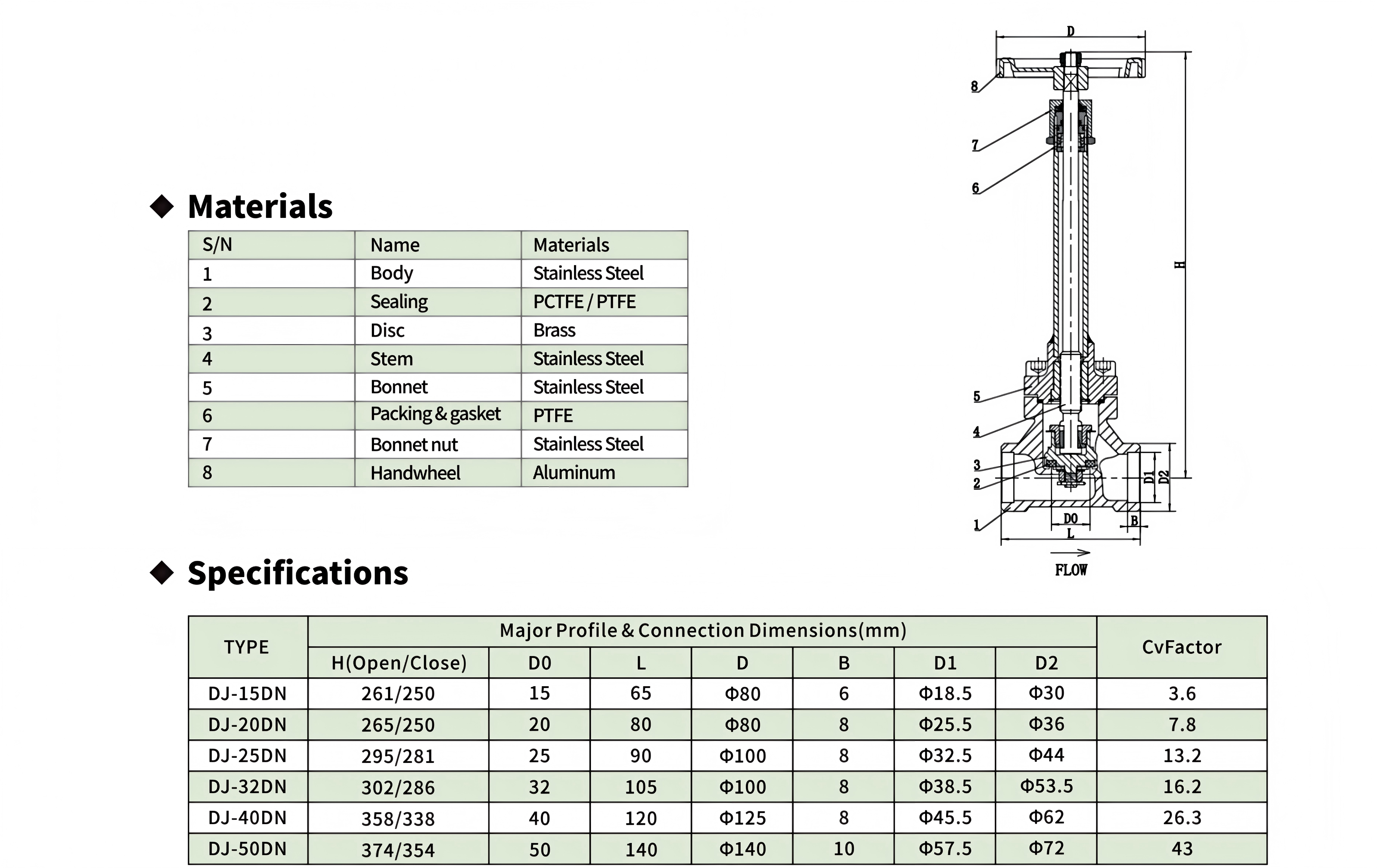
If you place the GN series dimension table and the DN series dimension table side by side, a striking fact emerges: L, D, D1, D2, B, and Cv are identical across both columns. The only difference is H (total height). DJ-15DN H=261/250 mm, a full 103 mm taller than DJ-15GN's 158/145 — every extra millimeter comes from the extended-bonnet thermal isolation neck. This is a precision platform design: the DN and GN series share the same body casting blanks and flange interface dimensions, switching temperature zones by swapping the bonnet assembly and sealing element. GN's short bonnet + PTFE-dominant composite seat serves −40°C gas service; DN's extended bonnet + PCTFE-dominant seat serves −198°C deep-cryogenic liquid/vapor service.
This platform strategy exactly mirrors the G/D ↔ D relationship — G/D is the gas-phase version on the ANSI flange platform, D is the deep-cryogenic extended version on the same platform; GN is the gas-phase version on the Chinese-standard flange platform, DN is the deep-cryogenic extended version on the same platform. Two platforms, two temperature zones, four series — differentiated by bonnet assemblies while maximizing body casting reuse, covering the largest market footprint with minimal SKU complexity.
The DN series' six models (DJ-15DN to DJ-50DN) span Cv 3.6 to 43, identical to GN. Medium range covers liquefied and vaporized atmospheric gases — LNG, LO2, LN2, LAr — full cryogenic service, not the gas-phase-only operation of GN/G/D. All-stainless body and bonnet, brass disc, bolted bonnet — consistent with the G/D/D series structural approach.
| Working Principle
Platform design: one body, two temperature zones
The DN and GN series share the exact same body castings. This can be verified by comparing L, D, D1, D2, and B values across the two sets — every row of the six data sets matches. This is not coincidence; it is a carefully considered platform design.
In industrial valve manufacturing, the body casting is the single most expensive component. The investment casting + machining cost of one DN15 stainless steel valve body can represent 35~40% of total valve manufacturing cost. If the deep-cryogenic version (DN) and the gas-phase version (GN) each required independent body castings, tooling costs and minimum order quantities would double, and small-batch production costs would rise sharply.
The DN series' design rationale: the body withstands pressure load and medium temperature, neither of which is temperature-zone-dependent — whether the medium is −198°C liquid nitrogen or −40°C cold nitrogen gas, the internal pressure (580 PSI) and the medium temperature's effect on 304 stainless steel strength and toughness both fall within design margins. CF8 stainless steel at −198°C retains good ductility and impact toughness, requiring no wall-thickness increase or material substitution for cryogenic service. Thus the same body casting can serve both −40°C and −198°C temperature zones — zone switching is accomplished by swapping the bonnet assembly and sealing material; the body itself remains unchanged.
The thermal isolation mechanism of the extended bonnet
The DN series' H values are 100~140 mm higher than comparably-bored GN series — every millimeter of this height difference comes from the extended bonnet's neck section. The neck's function is not structural pressure containment or connection; it is purely thermal isolation.
When −198°C deep-cryogenic medium flows through the body, the body temperature approaches the medium temperature. If the bonnet is too short, cold energy conducts through metal to the stuffing-box region, bringing PTFE packing temperature below −100°C — at this point PTFE has entered embrittlement, losing elasticity and sealing capability, with packing-box leakage risk rising sharply.
The extended bonnet neck inserts an additional length of conductive path between the body and the stuffing box, increasing the heat-conduction distance from ambient to the body. The bonnet's outer wall is exposed to ambient air, continuously absorbing ambient heat through convection and radiation, creating a temperature gradient along the bonnet axis from the body (−198°C) to the stuffing box (above +10°C). With a properly designed extension length, the stuffing-box region's steady-state temperature can be maintained in the 0~+10°C range — PTFE at this temperature has full elasticity and can effectively seal the stem.
The DN series' extension increments are not uniform across bores: DN1532 add 100108 mm, DN4050 add 130136 mm. Larger bores get longer extensions — because larger-bore bodies have greater thermal mass and higher cold-energy storage, requiring a longer conduction path to pull the stuffing-box temperature into the safe zone.
PCTFE-dominant sealing strategy: the significance of reversed material ordering
The GN series' sealing element is labeled "Intensified PTFE/PCTFE" — PTFE first, PCTFE second, the order implying PTFE as the matrix and PCTFE as the insert. The DN series' sealing element is labeled "PCTFE/PTFE" — order reversed, PCTFE first, PTFE second.
This ordering is not arbitrary. At −198°C, PTFE has already embrittled — its glass transition temperature is ~−110°C, and at −198°C it has almost completely lost elasticity and cold-flow capability. A pure PTFE seat under deep-cryogenic conditions would lose sealing-face contact stress due to cold contraction and embrittlement, causing leakage. PCTFE at −198°C retains usable elastic modulus and creep resistance — though harder and more brittle than at room temperature, it at least does not fail catastrophically like PTFE.
In the DN series' PCTFE/PTFE seat, PCTFE is the workhorse — directly facing the −198°C medium, providing bubble-tight sealing and anti-cold-flow capability. PTFE's role in this seat is not primary sealing but cushioning — providing a soft layer between the PCTFE sealing ring and the body support surface, helping distribute preload pressure evenly during room-temperature assembly and preventing the PCTFE seal ring from cracking during installation. PTFE is elastically intact during room-temperature assembly; during cryogenic operation it has embrittled — but by then PCTFE has already cold-contracted onto the sealing face, and PTFE no longer needs to contribute any sealing function.
This is a two-phase sealing strategy: "room-temperature assembly relies on PTFE; cryogenic operation relies on PCTFE" — fundamentally different from GN's single-phase strategy of "PTFE compression + PCTFE sealing face throughout."
Relationship with the D series: Chinese-standard platform vs ANSI platform
Both the DN and D series are extended deep-cryogenic types with identical medium and temperature ranges — both −198°C to +85°C, both covering liquefied and vaporized atmospheric gases. Their difference is the flange system:
D series: B=12.7/16 mm, D1/D2 corresponding to ANSI B16.5 150# — for ANSI-standard flange piping
DN series: B=8/10 mm, D1/D2 corresponding to Chinese standard HG/T 20592 PN16/PN25 — for Chinese-standard flange piping
The two series are functionally equivalent but interface-incompatible. Selection follows the piping flange system.
The DN series lacks DN65 — same as GN (the Chinese-standard platform covers only DN15~50). If a deep-cryogenic line requires a DN65 Chinese-standard flange valve, select the D series DJ-65D and adapt via a transition flange — the same strategy covered in the GN series FAQ, just the reverse direction (ANSI body adapted to Chinese-standard flanges).*

|
Factory Shoot


|
Application Video
|
Product parameters


| Data Sheet
|
Comment & FAQ
1: What is the exact relationship between the DN and GN series, given their nearly identical dimension tables?
A: Two variants on the same set of body castings. All body dimensions (L, D, D1, D2, B) are identical between DN and GN; the only difference is H (total height) — DN is 100~140 mm taller than GN, the extra height coming entirely from the extended bonnet's thermal isolation neck. GN is the −40°C gas-phase version (short bonnet + PTFE-dominant composite seat); DN is the −198°C deep-cryogenic version (extended bonnet + PCTFE-dominant seat). If you have a DJ-15GN and a DJ-15DN side by side, the body sections look identical, but DN's bonnet is visibly longer and the handwheel sits higher.
2: Both DN and D series are −198°C extended deep-cryogenic valves — how to distinguish and select?
A: Look at piping flanges. DN series flange thickness B=8/10 mm, corresponding to Chinese standard HG/T 20592 PN16/PN25. D series flange thickness B=12.7/16 mm, corresponding to ANSI standard ASME B16.5 150#. If your project drawing says "Flange HG/T 20592 PN16 DN25", pick DJ-25DN. If it says "Flange ASME B16.5 150# NPS 1", pick DJ-25D. An easy mnemonic: DN suffix → Chinese standard, D suffix → ANSI standard. Though both include "D", DN is a compound suffix (DJ-15DN reads as DJ-15-D-N), while D series has a standalone D suffix (DJ-15D).
3 : The DN series sealing is labeled "PCTFE / PTFE" while GN is "Intensified PTFE / PCTFE" — same materials, reversed order — does this matter?
A: It matters, and this distinction precisely explains why DN operates at −198°C while GN is limited to −40°C. GN's "PTFE / PCTFE" structure: PTFE is the elastic matrix, PCTFE is the embedded hard sealing face. PTFE handles compression and cold-contraction compensation; PCTFE handles bubble-tight sealing. PTFE at −40°C retains full elasticity, so the PTFE-dominant composite seat works well in this zone. But at −198°C, PTFE has embrittled — if GN's seat were used in deep-cryogenic service, the PTFE matrix would lose sealing capability through embrittlement and cold-contraction pressure loss; the entire seat would fail. DN's "PCTFE / PTFE" structure: PCTFE is the primary sealing face, directly facing the −198°C medium. PTFE's role shifts from "matrix" to "cushion" — providing an elastic layer only during room-temperature assembly to evenly distribute preload on the PCTFE seal ring, preventing cracking during installation. At −198°C operation, PTFE has embrittled, but by then PCTFE has cold-contracted onto the sealing face; sealing is entirely carried by PCTFE. Simple memory: PTFE first = ambient/low-temperature (−40°C), PCTFE first = deep-cryogenic (−198°C). Same material species in both seats, but completely different structural design and functional allocation.
4: Why does the DN series max out at DN50? How to handle deep-cryogenic DN65?
A: The DN and GN series share body castings, and the Chinese-standard flange platform body tops out at DN50. Deep-cryogenic DN65 under the Chinese-standard flange system has two workarounds: Choose D series DJ-65D + transition flanges. DJ-65D B=16 mm, D1/D2 are ANSI 150#. Install a DN65 Chinese-to-ANSI transition flange or transition spool piece on each end to connect to Chinese-standard piping. Cost: two transition pieces. If space allows, use two DJ-40DN in parallel. DJ-40DN Cv=26.3; two in parallel give effective Cv ≈ 52.6, approximately 70% of DJ-65D's Cv=75. If the line's actual flow demand does not exceed 52, dual DN40 parallel is a viable engineering solution.
5: Does the DN series have any special requirements for liquid oxygen (LO2) service?
A: The DN series has already undergone LOX cleaning and degreasing per CGA G-4.1 — the baseline requirement for liquid oxygen service. CGA G-4.1 mandates that all surfaces contacting liquid oxygen must be free of hydrocarbons (oil, grease, cutting fluid residue, etc.), because in high-pressure pure oxygen environments, trace hydrocarbon residues can cause auto-ignition or explosion. However, CGA G-4.1 cleaning is the ex-factory state — valves can be re-contaminated during transport, storage, and installation. Strongly recommended checks before installing on LOX lines: ① Visually inspect the body cavity for oil stains; ② Purge the body cavity with oil-free dry nitrogen for 30+ seconds; ③ If the valve has been stored for >6 months or packaging is damaged, re-clean for LOX service before installation. The DN series' all-stainless body + PCTFE seat material combination is inherently LOX-compatible — stainless steel and PCTFE do not undergo rapid oxidation in liquid oxygen. The brass disc is also safe in LOX — copper alloys have excellent oxygen compatibility; both NASA and CGA list copper alloys as preferred materials for liquid oxygen contact.
6: The DN and GN series have identical Cv values — why doesn't Cv need adjustment for deep-cryogenic conditions?
A: Cv is a geometric parameter, not a thermodynamic one. Cv is defined as "gallons of 60°F water flowing through a fully-open valve at 1 PSI pressure drop" — it reflects only the internal flow passage geometry and flow area, independent of medium temperature. DN and GN share the same body casting with identical internal flow passages, hence identical Cv. Under deep-cryogenic conditions, medium density and viscosity changes affect actual flow — saturated liquid nitrogen density ~808 kg/m³, ~20% lower than water's 1000 kg/m³; at the same pressure drop through an identically-Cv valve, mass flow will be ~10% lower than water. But this is a medium-property-induced flow difference, not a valve Cv issue. During selection, apply Cv with the fluid density correction factor to obtain actual service flow — the valve's Cv value itself does not need to change.

 yongy0223@gmail.com
 +86-17693104145
 Lanzhou New Area, Lanzhou City, Gansu Province, on the second floor to the east of New Harbor Road, to the east of Building Materials Road No. 2, to the west of Qilian Mountain Avenue (Jingqi Road)


