

 |


loading


DJ661F-40P
SLDW
| Size: | |
|---|---|
| Availability: | |
| Quantity: | |
| Application Overview
After six series of the DJ61F-40P globe valve family, the catalog turns to an entirely new product category: emergency shut-off valves. This product does not belong to the globe valve family — its prefix is DJ661F (one extra "6" versus DJ61F), and the dimension table lists DJQ-A sub-models. From globe valve to emergency shut-off, the product form evolves from "manual fluid control" to "automated system safety assurance."
The DJQ-A series is a pneumatic spring-return cryogenic emergency shut-off valve, designed specifically for semi-trailer, tank container, and LNG carrier loading/unloading operations. Its core competency is not precision flow control (that's the globe valve's job) but cutting off medium flow at non-negotiable speed in emergency scenarios. Two failure scenarios define its raison d'être: ① Accidental air supply loss — the spring automatically closes the valve, preventing uncontrolled atmospheric venting of cryogenic medium from the tanker or storage tank; ② Fire — when ambient temperature exceeds 70±5°C, the built-in hot melt plug melts, releasing cylinder air pressure, the spring closes the valve, stopping fuel supply to the fire.
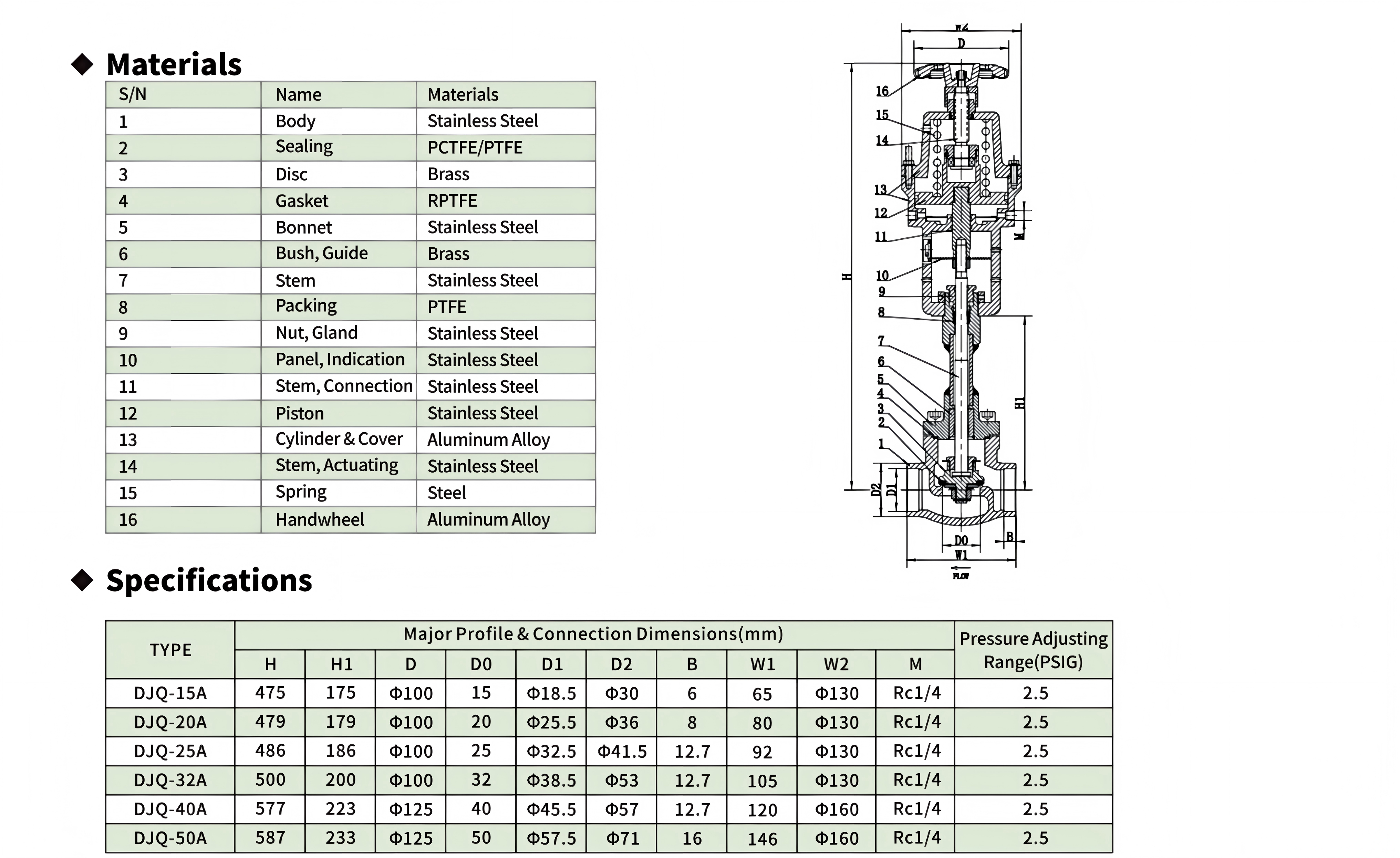
Structurally, the DJQ-A is a heavily modified DJ61F-40P: the bottom section is the familiar globe valve body (all-stainless, bolted bonnet, PCTFE/PTFE seal, brass disc), but above the bonnet, instead of a handwheel directly connected to the stem, sits an aluminum-alloy cylinder assembly containing a piston, actuating stem, return spring, and position indicator panel. The handwheel has been relocated to the top of the cylinder as an emergency manual backup when air supply fails. Total valve height reaches 475~587 mm — roughly twice that of a comparably-bored DN series deep-cryogenic globe valve — the extra height entirely occupied by the pneumatic actuator.
Six models cover DN15~50, body OD only Φ100 and Φ125, flange thickness B=6/8/12.7/16 corresponding to ANSI 150#. Pressure 580 PSI, temperature −198°C to +29°C, media covering LNG/LO2/LN2/LAr. Note the temperature upper limit is only +29°C — this is not a material limitation but a safety margin for the hot melt plug's 70°C trigger point: during normal operation, the medium's cold energy conducts through the body metal to the hot melt plug location, ensuring the plug never false-triggers in any normal operating scenario.
| Working Principle
Normal operation: air opens, spring closes
The DJQ-A's operational logic is "normally closed" — in the absence of compressed air, the spring always pushes the piston to the top of the cylinder, the disc tightly seated, the valve closed. To open the valve, supply 6 barg compressed air (via Rc1/4 connection) into the cylinder; air pressure pushes the piston downward against the spring force, transmitted through the connection stem (item 11) to the stem (item 7), which pushes the disc off the seat — valve opens.
The spring force is precisely calibrated — it must be fully compressed at 6 barg air pressure while reliably pushing the piston back and re-seating the disc when air pressure is lost. The spring's design compression corresponds to the valve's full stroke (fully closed → fully open), with air pressure and spring force reaching equilibrium at the fully open position.
This "air opens, spring closes" design is a classic implementation of fail-safe: any event causing air supply loss (compressor failure, hose rupture, electrical fault, accidental closure of the air supply valve) immediately returns the valve to the closed position. In LNG loading/unloading scenarios, this is a mandatory safety design requirement — the possibility of "valve remains open after power/air loss" is not permitted.
Hot melt plug: passive fire protection
The hot melt plug is the DJQ-A's most distinctive safety feature. It is a low-melting-point alloy plug installed on the cylinder's air passage. Under normal conditions, the cryogenic medium conducts cold through the body metal, keeping the hot melt plug's temperature well below 70°C — DN series data suggests the stuffing-box region of an extended bonnet under −198°C medium maintains 0~+10°C; if the hot melt plug is positioned near the bonnet flange face, its actual temperature may be in the 15~25°C range, with ample margin from the 70°C trigger point.
During a fire, external flames heat the valve's exposed portions. The hot melt plug's small cross-section and low thermal mass make it the first component on the valve to reach 70°C. When the alloy melts, the air path opens — compressed air is not trapped in the cylinder continuing to hold the spring back, but vents to atmosphere through the melted plug. Air pressure drops instantly, the spring immediately pushes the piston upward, and the valve closes within seconds.
This mechanism depends on no external power supply, sensors, PLCs, or any electrical/electronic components — it is purely a thermodynamic-fluid dynamic coupled passive safety device. Its reliability comes from its simplicity: as long as the hot melt plug alloy formulation is correct (70±5°C melting point with ±5°C tolerance), it will melt when needed, neither early nor late.
RPTFE gasket: from PTFE to reinforced PTFE
The DJQ-A's item 4 — the static sealing gasket between body and bonnet flanges — is labeled RPTFE (Reinforced PTFE), not the generic PTFE used on DJ61F-40P globe valves. This is a noteworthy material upgrade.
Pure PTFE's cold flow under sustained compression is a known issue: under continuous bolt preload, the PTFE gasket progressively thins — material is not compressed but extruded out of the gap between flange faces. In ambient-temperature valves, periodic bolt re-torquing addresses this. But under cryogenic conditions, re-torquing is not a viable maintenance action — each re-torquing requires system shutdown, line evacuation, warm-up, insulation removal.
RPTFE incorporates fillers (typically glass fiber or carbon fiber) into the PTFE matrix, significantly improving cold-flow creep resistance while retaining PTFE's chemical inertness and low-temperature elasticity. The reason RPTFE is used on DJQ-A but not on standard globe valves may be: emergency shut-off valves cycle far more frequently than manual globe valves (one full-stroke open/close per loading/unloading operation), the body-bonnet flange undergoes more thermal cycles, and the gasket suffers more severe fatigue. RPTFE provides more reliable long-term sealing life in this scenario.
Handwheel position: why at the top instead of the conventional location
The DJQ-A's handwheel sits on top of the cylinder — counterintuitive. A conventional globe valve's handwheel is directly above the bonnet; turning the handwheel rotates the stem thread directly, moving the disc up and down. The DJQ-A's handwheel above the cylinder drives the piston (item 12) through the actuating stem (item 14) — this force-transmission path is much longer and less efficient than direct stem drive.
But the handwheel's design intent is not daily operation — it is pure emergency backup. When air supply is available, the operator never touches the handwheel; everything is controlled by compressed air. The handwheel's sole existence scenario: air supply unavailable (compressor failure, frozen air line, power outage), but the valve must be manually closed or opened. In this emergency scenario, the handwheel's priority operation is closing (the spring already holds the valve closed; the handwheel needs only a counterclockwise rotation to lock the closed position) — opening is performed only when safety is confirmed, air supply is unavailable, and loading/unloading must proceed.
The handwheel's top position also offers an engineering benefit: stacking all actuator components (cylinder, piston, spring, handwheel) above the bonnet, with a single assembly/disassembly direction (all from top access), requiring no lateral or bottom access for any component during maintenance. In the confined space atop a tanker, this unidirectional maintenance design is practical.
W1 vs L: the globe valve's L and the emergency shut-off's W1 are the same dimension
The DJQ-A's W1 values (65/80/92/105/120/146 mm) closely match the face-to-face length L of DJ61F-40P D/G/D series (DN15~50: 65/80/92/105/120/146 mm). This dimensional consistency suggests the DJQ-A's body casting is shared with the D/G/D series — at minimum, a product of the same casting tooling. Body OD D is also Φ100/Φ125, further supporting this inference.
This means the DJQ-A's wetted section (from bottom flange face to bonnet flange face) is substantially equivalent to a DJ61F-40P D series valve — same DN bore, same body blanks, same disc/seal/stem sub-assembly. The difference is only above the bonnet — D series carries extended bonnet + handwheel, DJQ-A carries pneumatic cylinder actuator + top handwheel.
This has practical implications for procurement and spare parts management: DJQ-A body internals (seal, disc, stem, packing, gasket) are very likely interchangeable with same-bore DJ61F-40P series, enabling unified spare stock.*

|
Factory Shoot


|
Application Video
|
Product parameters


| Data Sheet
|
Comment & FAQ
1: Normally open or normally closed? What state is the valve in without air?
A: Normally closed. No air = closed. Without air pressure, the spring always pushes the piston to the top of the cylinder, the disc firmly seated. The valve opens only when 6 barg compressed air is supplied. This design ensures any air supply interruption (compressor failure, hose rupture, power outage, accidental manual closure of air valve) automatically closes the valve. This normally-closed logic is the opposite of most industrial pneumatic globe valves — conventional pneumatic valves are typically normally open (spring opens, air closes) or require double-acting cylinders (air opens + air closes). The DJQ-A has chosen a single failure mode: the only failure direction is close. This is based on the safety philosophy of LNG loading/unloading — a failure to close is an accident; a failure to open is at most a shutdown.
2: The hot melt plug melted and the valve closed — how to recover? Replace with a new hot melt plug?
A: Yes, replacement is required. The hot melt plug is a one-time safety device — once the alloy melts, the original plug is permanently destroyed, the air passage is opened, and the valve cannot re-establish air tightness even after temperature returns to normal. Install a new hot melt plug, reconnect the air line, supply compressed air, and normal operation resumes. But more importantly: hot melt plug melting indicates a fire or abnormal high temperature has occurred — before replacing the plug, the valve itself must be inspected for fire damage. Focus on: ① Cylinder aluminum alloy shell — any deformation or melting signs (Al melting point ~660°C, typically won't melt but may anneal-soften); ② PTFE packing and PCTFE/PTFE seat — any decomposition from high temperature (PTFE ~260°C onset, PCTFE ~380°C); ③ Spring — any annealing-induced loss of elasticity. If any check fails, replace the entire valve — don't just replace the hot melt plug.
3 : Why is the upper temperature limit only +29°C?
A: The DJ61F-40P globe valves go to +85°C. +29°C is not a material limitation but a safety margin for the hot melt plug. The DJQ-A's body material is identical to the D series (CF8 SS), and the sealing material is also PCTFE/PTFE — these materials themselves have no problem at +85°C. But the hot melt plug's melting point is set at 70±5°C; if the working temperature limit were +85°C, the hot melt plug would already have melted during normal operation — effectively no safety device. The +29°C design logic: with −198°C medium normally flowing through the body, the body's low temperature conducts through the metal, keeping the hot melt plug area well below 70°C. But after tanker loading/unloading ends and the line is evacuated and warms to ambient, the hot melt plug area temperature will rise — if the design temperature limit is +29°C, this means the valve is in a safe state only when medium is continuously flowing or the body still has residual cold energy. Once the line is evacuated and the valve is exposed to an environment above 29°C (e.g., outdoor summer tanker), the hot melt plug area temperature will rise but still has a 41°C buffer (70−29) — sufficient margin to cover normal daytime warming without false trigger.
4: What is the Rc1/4 air connection specification? Can an NPT connector be used?
A: Rc1/4 is British Standard Taper Pipe internal thread (ISO 7-1, formerly BSPT), not NPT (American Standard Taper Pipe). Rc and NPT are incompatible — thread flank angles differ (Rc 55°, NPT 60°); forced mismatch will cause thread galling or leakage. If only NPT connectors are available on site, add an Rc1/4 female → NPT1/4 male adapter. Do not attempt to fill the flank angle difference with PTFE tape — the 5° gap between 55° and 60° cannot be compensated by sealant tape. For pneumatic lines, recommend Φ6 or Φ8 nylon/PU tubing with Rc1/4 push-in fitting on one end to the valve and connection to 6 barg compressed air source on the other.
5: What is the relationship between DJ661F-40P and DJQ-A? The title says 661F, the dimension table says DJQ — which is correct?
A: Both are correct, referring to the same product. DJ661F-40P is the general model designation (corresponding to the numbering system in the valve design standard), and DJQ-A is the internal sub-model series identifier. The DJ prefix shares the same naming system as DJ61F-40P; the extra "6" very likely represents "pneumatic actuator" (corresponding to the actuation method code in valve model numbering standards). Q is speculated to represent "cut-off/shut-off," and A represents the actuator type (possibly with a B variant — double-acting cylinder or larger bore). In procurement, technical exchanges, and drawing annotations, either model designation may be used. But when submitting technical specifications to design institutes or compiling line valve lists, unify under DJ661F-40P as the valve model, with an appendix detailing the internal sub-model DJQ-xxA to DN bore cross-reference.
6: What are GB/T 24918 and EN1626? How do they differ from DJ61F-40P's GB/T 24925?
A: This is the most fundamental regulatory difference between the DJQ-A and DJ61F-40P — two entirely different product standard systems. GB/T 24918: Chinese national standard "Emergency Shut-off Valves for Cryogenic Service" — specifically covers emergency shut-off valve type testing, fire testing, hot melt plug activation temperature, closure time, and other safety function tests. The DJQ-A's hot melt plug 70±5°C and fail-safe design are both requirements of this standard. EN1626: EU standard "Valves for Cryogenic Vessels" — more stringent than GB/T 24925 (general cryogenic valve standard), specifically for tanker/TANK container valves, including fire safety testing and emergency shut-off time requirements. GB/T 24925: DJ61F-40P globe valve standard — general technical conditions for cryogenic valves, does not include fire safety or emergency shut-off function testing. In short: GB/T 24925 addresses "works normally at cryogenic temperatures"; GB/T 24918 + EN1626 address "must automatically close in fire." The DJQ-A's emergency shut-off function is a mandatory requirement of these two standards, not an option.

 yongy0223@gmail.com
 +86-17693104145
 Lanzhou New Area, Lanzhou City, Gansu Province, on the second floor to the east of New Harbor Road, to the east of Building Materials Road No. 2, to the west of Qilian Mountain Avenue (Jingqi Road)


